
Powering Workforce Intelligence for a $60B NYC-based Global Biopharmaceutical Leader
Discover How Draup Enabled Data-Driven Workforce Planning for a Pharmaceutical Manufacturing and R&D Leader
~90000
Employees
$60B
Revenue
Biopharmaceuticals
Industry
New York City, U.S.
Headquarters
About the organization
A global biopharmaceutical leader, the company operates one of the industry’s most advanced U.S. manufacturing networks, spanning small-molecule production, mRNA therapeutics, highly regulated quality operations, and increasingly automated digital facilities. As demand grows for precision CMC capabilities, next-generation mRNA manufacturing, and automation-driven workflows, the company prioritized a future-ready workforce strategy built on deeper visibility into talent availability, evolving skills, and location competitiveness across its national footprint.
The Core Challenges
Inconsistent Role Frameworks
To standardize CMC and Automation Engineering role frameworks for workforce modeling.
Untracked Skills Evolution
To map emerging mRNA manufacturing capabilities and skills evolution.
Talent-Cost Tradeoffs
To balance talent depth with cost, competition, and market maturity across U.S. hubs.
No Hiring Difficulty Data
To build quantitative, location-specific hiring difficulty models for critical roles.
The Solution
Research & Development (R&D) Manager

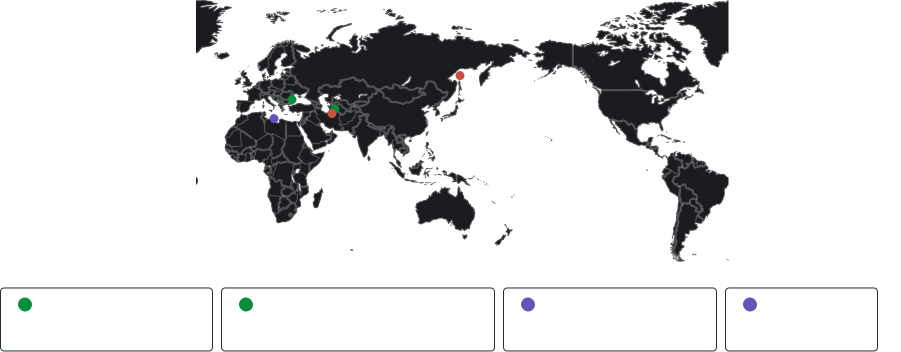
GEOGRAPHIC INSIGHTS
TALENT MARKET INSIGHTS

CAREER PATHS
ROLE MAP

The image is for representational purpose only.
01
End-to-End Talent & Skill Intelligence
Mapped CMC, mRNA, and Automation Engineering roles to clarify evolving capabilities, digital adjacencies, and regulatory skill demands.
02
Generative AI Workforce Impact Assessment
Identified how AI, automation, and digital systems will transform manufacturing workloads, outlining targeted reskilling pathways for future-ready teams.
03
Location Prioritization & Market Benchmarking
Evaluated U.S. regions on availability, cost, competition, and hiring difficulty to identify the most scalable hubs for CMC, mRNA, and automation operations.
04
University Ecosystem Benchmarking
Assessed STEM output, research alignment, and collaboration readiness to identify top university partners for biotech and automation talent pipelines.
Outcome
6,100+
Locations
4M+
Career Paths
1.7M+
Peer Group Companies
28K+
Skills
3,500+
Roles
1B+
Professionals
55K+
Universities
1B+
Job Descriptions
200K+
Courses
180K+
Technology Solutions
1.6M+
Account Priorities
Labor Market Data Contextualized with Business Intelligence for Every Decision
Analyzing 1B+ data points daily from 100K+ sources
6,100+
Locations
4M+
Career Paths
1.7M+
Peer Group Companies
28K+
Skills
3,500+
Roles
1B+
Professionals
55K+
Universities
1B+
Job Descriptions
200K+
Courses
180K+
Technology Solutions
1.6M+
Account Priorities

.svg)




.svg)
