


Talent Acquisition in 2026: What Enterprise TA Leaders Need to Know Right Now
A guide to the six biggest shifts reshaping how enterprises source, verify, and hire talent in an AI-driven market
By filling up this form, you agree to allow Draup to share this data with our affiliates, subsidiaries and third parties


Talent Acquisition Has Changed More in the Last Two Years Than in the Previous Twenty
The function once defined by job postings, resume screens, and requisition management has been fundamentally reshaped by AI, shifting labor market dynamics, and a profession-wide pivot toward skills-based hiring. In 2026, talent acquisition professionals are no longer simply filling roles. They are architecting the talent strategies that determine whether organizations can compete, adapt, and grow.
This guide draws on Draup practitioner roundtables and cross-industry discussions to examine six questions at the center of that transformation.
The Seven Forces Reshaping Talent Acquisition Right Now
The profession is managing a convergence of pressures that no previous generation of TA leaders has faced in combination.
Based on our roundtable discussions with practitioners across industries, these are the defining challenges of 2026:

Candidates are using AI agents to auto-apply to hundreds of positions while employers use AI to screen them out. The result is a cycle that buries recruiters in noise and renders the traditional resume nearly meaningless as a reliable signal.

Candidate fraud has moved from an edge case to a systemic concern. Some candidates are deepfaking video interviews; others are embedding prompt injections in invisible white text on resumes to manipulate applicant tracking systems into advancing them.

Skills-first hiring is increasingly replacing the degree as the default filter. When AI can fabricate a polished resume in seconds, the most reliable signal remaining is whether a candidate can actually perform the work in front of you.

Autonomous AI agents are being added to recruiting teams, but significant questions remain about their effectiveness in competitive hiring scenarios relative to skilled human recruiters.

Boardrooms are focused on hiring for AI technical skills, but practitioners consistently report that critical thinking matters more. The real bottleneck is not whether employees can use AI tools; it is whether they know when and how to apply them effectively.

AI hiring regulation is arriving fast and unevenly across jurisdictions. The EU AI Act, Colorado's SB 24-205, and New York City's Local Law 144 each impose different requirements, leaving employers navigating a compliance patchwork without a unified playbook.

Recruiters are no longer filling individual requisitions. They are increasingly acting as architects of enterprise capability, building interconnected talent pipelines across domains including AI, automation, analytics, and R&D.
Each of these pressures intersects with the others. Together, they are forcing a fundamental rethinking of what talent acquisition is, what it requires, and what it is accountable for. The most urgent of those pressures is one that is already active on every hiring desk today: the collapse of traditional candidate verification.
Verification Is Now a Core Talent Acquisition Responsibility
When AI generates both candidates and screening decisions, human verification becomes the critical control.
The rapid adoption of AI across the recruiting lifecycle has introduced significant efficiencies. It has also created a critical vulnerability: the risk that unverified, biased, or misleading algorithmic outputs will shape hiring decisions at scale.
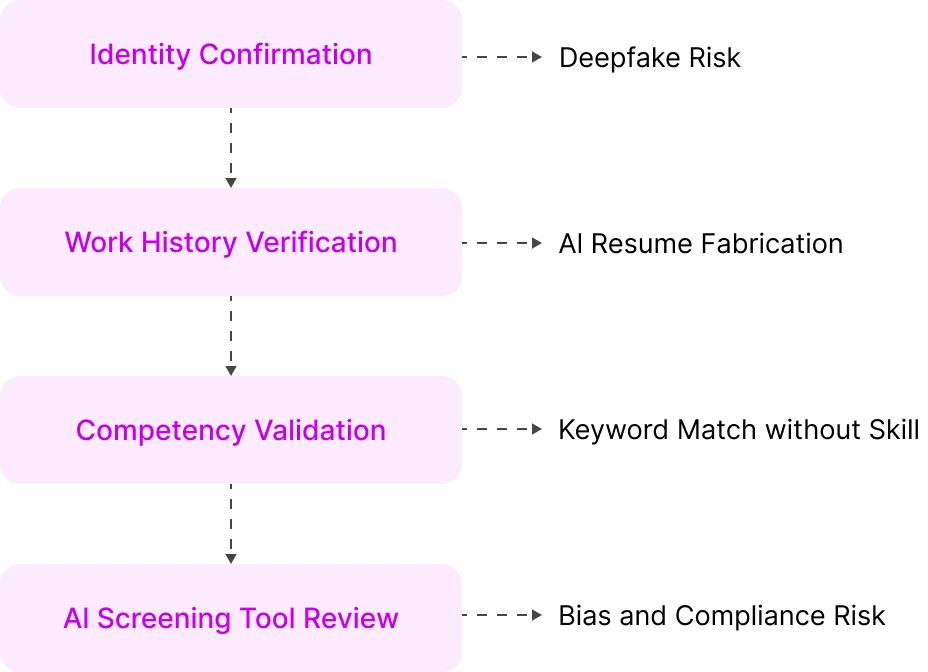
What makes this moment distinct from previous disruptions is the collapse of traditional hiring signals. When both candidates and employers use AI, a perfectly keyword-matched resume no longer indicates talent. It indicates the quality of the prompt used to generate it. Verification now starts earlier than it ever has. Before evaluating a candidate, TA professionals must confirm the candidate is real, that their stated work history is verifiable, and that the person on the video call is the same person who applied.
This demands what practitioners are calling critical AI literacy: understanding how screening algorithms weight candidate attributes, recognizing when tools introduce bias, validating the data feeding predictive models, and knowing when to override automated recommendations with human judgment. It also means confronting the vendor accountability gap. Most TA teams are acquiring AI tools they cannot audit. With the EU AI Act and state-level regulations in effect or imminent, the ability to interrogate your own technology stack is becoming a compliance requirement, not a discretionary capability.
There is a genuine tension here. The more verification you layer into a process to catch fraud, the more friction you create for legitimate candidates. Too much friction, and you lose strong candidates to organizations with more streamlined processes.
This is why high-touch methods are making a comeback. Referrals, work samples, live problem-solving sessions, and proactive outreach to passive candidates are resurging across enterprise TA functions. Not because they are new, but because they are among the few signals AI cannot reliably fabricate. Verification, in this context, is not just about catching fraud. It is about rebuilding trust in the hiring system itself.
The verification challenge is not a tactical patch to apply on top of an otherwise unchanged function. It is a symptom of a deeper structural shift: talent acquisition itself is changing what it is, what it owns, and what it is responsible for delivering.
Talent Acquisition Is No Longer Just a Hiring Function
The shift from transactional recruiting to strategic workforce architecture is well underway.
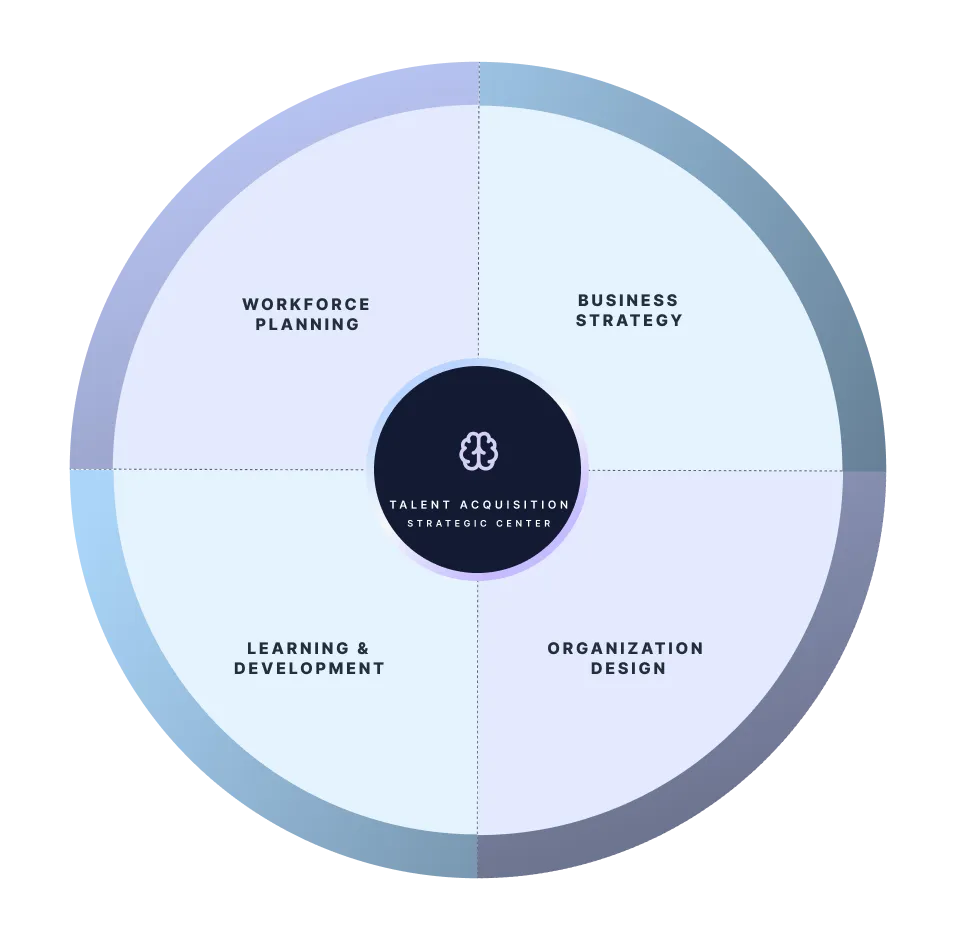
The identity of talent acquisition has undergone a significant evolution. Practitioner reflections from industry discussions reveal a function moving decisively away from transactional recruiting toward a strategic discipline that intersects with workforce planning, organizational design, and business strategy. The traditional model of posting a job, screening resumes, and filling a seat is giving way to a more sophisticated approach built around talent intelligence platforms, real-time labor market analytics, and predictive hiring models.
Central to this shift is the rise of skills-based hiring. Organizations are increasingly moving away from degree requirements and job-title matching in favor of competency frameworks that assess what candidates can actually do. Talent intelligence platforms powered by machine learning now enable TA teams to map skills adjacencies, identify non-obvious talent pools, and forecast hiring needs before requisitions are opened. This elevates the recruiter from a transactional operator to a strategic talent advisor, one who shapes workforce composition rather than simply responding to it.
The practical implication for enterprise organizations is clear: the infrastructure, metrics, and expectations built around the old TA model are increasingly misaligned with what the function actually needs to deliver. And that misalignment becomes even more visible when you examine how the sourcing model itself has changed.
How Shifting Work Models Are Changing Sourcing Strategy
Full-time permanent hiring is no longer the only model talent acquisition teams need to plan for.
The forces reshaping talent markets extend well beyond technology. TA teams are simultaneously managing demographic shifts, geographic redistribution of talent, evolving candidate expectations around flexibility and purpose, and the structural transformation of employment models. The rise of contingent work, fractional roles, and project-based engagements means that talent acquisition can no longer operate solely within the paradigm of full-time permanent hiring.
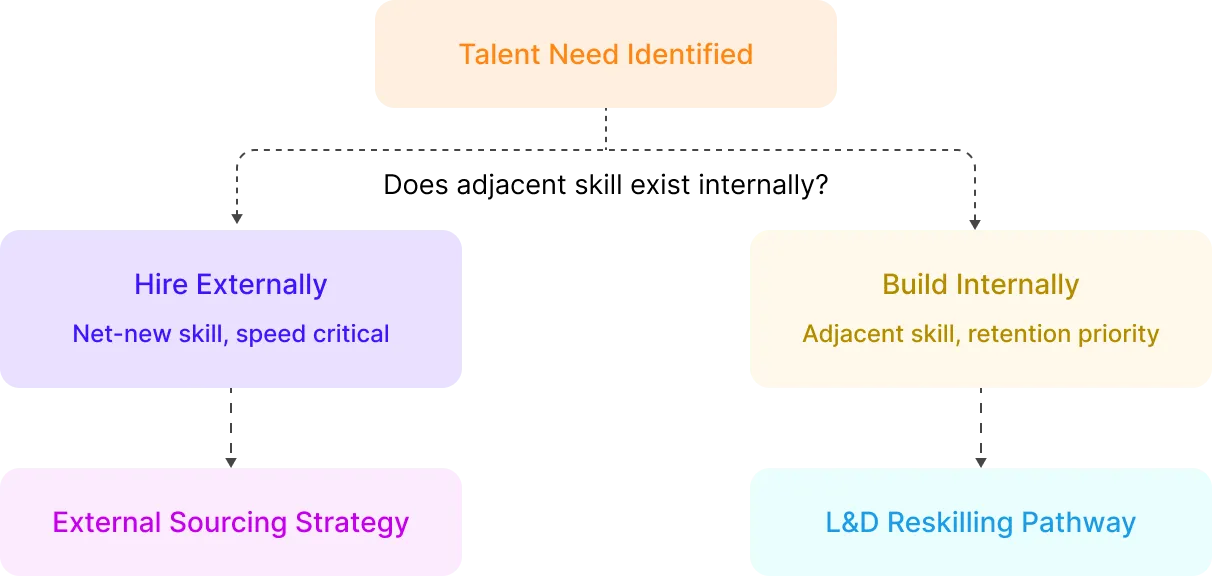
Equally significant is the reskilling imperative and its direct impact on sourcing strategy. As organizations invest more heavily in upskilling existing employees, TA teams must calibrate their efforts between build-versus-buy talent decisions, working closely with learning and development functions to determine which roles genuinely require external hiring and which can be filled through internal mobility and reskilling pathways.
These two shifts together — the diversification of employment models and the growing strategic weight of the build-versus-buy decision — require TA functions to develop sourcing strategies that are more modular and more integrated with workforce planning than most current operating models allow. Navigating that complexity, in turn, requires a fundamentally different set of skills from the TA professionals doing the work.
The Skills That Define the Modern Talent Acquisition Professional
The baseline has moved. What was once a differentiator is now a minimum requirement.
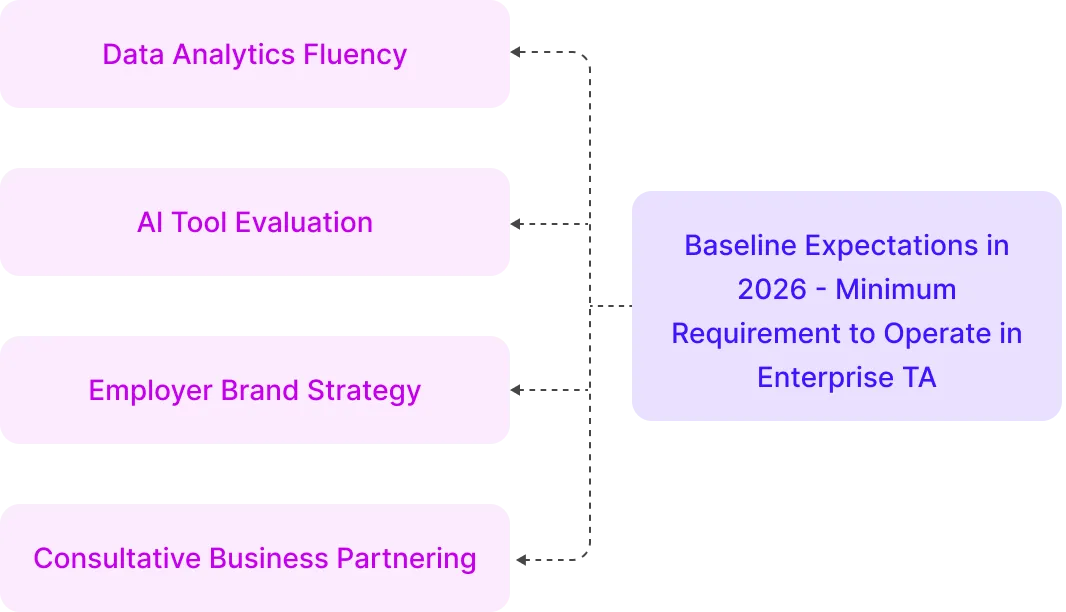
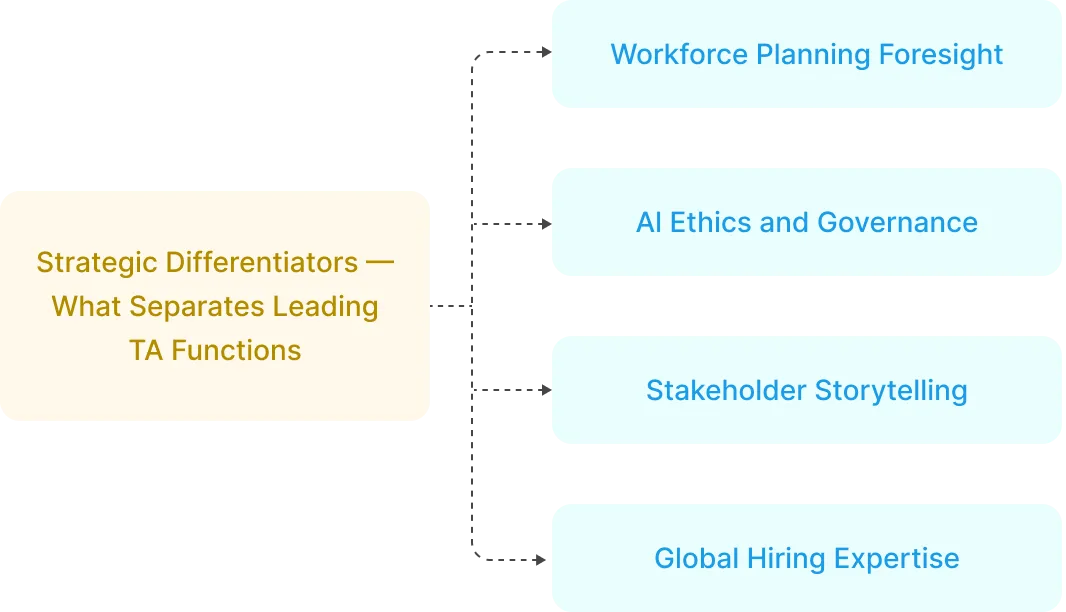
The competency profile for talent acquisition professionals has expanded significantly. Fluency in data analytics, AI tool evaluation, employer brand strategy, and consultative business partnering are now baseline expectations, not differentiators. A TA professional who cannot interpret a talent market heat map, assess the validity of an AI screening tool, or construct a data-driven hiring narrative for a CHRO audience will find it increasingly difficult to operate effectively in enterprise environments.
Beyond technical capability, the profession demands a new kind of strategic agility. TA professionals in 2026 need to:
Closing this capability gap requires intentional investment in continuous professional development, cross-functional exposure, and direct engagement with the business problems that talent strategy exists to solve. Building these capabilities is not only about what TA professionals can do today — it is also about whether they can anticipate and hire for the roles that do not yet fully exist.
How to Hire for Roles That Do Not Yet Exist
The 2028 labor market will require TA teams to build pipelines for capabilities that are still taking shape.
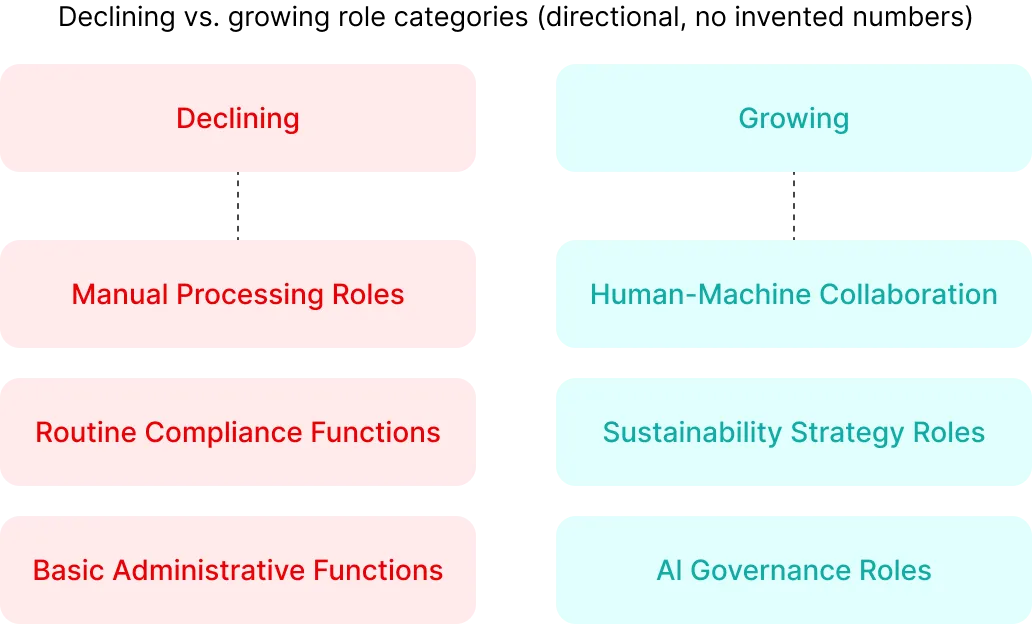
Looking beyond the immediate horizon, the labor market entering 2028 will reflect a significant structural shift in the composition of work. While automation and AI will continue to eliminate certain routine roles, the net effect will be an expansion of uniquely human work: roles demanding creativity, complex problem-solving, emotional intelligence, and ethical reasoning. Emerging job categories in AI governance, human-machine collaboration, and sustainability strategy are growing rapidly, while traditional roles in manual processing, routine compliance, and basic administrative functions are declining.
For talent acquisition, this requires a fundamental rethinking of sourcing, assessment, and selection. The roles being created through this transition require competencies that traditional recruiting processes were never designed to evaluate. Systems thinking, ethical reasoning, and collaborative intelligence cannot be measured by keyword matching or credential verification alone.
The TA leaders who will be most effective through this transition are those who can anticipate talent needs for a workforce that does not yet fully exist and build pipelines for roles that are still taking shape.
How We Help TA Leaders Navigate This Shift
The intelligence required to lead through these changes does not come from static benchmarks or annual survey reports. It requires continuous, real-time visibility into how roles, skills, and talent markets are evolving across geographies, industries, and organizational types.
We built our talent intelligence platform to give enterprise TA leaders exactly that:
Tracking how competency requirements are shifting across functions, geographies, and industries in near real time, so TA teams can anticipate demand before it materializes as a requisition
Identifying where qualified talent exists globally, what it costs to access, and how supply is evolving across markets, including those relevant to Global Capability Center strategy
Understanding how roles are being restructured by AI and automation, enabling more precise external hiring decisions and more effective build-versus-buy calibration
Structured approaches for translating labor market intelligence into TA strategy that holds up in conversations with CHROs and business leaders
Talent acquisition in 2026 operates in a fundamentally different environment from even two years ago. The function is managing AI-driven candidate fraud, navigating an uneven regulatory landscape, transitioning to skills-based hiring models, and being asked to anticipate workforce needs that have not yet been fully articulated. The organizations that will hire well through this period are those that invest in the intelligence, tools, and professional capability to turn that complexity into a strategic advantage. We are built to support that work.

.svg)




.svg)
