


The Enterprise Playbook for AI-Augmented Workforce Strategy
A Framework for Workforce Leaders Navigating the AI Transition
By filling up this form, you agree to allow Draup to share this data with our affiliates, subsidiaries and third parties


Why the AI Jobs Crisis Story Doesn't Hold Up
Public discourse around artificial intelligence has converged on a crisis story: widespread white-collar displacement, collapsing wages, and structurally high unemployment by 2028. It is a compelling narrative. It is also, on the current evidence, systematically wrong.
This framework synthesizes labor market research from nine leading institutions, the World Economic Forum, the International Monetary Fund, MIT Sloan, Harvard Business School, Stanford University, Yale's Budget Lab, Goldman Sachs Research, the Anthropic Economic Index, and our own analysis of over one billion Fortune 500 job descriptions. Across millions of workers, hundreds of industries, and multiple economies, one pattern holds: AI changes the composition of work far more than it reduces the demand for work.
The workforce challenge of the next decade will not be too few jobs. It will be too few workers prepared for AI-augmented work.
How AI Is Actually Changing Work Right Now
The evidence points to three structural transformations reshaping work right now, not in the future.

Analysis of Claude.ai interactions in November 2025 found that 52% of AI usage was augmentative, humans learning, iterating, and collaborating with AI, while fully automated interactions accounted for 45%. The augmented share grew 5 percentage points between August and November 2025, moving toward collaboration as AI matured.

Our analysis of Fortune 500 job descriptions shows skills density, the average number of distinct skills required per role, rising by 3.5 skills per job description year-on-year across all major business functions. AI is enriching roles, not flattening them.

MIT Sloan's EPOCH study of 19,000 tasks across 950 job types found that human-intensive tasks have increased between 2016 and 2024. Tasks newly added to the occupational database in 2024 carry higher human-capability requirements than tasks that previously existed. The economy is not replacing human work. It is demanding more of it.
The Data Is Clear: AI Creates More Jobs Than It Displaces
The WEF Future of Jobs Report 2025, drawing on 1,000 employers representing 14 million workers across 55 economies, is the most comprehensive quantitative assessment available. Its findings are unambiguous:

For every job displaced, nearly two new jobs are projected to be created, a 1.8:1 creation-to-destruction ratio. Goldman Sachs Research projects generative AI will permanently raise global GDP by 7% and boost labor productivity growth by 1.5 percentage points annually over the coming decade.
The Five Human Capabilities AI Cannot Replicate
Roberto Rigobon and Isabella Loaiza at MIT Sloan identified five human capability categories that AI consistently fails to replicate, and that are associated with employment growth, not decline.
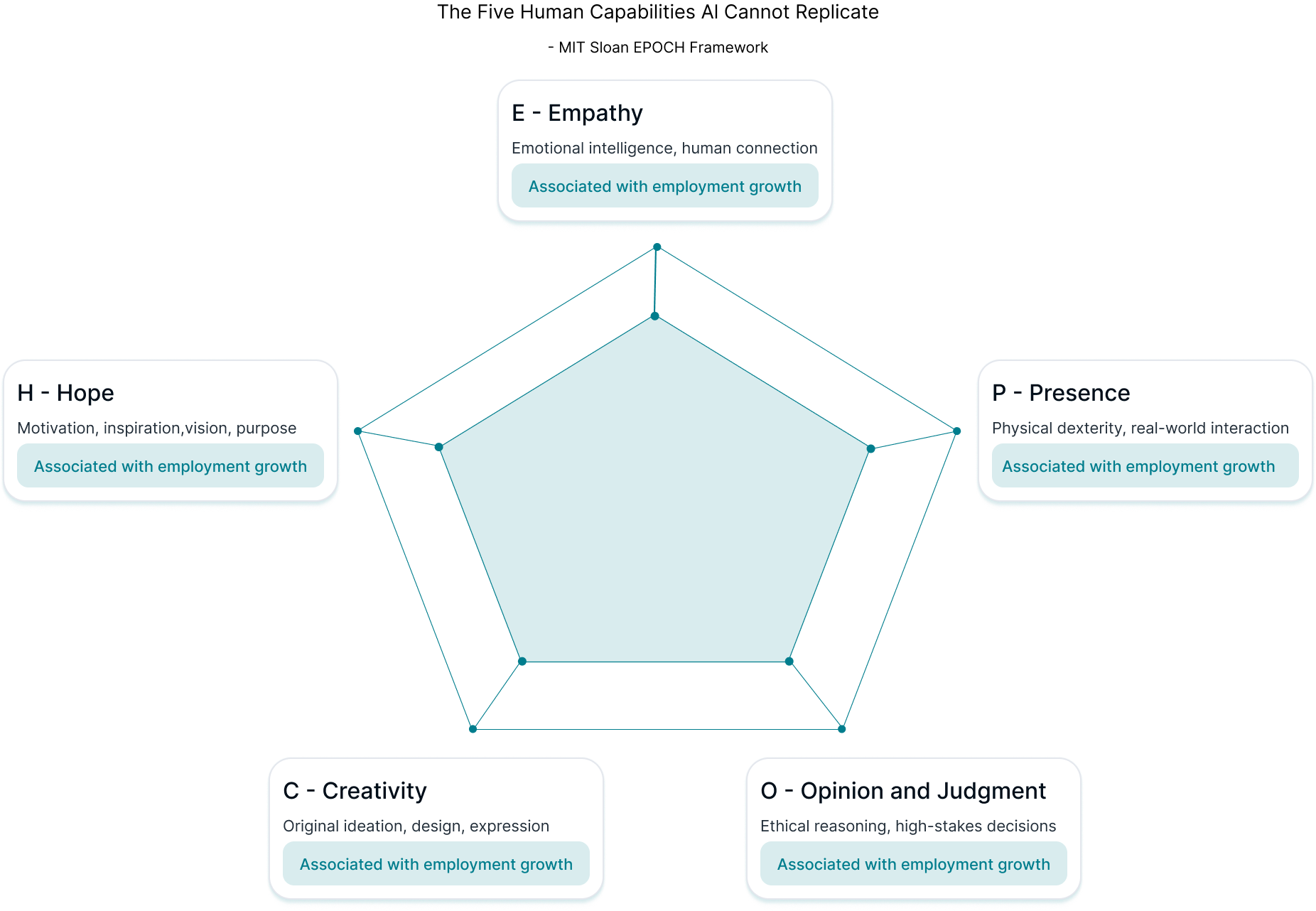
As AI automates routine cognitive work, the economy is creating more work that requires these capabilities, and paying more for it. Harvard HBS Working Paper 25-039 confirms: augmentation-prone roles, those requiring judgment, creativity, and complex problem-solving, see increasing labor demand and rising skills complexity under AI adoption.
AI Boosts Worker Performance, Especially for Those Just Starting Out
One of the strongest empirical findings in this space comes from Brynjolfsson, Li, and Raymond (NBER/QJE 2025), studying a generative AI assistant deployed across 5,179 customer support agents:
- 15% average productivity gain across all workers
- 34% productivity gain for novice and low-skilled workers specifically
- 0% incremental benefit for already-expert workers
The mechanism: AI disseminates the best practices of top performers, democratizing expertise that previously required years to acquire. The study also found AI assistance improved customer sentiment and increased employee retention. This is not a displacement dynamic. It is an empowerment dynamic.
Our analysis confirms the same pattern at scale. Rather than reducing headcount, leading Fortune 500 companies are rewriting job descriptions to explicitly delineate human and AI workloads, hybrid roles where the human contributes judgment, relationships, and creativity while AI handles information processing and routine execution.
The Real Shortage: Prepared Workers, Not Available Jobs
The displacement narrative frames AI as producing too many workers for too few jobs. The data tells the opposite story. Our Global AI Report 2025 finds:
- 2.2 million workers globally have the requisite AI skills to meet enterprise demand
- 310,000 AI-skilled professionals in the US, the global leader, yet a fraction of what Fortune 500 companies alone require
- 73% of companies are struggling to build quality AI talent pipelines
- Computer and mathematics occupations are projected to grow 16.2% between 2023 and 2033 (US Bureau of Labor Statistics)
This is not a labor market with too many workers and too few jobs. It is a labor market with too many AI-era jobs and too few workers prepared to fill them.
The IMF's January 2026 analysis of millions of job postings across six economies reinforces this: workers with new-skill capabilities command a 3–3.4% wage premium at the job-posting level in the US and UK. Skill scarcity, not surplus, is the operative dynamic.
AI Skills Are Now Growing Across Every Business Function
Our January 2026 analysis of over one billion Fortune 500 job descriptions reveals a defining enterprise hiring signal: demand in 2025 is concentrated on operating AI, not building it. Governance, orchestration, and integration skills are growing far faster than model-building skills.
- AI Governance & Model Risk skills: +81% YoY
- Cost Optimization & Margin Protection skills: +77.6% YoY
AI is no longer confined to IT. It is diffusing across the entire enterprise:

This is the hiring profile of companies deploying AI across their enterprise workforce, not eliminating it.
How Roles Are Evolving Under AI: Three Distinct Paths
Not every role is affected the same way, or at the same speed. Based on our analysis of over one billion job descriptions across six years, three distinct trajectories emerge:
Path 1, Disruption with a Reskilling Opportunity
Tasks change but the worker, upskilled, remains central. This is the most common scenario. The critical variable is time: most role transformations are gradual, giving workers a meaningful window to adapt.
Path 2, Deeper Transformation Required
Roles disrupted beyond simple reskilling, where career pivots and policy-supported transitions become necessary. A real category, but a far smaller share than displacement narratives assume.
Path 3, New Roles That Did Not Previously Exist
AI Governance Specialists, Responsible AI Leaders, Model Risk Managers, AI Integration Engineers, Workflow Orchestration Designers, roles that barely existed three years ago, now among the fastest-growing in Fortune 500 hiring data.
The critical insight is time. Gradual transformation, not sudden displacement, is the operative mechanism. Workers have meaningful windows to adapt when employer investment supports their transition.
Five Workforce Priorities Every Enterprise Leader Needs Now
The evidence from WEF, IMF, MIT, Harvard, Stanford, Yale, Goldman Sachs, Anthropic, and our own data converges on one conclusion: the workforce challenge of the next decade is not technological unemployment. It is workforce transformation at unprecedented speed and scale.
Five priorities emerge directly from the data:
1. Redesign jobs for human-AI collaboration.
Explicitly allocate tasks between humans and AI. Humans own judgment, interpretation, and decision-making. AI handles data processing and routine execution.
2. Build AI literacy across the entire workforce.
AI literacy is rapidly becoming a baseline capability, not a specialist skill. The most valuable employees will be those who can operate and interpret AI tools across any function.
3. Plan around capabilities, not just headcount.
AI changes worker productivity, not just workforce size. Planning must shift from counting roles to developing capability portfolios that combine domain expertise with AI-enabled workflows.
4. Make reskilling a continuous organizational habit.
The half-life of tech skills has fallen below two years, with approximately 40% of current tech skills expected to be partially obsolete by 2027. Organizations that treat learning velocity as a strategic capability will adapt far faster than those relying on periodic training cycles.
5. Hire proactively for AI governance roles.
AI Governance and Model Risk hiring grew 81% year-on-year across Fortune 500 companies. As AI scales, demand for governance, compliance, and responsible AI leadership is rising faster than any other category.
The Organizations That Act Now Will Pull Ahead
As intelligence becomes abundant, the economic value of what only humans can provide, judgment, creativity, leadership, empathy, ethical reasoning, rises. The WEF data confirms this is already happening: 85% of employers are prioritizing upskilling their current workforce, and the share of skills becoming outdated is falling, from 57% in 2020, to 44% in 2023, to 39% in 2025. Workers and organizations are adapting faster than AI is disrupting.
The 2028 labor market will not be defined by a shortage of jobs. It will be defined by a shortage of workers ready for AI-augmented work, and by the competitive advantage that accrues to organizations that close that gap now.
We help enterprise workforce leaders understand exactly where the gap is, which roles are transforming fastest, and what capability investments will close it. That is what intelligence-driven workforce planning looks like at scale.

.svg)




.svg)
