
Quantifying AI's Financial Impact for Enterprises
A 5-step framework from productivity claims to measurable workforce savings.
By filling up this form, you agree to allow Draup to share this data with our affiliates, subsidiaries and third parties


The AI Workforce Quantification Gap
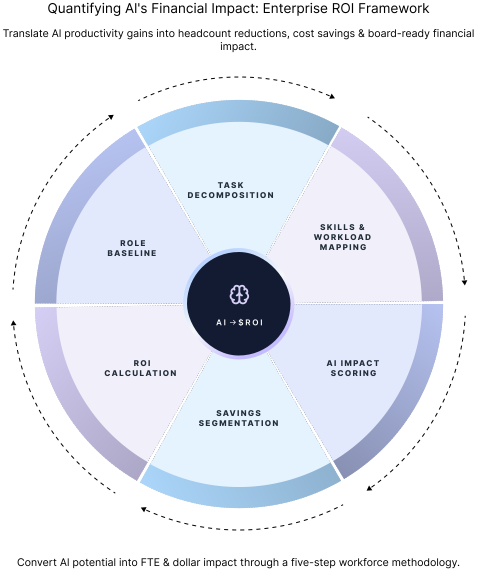
Artificial Intelligence adoption accelerates across enterprises, yet most organizations lack rigorous methods to translate AI capabilities into headcount implications, cost savings, and measurable financial outcomes. This framework provides a CFO-ready methodology to calculate AI's workforce impact through role-by-role, task-by-task analysis that withstands board-level scrutiny.
Who This Framework Serves
These leaders share a common challenge:
AI conversations stay conceptual while boards demand dollar-specific answers. The disconnect stems from a fundamental gap in how enterprises measure AI impact.
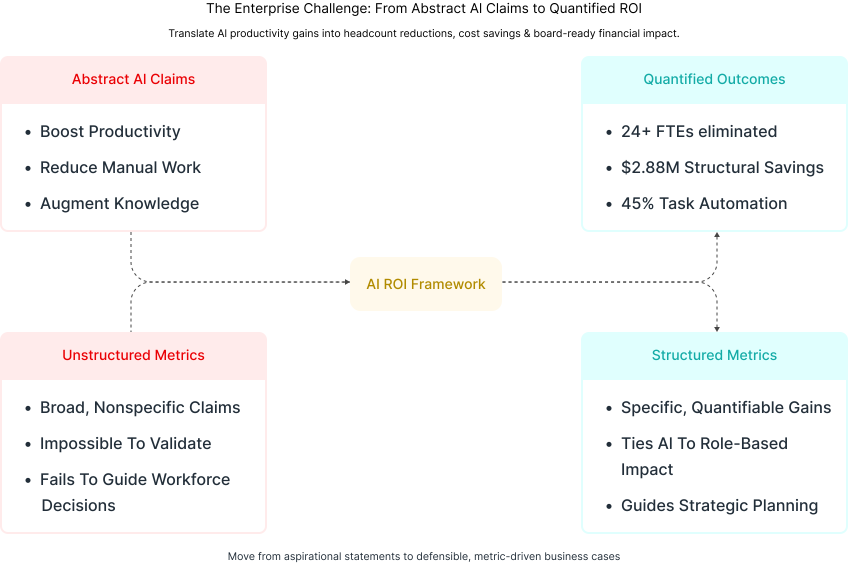
The Enterprise Challenge: From AI Promise to Proof
Three realities intersect: AI adoption speeds across functions, headcount represents the largest controllable enterprise cost, yet leadership lacks unified models to connect AI capability with workforce decisions. McKinsey research indicates 70% of AI transformations fail to deliver expected value, often because financial impact remains abstract rather than quantified at role and task levels.
Most AI business cases stay vague:
- "AI improves productivity" – by how much, in which roles?
- "AI reduces manual work" – which tasks, with what confidence?
- "AI augments knowledge workers" – translating to how many FTEs?
The gap: Structured methodology answering which roles transform, how many hours/FTEs reduce realistically, what savings prove structural vs. temporary, over what horizons savings materialize, and with what confidence levels.
Closing this gap requires a systematic approach that breaks AI impact analysis into five sequential components, each building on the previous to create compounding precision. The methodology begins with establishing what exists today before measuring what AI will change.
The 5-Component AI Workforce ROI Methodology
Establish Role & Headcount Baseline
Build a clean current-state inventory before measuring change. Deloitte workforce analytics studies show enterprises underestimate data fragmentation across HR, finance, and functional systems, without unified baselines, downstream AI analysis becomes speculative.
Key Inputs:
- Total headcount by function and role
- Level distribution (IC, Manager, Director, VP)
- Weighted average fully loaded cost per head (salary + benefits + overhead)
- Current span-of-control metrics
Example: Sales Operations Baseline
- 120 employees: 80 ICs ($120K avg), 30 Managers ($165K avg), 10 Directors ($210K avg)
- Total function cost: $16.65M annually
This baseline establishes the "before" snapshot, the total workforce cost, and the organizational structure. But headcount alone doesn't reveal where AI creates impact. To answer that, we must look inside roles to understand the atomic units of work: tasks and the skills required to execute them.
Decompose Roles into Tasks & Skills
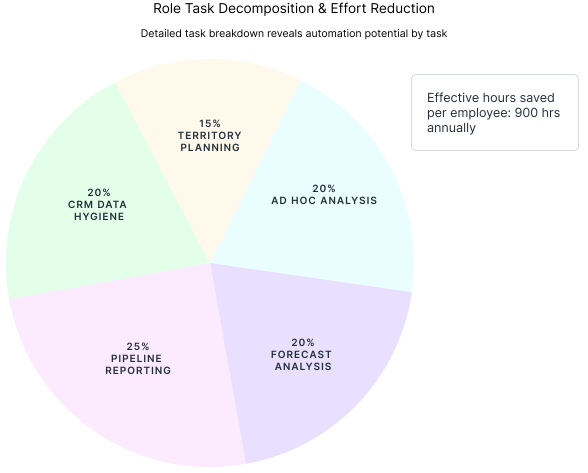
AI doesn't replace roles; it automates or augments specific tasks. MIT-IBM Watson AI Lab research demonstrates that task-level decomposition provides 3-5x more accurate automation forecasts than role-level estimates.
Break each role into:
- Core tasks with frequency and effort allocation
- Skill intensity per task
- Repeatability and automation susceptibility
- Time allocation (hours/year)
With tasks defined and time allocated, the natural question emerges: which of these tasks can AI actually handle, and to what degree? This requires mapping each task against current AI capabilities and maturity, the critical link between theoretical potential and practical implementation.
Map AI Impact & Automation Potential
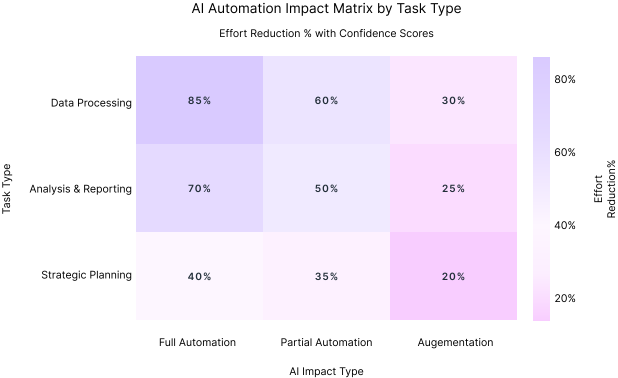
Assess AI impact across three dimensions with confidence-weighted scoring:
Gartner's AI Maturity Model emphasizes integration readiness and change management constraints critically affect realization timelines; technical feasibility alone overestimates impact by 40-60%.
Critical Assessment Factors:
- Current AI tool maturity for specific task types
- Integration dependencies with existing systems
- Change management and adoption curves
- Risk factors and fallback requirements
Once you've quantified which tasks AI transforms and by how much, the next challenge is translating effort reduction into actual dollars. Not all savings manifest the same way, a distinction that determines whether your CFO sees AI as a strategic investment or a speculative expense. This directly leads to how savings are categorized.
Segment Savings into Value Buckets
Not all savings are equal. BCG workforce transformation research shows segmentation enables phased realization and builds CFO confidence through conservative vs. aggressive scenario modeling.
Bucket 1: Structural Efficiency (Role Reduction)
Definition:
Permanent FTE elimination from sustained automation
Characteristics:
High confidence, long-term savings, direct P&L impact
Timeline:
12-36 months aligned with workforce planning cycles
Example Calculation:
- 24 × $120K fully loaded = $2.88M annual structural savings
- 80 Sales Ops ICs × 45% effort reduction × 30% conservative FTE conversion = 24 FTEs eliminated
Bucket 2: Operational Efficiency (Productivity Gains)
Definition:
Effort reduction per role without immediate headcount cuts
Characteristics:
Medium confidence, faster realization, often reinvested
Outcomes:
Capacity unlocked, cost avoidance, delayed hiring
Example Calculation:
- 56 remaining ICs × 500 hours saved = 28,000 hours = 14 FTE capacity unlocked
- Avoided hiring: 14 × $120K = $1.68M annual cost avoidance
Bucket 3: Organizational Structure Efficiency (Layer Reduction)
Definition:
Flatter structures via improved visibility and decision automation
Characteristics:
High leverage, politically sensitive, significant cost impact
Outcomes:
Wider spans of control, reduced management layers
Example Calculation:
- Span improvement: 1 Manager per 3 ICs → 1 per 6 ICs = 12 Managers eliminated
- Director span: 1 per 3 Managers → 1 per 5 = 4 Directors eliminated
- Savings: (12 × $165K) + (4 × $210K) = $2.82M annually
Segmenting savings by type is only half the equation; finance leaders also demand visibility into when and with what certainty those savings materialize. This brings us to the final component: converting segmented savings into board-defensible ROI projections that account for phased implementation and risk.
Calculate ROI & Confidence Scores
Translate segmented savings into multi-year financial outcomes using phased realization timelines. Distinguish between theoretical maximum, expected realizable, and committed savings to build board credibility.
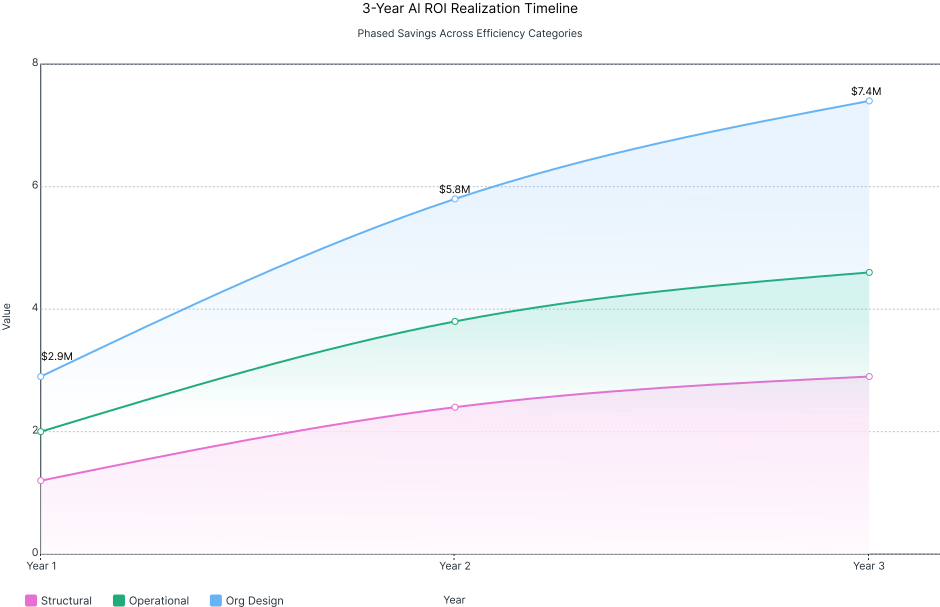
These five components form a complete methodology, but in practice, most enterprises struggle to execute this analysis internally. Understanding why reveals the hidden costs of DIY approaches and why specialized platforms accelerate outcomes dramatically.
Why Standard Internal Approaches Struggle
Enterprises attempting manual ROI analysis face:
- 9-18 month timelines before actionable insights
- $1M-$2M internal analyst labor costs
- Inconsistent assumptions across functions
- Low confidence in output (often requires external validation)
- Static point-in-time views that stale as AI evolves
Gartner's 2024 CFO & Finance survey finds that organizations further along in AI adoption are nearly 3x more likely to see high impact and two-thirds of finance leaders report greater optimism about AI's impact on their function than the year prior.
The inefficiency isn't just about time and cost, it's about confidence and continuity. Manual approaches produce one-time snapshots that decay as AI capabilities evolve. What enterprises need is an intelligence system that systematizes this analysis and updates continuously. That's precisely where our Etter platform transforms the equation.
How Draup's Etter Accelerates ROI Realization
Etter functions as an intelligence system for AI-driven workforce analysis, systematizing what manual approaches leave fragmented:

- Standardized role/skill decomposition across 500+ enterprise roles
- Continuous AI tool tracking – 200+ tools mapped to task automation potential
- Confidence-weighted impact scoring based on 10M+ labor market data points
- Scenario modeling across roles, functions, geographies, and time horizons
- CFO-ready outputs tying directly to headcount and P&L impact

- Speed: 6-8 weeks vs. 9-12 months internal analysis
- Consistency: Unified methodology withstanding financial scrutiny
- Credibility: Outputs grounded in external labor market benchmarks

- Etter’s annual cost: $200K
- Conservative first-year realized savings: $1.5M
- ROI multiple: 7.5x | Payback: <2 months





.svg)



.svg)
