


How the Fortune 500 Are Transforming Their Hiring Models
A hiring intelligence guide to enterprise workforce shifts in 2025
By filling up this form, you agree to allow Draup to share this data with our affiliates, subsidiaries and third parties


Understanding the Research
Enterprise hiring patterns reveal far more than talent demand; they signal strategic pivots, operating model transformations, and technology adoption at scale. Our analysis of Fortune 500 job opening trends across 2024–25 and 2025–26 uncovers nine structural shifts reshaping how the world's largest enterprises build, deploy, and govern their workforce in the AI era.
This guide translates hiring signals into actionable workforce intelligence for CHROs, Heads of Talent Acquisition, and Workforce Planning leaders targeting Fortune 500 enterprises. Analysis is based on our proprietary database of 1 billion+ global job descriptions across Fortune 500 companies.
Fortune 500 Workforce Strategy: A Data-Led View
Fortune 500 companies posted significantly different hiring profiles in 2025 compared to 2024, reflecting a transition from AI experimentation to AI operationalization. The data reveals three macro themes:
Embedded AI adoption across customer-facing and operational functions, not just R&D
Control-oriented hiring prioritizing governance, cost optimization, and risk management over pure innovation
Flexible workforce models emphasizing contract, project-based, and specialist hiring over permanent headcount expansion
These patterns suggest Fortune 500 enterprises are moving from "building AI" to "operating AI at scale" while simultaneously tightening cost discipline and workforce flexibility.
Nine Structural Shifts in Fortune 500 Hiring (2024 vs. 2025)
AI Hiring Becomes 'Embedded' Inside Business and Enterprise Functions
The Signal:
AI skills and tools are no longer confined to engineering and data science roles. AI-related competencies appeared with increasing frequency across non-technical business functions.
Key Data Points: AI Skills Demand Growth by Function
- Customer Support & Service: 24.8% increase in AI skills requirements
- Sales & Marketing: 23.6% increase in AI skills requirements
- Industrial Manufacturing: 23.0% increase in AI skills requirements
- Financial Operations: 21.3% increase in AI skills requirements
- Information Technology: 9.0% increase (reflecting normalization in already AI-mature functions)
What It Means:
Fortune 500 enterprises are embedding AI capabilities into frontline and operational workloads, automating customer interactions, optimizing sales processes, and driving decision support across business units. This represents a fundamental shift from centralized AI teams to distributed AI literacy.
Strategic Implications:

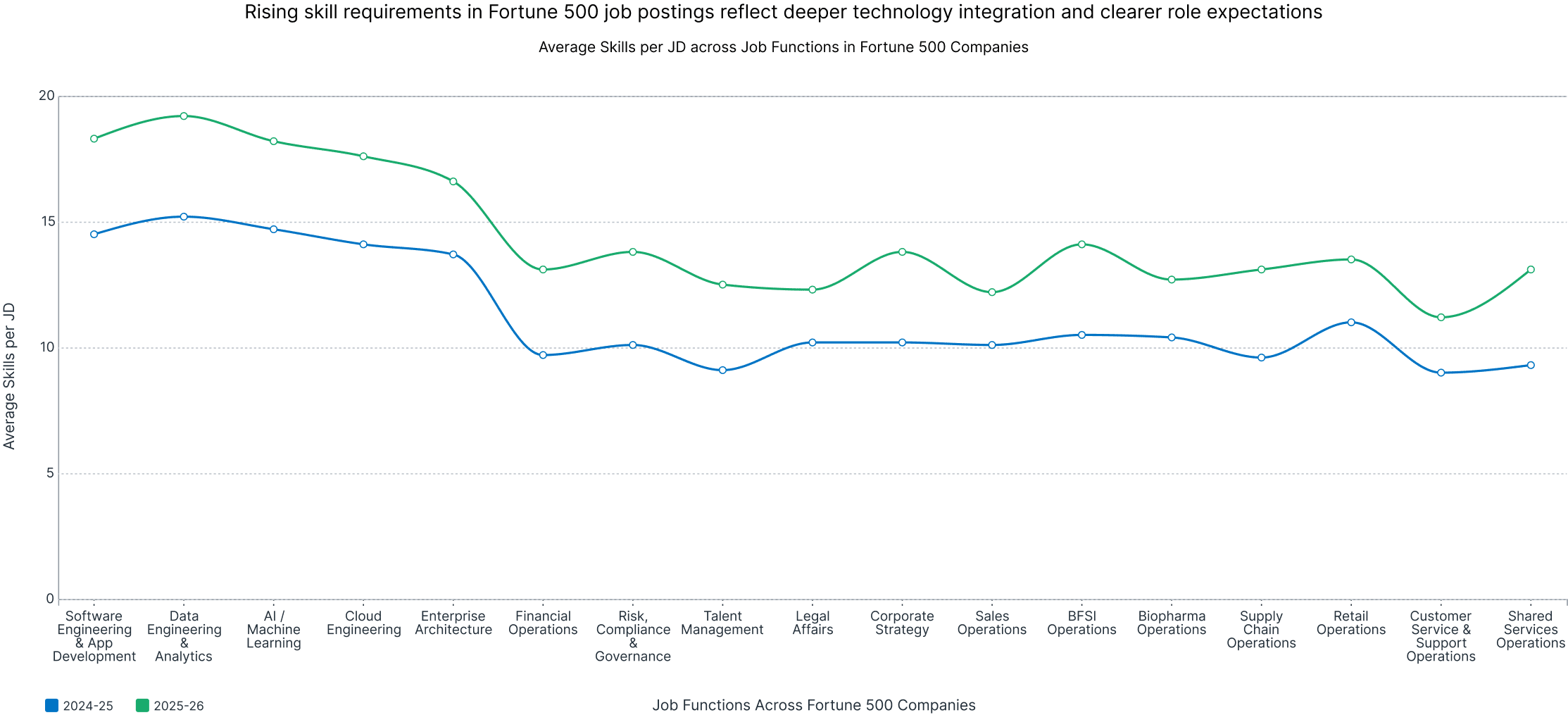
Skills Density (Skills Per Role) Increases Across All Major Job Functions
The Signal:
From 2024 to 2025, skill intensity, defined as the average number of distinct skills required per role, rose sharply across technology and operational functions.
What It Means:
Fortune 500 roles are becoming more complex and multi-disciplinary. Employers expect individual contributors to operate across broader capability sets, blending technical proficiency with domain expertise and business acumen. This trend aligns with the broader shift toward skills-based hiring frameworks.
Strategic Implications:
Hiring Growth Is Led by Execution Roles
The Signal:
Fortune 500 hiring in 2025 is increasingly concentrated in execution-oriented individual contributor (IC) roles, while leadership hiring remains selective and targeted.
Key Data Points:
- Individual Contributor Roles showed the highest growth rate in job demand across Fortune 500 companies
- Director-level and VP-level roles showed significantly lower growth compared to IC and managerial positions
- This pattern was consistent across Information Technology, Finance & Accounting, Supply Chain & Procurement, and Sales & Marketing functions
What It Means:
Enterprise hiring strategies prioritize operational delivery over managerial expansion. This reflects a broader trend toward flatter organizational structures and greater reliance on senior ICs to drive technical execution.
Strategic Implications:

Global Hiring Momentum Continues
The Signal:
From 2024 to 2025, Fortune 500 hiring continued across global geographies, with sustained talent demand in traditional markets and emerging high-growth countries.
What It Means:
Despite economic uncertainty, Fortune 500 enterprises maintain globally distributed hiring strategies, driven by access to specialized skills, cost arbitrage, and localized market expansion. Emerging markets in the Middle East, Southeast Asia, and select European markets are experiencing accelerated hiring momentum.
Strategic Implications:


Demand Is Concentrated More in "Operators of AI"
The Signal:
Fortune 500 AI demand is focusing on operating AI rather than building AI. Governance, orchestration, and integration skills are growing far faster than foundational AI research skills.
Fastest-Growing AI Operator Skills
- Responsible AI (governance and ethics frameworks)
- AI Integration (connecting AI to enterprise workflows)
- AI Governance (policy, compliance, oversight)
- LangChain (orchestration framework)
- Workflow Automation (AI-powered process optimization)
- Retrieval-Augmented Generation (RAG) (enterprise knowledge integration)
Slower-Growing AI Builder Skills:
- Model Training
- Deep Learning
- Neural Networks
- Generative Modeling
- Foundation Model development
- Research & Development (R&D)
Key Data Insight:
AI Governance, Orchestration, and Integration skills showed growth rates 400-600% higher than AI Builder skills, with significantly higher relative demand in 2025 job postings.
What It Means:
Enterprises have shifted from R&D-driven AI experimentation to enterprise-scale AI deployment, requiring skills in integration, governance, and business alignment rather than foundational research. This signals maturation from "AI innovation labs" to "AI operations" across business units.
Strategic Implications:
Hiring Signals Emphasize Cost Optimization Language
The Signal:
Across Fortune 500 tech roles, cost optimization-driven hiring language is rising sharply. Job descriptions increasingly emphasize ROI, cost-to-serve, productivity gains, and margin protection over pure build-led growth.
Cost Optimization Signal Growth in Tech Roles (2024-2025):
What It Means:
Enterprises are shifting tech hiring toward efficiency-led outcomes. Job descriptions increasingly emphasize ROI, cost-to-serve, productivity gains, and margin protection, signaling that investment is being justified through measurable business impact rather than build-led growth.
Strategic Implications:
Note: CFO-driven signals refer to mentions of terms such as ROI, margin protection, cost optimization in job descriptions.
Hiring Growth in 2025 Is Strongest in Control-Oriented Skill Clusters
The Signal:
Across Fortune 500 companies, hiring is increasing for roles focused on security, privacy, AI governance, risk, and cost optimization.
Year-over-Year Growth Rate Analysis (2024-2025):
Hire for Control Clusters:
- Risk, Audit & Compliance: 81.0% growth
- Security, Privacy & Resilience: 77.6% growth
- AI Governance & Model Risk: 31.5% growth
- Cost Optimization & Margin Protection: 27.5% growth
Hire for Growth Clusters:
- Platform-Oriented Development: 19.9% growth
- Program Management: 19.6% growth
- GTM Execution & Expansion: 15.6% growth
What It Means:
AI skills and tools are no longer confined to engineering and data science roles. Across Fortune 500 companies, hiring is increasing for roles focused on security, privacy, AI governance, risk, and cost optimization.
Strategic Implications:
The Fortune 500 Increases Contract, Project-Based, and Specialist Hiring
The Signal:
In 2025, Fortune 500 companies increasingly rely on contract and specialist hiring, with contract roles rising sharply.
Key Data Points:
- Contractual job postings increased from 520,000 (2024-25) to 610,000 (2025-26)
- Growth rate: 17.3%
Most Affected Contract Roles & Business Functions (Growth Rates):
Engineering R&D:
- Project Engineer: 23% growth
- Senior Research Associate: 19% growth
- Quality Engineer: 16% growth
Finance & Accounting:
- Senior Financial Analyst: 33% growth
- Accounts Payable Clerk: 31% growth
- General Accountant: 26% growth
- Fund Accounting Specialist: 20% growth
Telecom & Operations:
- Telecom Specialist: 20% growth
What It Means:
Permanent headcount expansion is being replaced by flexible workforce models that allow rapid scaling and de-scaling based on project needs. This reflects both cost discipline and a preference for specialized expertise over generalist full-time employees.
Strategic Implications:
Early Signals Suggest External Hiring Is Slowing in Select Roles Identified as Highly Automatable or Augmentable by AI
The Signal:
Preliminary analysis shows that job postings in highly AI-augmentable roles, particularly in Finance, are declining faster than in low-augmentation roles.
Key Data Points:
- Finance roles with high AI augmentation potential: 290,000 (2024–25) → 180,000 (2025–26)
- Finance roles with low AI augmentation potential: 600,000 (2024–25) → 550,000 (2025–26)
Important Caveat:
This represents an early directional signal; further data is needed to confirm the trend. The pattern suggests early substitution of routine work through AI, particularly in Finance.
What It Means:
AI is beginning to displace external hiring demand for roles with high degrees of routine, structured work. While the trend requires longer validation cycles, early indicators suggest Fortune 500 companies are testing AI-first workflows before expanding headcount.
Strategic Implications:
How We Support Enterprise Hiring Intelligence
Our platform provides real-time, AI-powered talent and market intelligence that enables enterprises to anticipate workforce trends, optimize hiring strategies, and build future-ready talent architectures. We analyze 25M+ data points daily from 75,000+ sources.
For Talent Leaders:
Strategic Workforce Planning
Talent Acquisition
Skills Architecture
Implications for Enterprise Decision-Makers
The Fortune 500 hiring patterns of 2025 reveal a fundamental recalibration of workforce strategy:
AI is scaling from labs to lines of business, requiring broad-based AI literacy and integration skills
Control and governance are enterprise-wide priorities, not afterthoughts to innovation
Workforce flexibility is replacing headcount expansion, signaling a shift toward demand-led talent deployment
Cost optimization is a strategic imperative, not a reactive measure
Skills density is rising across all functions, requiring more sophisticated talent assessment and development
For CHROs and Talent Leaders, these shifts demand workforce planning models that integrate market intelligence, skills forecasting, and flexible talent sourcing.
Methodology & Analytical Framework
How We Derived These Insights
1. Enterprise-Scale Data Foundation
- Analysis draws on Draup's proprietary database of 1 billion+ global job descriptions, covering Fortune 500 companies across industries
- Job postings span multiple geographies, functions, roles, and seniority levels
- Core analysis focuses on 2024–25, with early directional signals from 2025–26 where trends are emerging
2. Job & Skill Normalization
- All job postings were standardized and mapped across job functions (IT, Finance, HR, Supply Chain, Sales) and hierarchical levels (IC, Manager, Director, VP)
- Skills were extracted using NLP models and mapped to Draup's proprietary skills ontology
3. Skills Density Measurement
- Skills Density is defined as the average number of distinct skills required per role
- Year-over-year changes analyzed to identify role consolidation and technology/AI infusion into traditional roles
4. AI Signal Identification
- AI-related skills and keywords (AI/ML, automation, governance, orchestration, data platforms) were tagged to measure AI penetration across functions
- Growth vs. normalization effects applied (base-effect adjustments for early adopters such as IT and R&D)
5. Control vs. Growth Skill Clustering
- Skills grouped into "Hire-for-Growth" (platform development, GTM execution) and "Hire-for-Control" (security, risk, AI governance, cost optimization)
- YoY growth rates calculated to assess shifts in enterprise hiring priorities
6. Cost-Optimization Signal Analysis
- Job descriptions scanned for CFO- and efficiency-oriented language (cost optimization, ROI, margin protection, efficiency)
- Signal growth analyzed across AI, cloud, data, DevOps, and security workloads
7. External Hiring Trend Assessment
- External hiring volumes compared across roles with high vs. low AI automation/augmentation potential
- Findings labeled as "early signals" where trend maturity is still evolving
8. Geographic Hiring Analysis
- Hiring activity aggregated at country level to assess growth momentum and regional rebalancing
- Countries classified as highly positive, slightly positive, slightly negative, or highly negative
9. Analytical Guardrails
- Insights reflect directional trends, not single-point observations
- Percentage growth indicates relative change, not absolute hiring volume
- Emerging patterns explicitly caveated where longer validation cycles required
Note: This page is structured as a decision guide for enterprise leaders evaluating workforce transformation strategies and market intelligence platforms. It does not represent investment advice or employment forecasting for specific organizations.

.svg)




.svg)
