


Global Talent Location Strategy in the Age of Regionalization
A Technical Evaluation Framework for Enterprise Leaders
By filling up this form, you agree to allow Draup to share this data with our affiliates, subsidiaries and third parties


The New Reality of Global Talent Location Strategy
The rules governing where work gets done are fundamentally changing.
As enterprises enter 2026, location strategy is no longer about finding the lowest-cost hub, it's about architecting a resilient portfolio of capabilities across a fragmented global system. Mobility is tightening in traditional talent markets. AI sovereignty is reshaping where sensitive workloads can run. And productivity gains from AI are making smaller, specialized hubs more strategic than ever.
For CHROs and workforce planning leaders, this means location strategy has evolved from an optimization problem into a portfolio design problem.
This page provides a practical framework grounded in observable policy signals and market data to help you evaluate where to place work in 2026 and beyond.
Read the Complete Report – The New Geography of Work | January 2026
The Five-Lens Analytical Framework for Talent Hub Evaluation
A Technical Framework For Enterprise Leaders Evaluating Global talent Locations In The Age Of Regionalization

Enterprise leaders evaluating talent location decisions in 2026–2031 must assess each potential hub through five technical dimensions. This framework moves beyond cost arbitrage to incorporate geopolitical risk, regulatory constraints, and execution feasibility.
The 5-Component AI Workforce ROI Methodology
Policy Friction
Policy friction evaluates the regulatory and administrative barriers to talent mobility, work authorization, and cross-border operations.
What to Evaluate:
- Visa processing timelines and denial rates for skilled worker categories (H-1B, Skilled Worker visas, etc.)
- Student visa policies and pathways to permanent residency
- Enforcement intensity and compliance risk (raids, documentary scrutiny, retroactive denials)
- Immigration policy volatility and political sensitivity
2026 Signals:
Strategic Implication:
Enterprises heavily dependent on cross-border talent mobility must build domestic talent manufacturing engines (apprenticeships, internal academies, community college partnerships) and diversify hiring across multiple jurisdictions to hedge policy risk.
Economic Gravity
Economic gravity measures investment flows, sector growth momentum, wage pressure, and macroeconomic stability.
What to Evaluate:
- Foreign Direct Investment (FDI) trends and government incentive structures
- Sector-specific growth rates (technology, manufacturing, business services, R&D)
- Wage inflation trajectories and cost-quality curves
- Currency stability and economic volatility
2026 Signals:
Strategic Implication:
Strategic Implication: Location decisions must incorporate economic gravity risk, assessing not only current cost but future wage pressure, currency volatility, and exposure to single-market dependencies (e.g., Vietnam's reliance on U.S. exports).
Capability Density
Capability density evaluates the depth, breadth, and maturity of talent ecosystems for specific roles and skill families.
What to Evaluate:
- Talent availability for target roles (e.g., AI/ML engineers, cybersecurity specialists, multilingual support)
- Ecosystem maturity (universities, startups, vendor density, leadership benches)
- Skills adjacency and reskilling potential
- Retention patterns and attrition risk
2026 Signals:
Strategic Implication:
Enterprises should segment hubs by capability density, not just cost. India offers scale and depth for AI, data platforms, and enterprise operations. Eastern Europe provides EU-compliant multilingual and regulated workload execution. Canada offers targeted graduate talent in AI and research.
Sovereignty Constraints
Sovereignty constraints evaluate data residency requirements, AI model localization mandates, export controls, and regulatory alignment.
What to Evaluate:
- Data residency and localization requirements (GDPR, CCPA, China Cybersecurity Law, etc.)
- AI sovereignty initiatives (sovereign compute, locally trained models, inference localization)
- Export controls on advanced chips, software, and dual-use technologies
- Regulatory alignment with enterprise operating jurisdictions
2026 Signals:
Strategic Implication:
AI strategy and location strategy are now inseparable. Enterprises must adopt a multi-stack AI posture: global stack + EU-sovereign stack + China-local stack (where relevant), with procurement and MLOps infrastructure supporting segmented deployment.
Execution Reality
Execution reality assesses time-to-stand-up, operational risk, vendor ecosystem maturity, and business continuity exposure.
What to Evaluate:
- Time-to-hire and onboarding speed
- Vendor ecosystem maturity (staffing providers, real estate, infrastructure)
- Geopolitical volatility and business continuity risk
- Operational scalability and management overhead
2026 Signals:
Strategic Implication:
Location risk is now as material as cost risk. Enterprises must evaluate execution reality not only by time-to-hire but by geopolitical volatility, trade exposure, and business continuity risk under adverse scenarios.
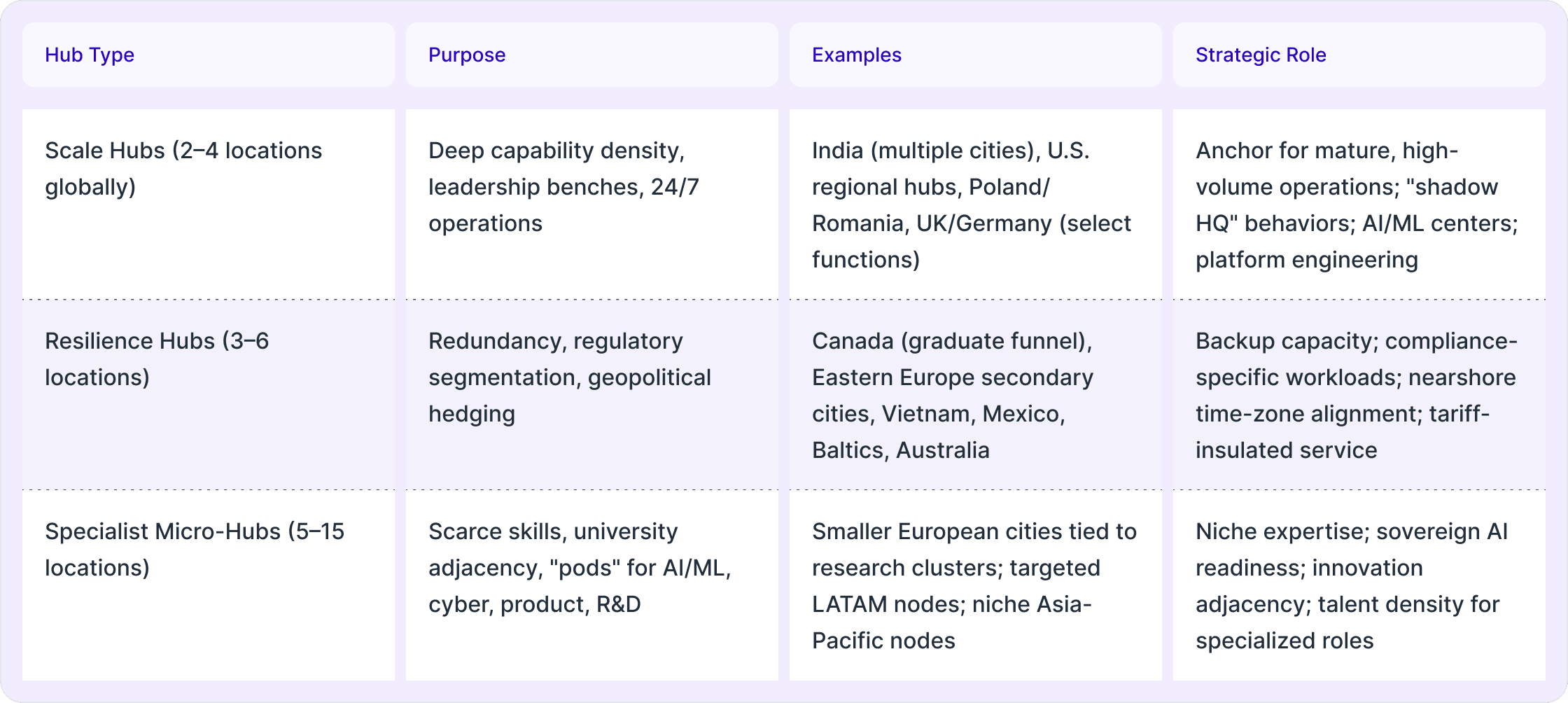
The 3-Layer Hub Portfolio Architecture
The highest-performing organizations over the next five years will deliberately balance three layers of talent hubs:
Why This Matters:
As AI optimizes human labor requirements, the next five years will favor smaller, specialized hubs, not only mega hubs. If AI tools lift per-person productivity, companies can meet growth targets with smaller teams, more specialized skill profiles, and more distributed footprints. The strategic question shifts from "Where can I hire 5,000 people?" to "Where can I hire 200–800 people with niche skills, stable retention, and compliant infrastructure?".
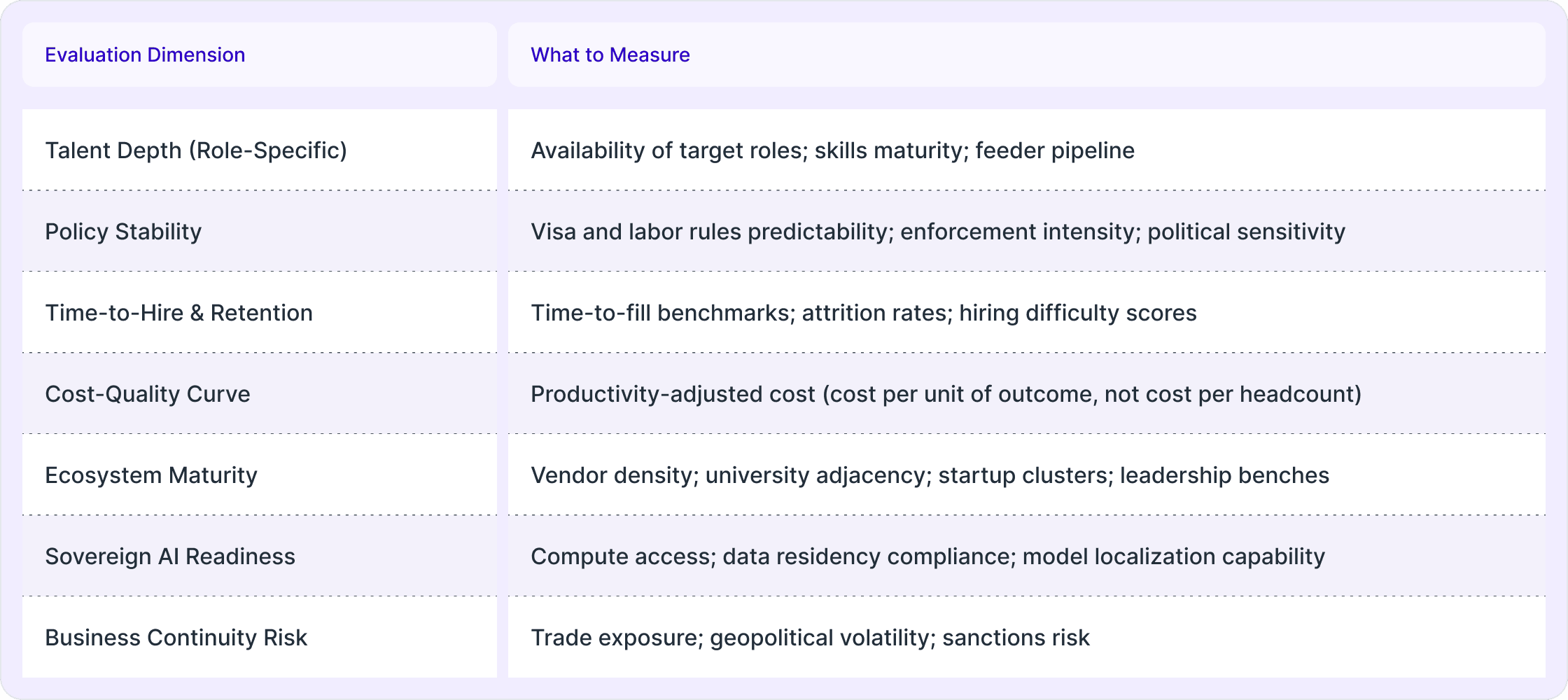
Hub Viability Scorecard: Evaluate Any Location Immediately
Use this illustrative decision framework to score potential talent hubs across seven dimensions:
Key Shift:
"Cost" should be measured as cost per unit of outcome (tickets resolved, features shipped, models deployed), not cost per headcount.
Scenarios for 2026–2031
.png)

Recommended Actions: Next 2–3 Quarters
For CHRO / Talent Leaders
- Build a U.S. domestic talent manufacturing engine (apprenticeships, community colleges, reskilling) to reduce visa dependency
- Create a Canada graduate funnel strategy (master's/PhD recruiting, research partnerships) leveraging cap exemptions
- Plan for localized wage pressure in Eastern Europe and build second-city options early (before saturation)
For CIO/CTO / Data & AI Leaders
- Adopt a 3-stack AI posture: global stack + EU-sovereign stack + China-local stack (where relevant)
- Treat compute access as a strategic dependency (especially where export-control uncertainty affects hardware)
- Standardize delivery with "small teams, high leverage" playbooks: model reuse, platform engineering, and rigorous evaluation
For COO / GBS / Shared Services Leaders
- Double down on India for scale but diversify across cities and vendors to manage attrition and concentration risk
- Use Eastern Europe as the EU execution layer for regulated workloads (finance ops, multilingual support, cyber, analytics)
- Pilot micro-hubs with clear mandates (e.g., "AI model risk & eval hub in Germany," "multilingual CX hub in Latvia," "finance transformation pod in Poland")
For Supply Chain / Manufacturing Leaders
- Segment supply chains by tariff and resilience exposure; don't assume Vietnam's gains are risk-free given U.S. dependence
- Pair India manufacturing bets with engineering/GCC adjacency to speed iteration and localization
Key Metrics to Monitor (Monthly/Quarterly)
Track these leading indicators to manage location risk and optimize your hub portfolio:
- Mobility Risk Index: Visa processing time volatility + denial rates + policy announcements
- Hub Concentration Index: % of critical roles in top 1–2 locations
- Outcome-Adjusted Labor Cost: Cost per feature delivered / model deployed / case resolved
- AI Leverage Rate: Productivity uplift vs baseline + quality metrics (defect rates, customer satisfaction)
- Attrition Heat Map: By city, role family, and tenure band
- Regulatory Segmentation Readiness: Ability to deploy EU-sovereign vs global AI stack without re-architecting
How Draup Powers Global Talent Location Strategy
We provide the intelligence layer for location strategy decisions, analyzing 25M+ data points daily from 75,000+ sources to deliver real-time insights on talent supply, cost, skills evolution, and geopolitical risk.
Our Capabilities

Track talent metrics, compensation benchmarks, hiring difficulty, and skill availability across global hubs. Our data refreshes daily to reflect market reality, not last quarter's spreadsheet.

Forecast how roles and skill mixes will evolve, identify sunrise/sunset skills, and design reskilling or hiring plans before gaps appear.

Pinpoint the best global hubs balancing cost, skill depth, diversity, and geopolitical risk using our five-lens evaluation framework.

Model talent needs using real units of work like workloads, tasks, and scenarios, not static job titles . Map a clear flow from role to budget impact to see how shifts in responsibility, efficiency, or AI change your organization.

Compare workforce metrics, hiring competition, and talent strategies against named peer groups or industry leaders.

- APIs & Integrations: Native integrations with 33+ HCM, HRIS, and ATS platforms (Workday, SAP SuccessFactors, etc.) for real-time labor market enrichment
- Custom Data Feeds: Scheduled pushes to data lakes/warehouses (S3, ADLS, BigQuery, SFTP) for analytics at scale.
- Draup Platform: Ready-to-use UI with 200+ productized use cases, enterprise controls (SSO, RBAC, governance), and fastest time-to-value.

What This Means for Enterprise Leaders
The next era of global talent hubs is not about picking the "best" location, it is about designing a resilient network of capabilities. Enterprises best positioned for 2026–2031 will treat talent hubs the way sophisticated investors treat portfolios, diversifying risk, balancing short-term efficiency with long-term optionality, and continuously reweighting exposure as geopolitical and technological conditions evolve.
Location risk is now as material as cost risk.
AI strategy and location strategy are inseparable.
Sovereign AI will constrain where sensitive work can run.
Micro-hubs will absorb marginal growth, not mega hubs.
The shift is already underway. Organizations that recognize it early, and redesign their global footprints accordingly, will not only absorb geopolitical disruption more effectively but convert it into a durable competitive advantage.

.svg)




.svg)
