


5-Step HCM Skills Transformation Framework
A Technical Evaluation Guide for Enterprise HR and Architecture Leaders
By filling up this form, you agree to allow Draup to share this data with our affiliates, subsidiaries and third parties


Why HCM Systems Need an Intelligence Layer
Leading HCM platforms like Oracle HCM Cloud, Workday, and SAP SuccessFactors power enterprise talent operations but constrain skills-based strategies due to job-centric data models.
Each platform represents a different architectural approach with intentional trade-offs. Oracle, Workday, and SAP SuccessFactors each excel in specific dimensions, compliance rigor, talent mobility, or flexible role modeling. Our intent is to help enterprise leaders, CHROs, SWP and TA leaders, and workforce transformation owners, understand these architectural foundations and identify where integrating market intelligence amplifies their HCM investment
This framework analyzes their architecture, highlights integration gaps, and positions our Draup intelligence layer as the essential enhancer for real-time, market-aligned decisions.

This guide is designed for CHROs and CPOs, VPs and Heads of Workforce Strategy (SWP) and Talent Acquisition, HR Technology leaders, Enterprise Architects, and Workforce Planning COEs and HR Analytics leaders.
The 5-Component HCM Skills Readiness Assessment Framework
Draup’s framework evaluates HCM readiness across five technical components. This model is designed to align HR leaders and enterprise architects on why a skills program succeeds or fails in production.
Component overview table
Job-Centric vs Skills-Based HCM Architectures
Traditional HCMs prioritize jobs over skills, limiting agility in dynamic markets (Deloitte). Oracle's Profile Management hierarchies group via Job Families but tie skills to static profiles. Workday's object-oriented Job Profiles enable mobility yet fragment with dual competency/skills clouds SAP SuccessFactors decouples Roles via Metadata Framework, leveraging its Talent Intelligence Hub (TIH) - SAP's centralized skills and attributes repository, but this adds abstraction overhead for global normalization.
Key Architectural Trade-offs:
Oracle HCM Cloud
Workday
SAP SuccessFactors
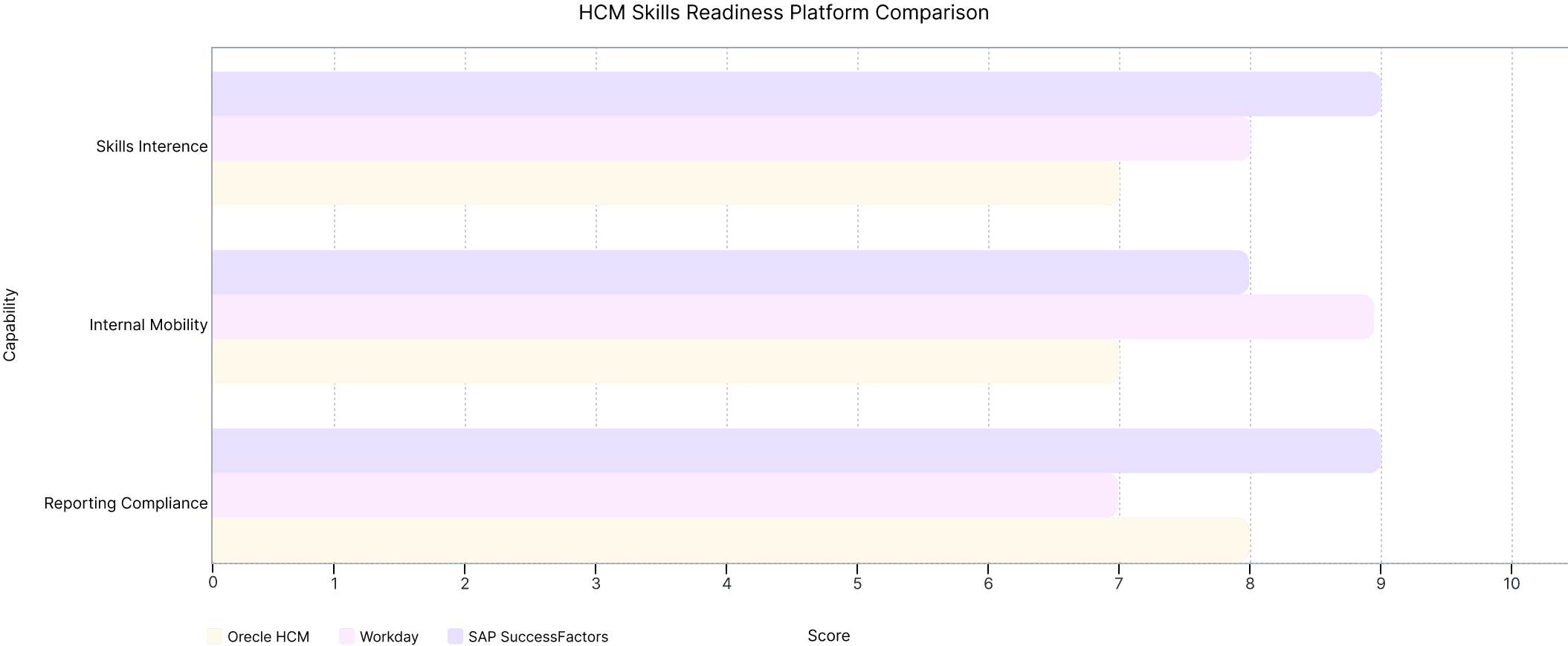
Despite these capabilities, all three platforms still lack native real-time market intelligence and evidence-based skills validation, requiring integration with external talent intelligence platforms to bridge the gap between internal HCM data and evolving market demand, and to move beyond self-reported proficiency toward objective, outcome-driven skills assessment.
Skills & Competencies Data Structures
HCM skills models blend behaviors and abilities unevenly (Forrester). Oracle's Skills Nexus (technical) + Content Library (competencies) (Oracle) supports AI mapping but requires syncing. Workday's Skills Cloud (machine-learning-powered collection) vs. static Competencies (Beamery) powers marketplaces via inference. SAP's TIH Attributes enable "Whole Self" views with normalized scales (LearningSAP).
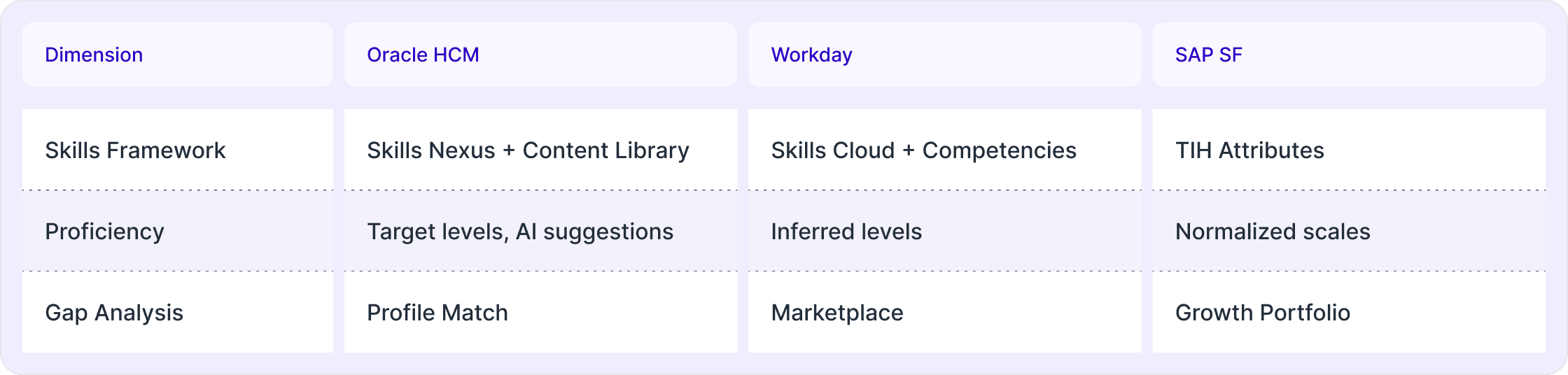

HCM Integration & API Capabilities for Skills Enrichment
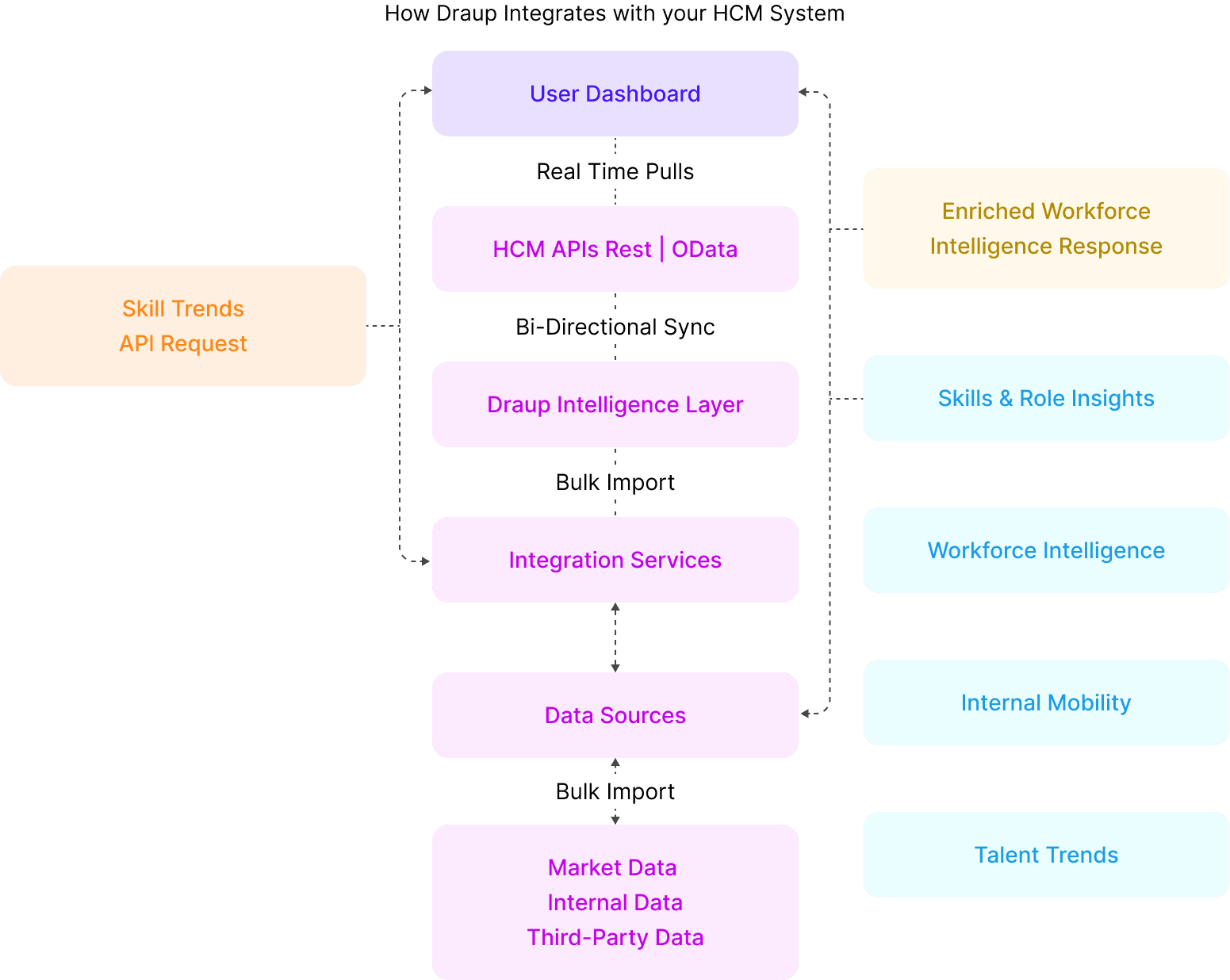
Skills transformation demands open APIs (Forrester). Oracle's REST/HDL/OIC (Oracle) handle bulk profile updates. Workday's EIB/Studio (Workday) enable ontology syncs. SAP's OData/Integration Center (LearningSAP) support TIH feeds.
Integration Checklist:
- REST/OData endpoints for real-time pulls.
- Bulk loaders for taxonomy imports.
- Bi-directional sync for proficiency updates.
Forrester highlights extensible HCM platforms need third-party extensibility.
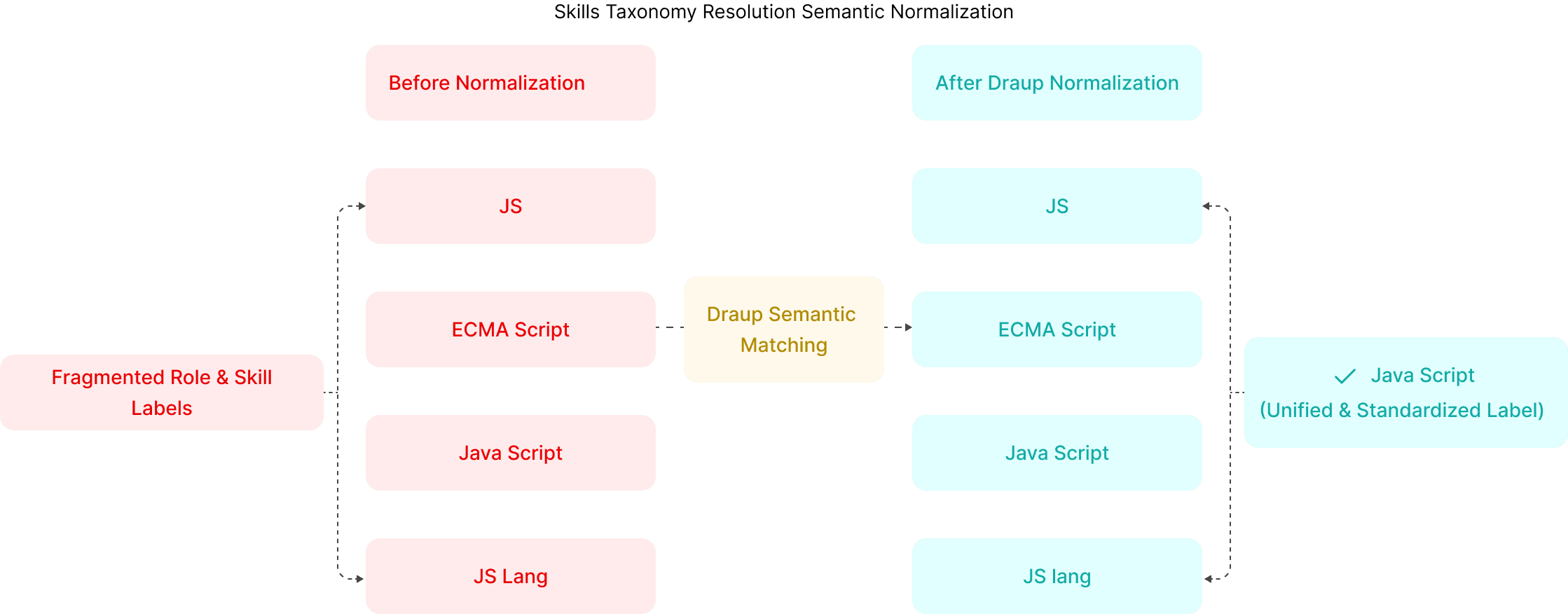
Overcoming Taxonomy & Nomenclature Conflicts in HCM
Semantic inconsistency silos data. Oracle AI-normalizes via Nexus, Workday partner-maps ontologies, SAP centralizes Attributes. Draup resolves with live ontology.
Draup Taxonomy Benefits:
- Semantic matching (high accuracy)
- Daily market refreshes.
- Adjacency graphs for reskilling.
The Unified Skills Ecosystem (HCM + Intelligence + Evidence)
A scalable skills-based operating model requires three layers:
- HCM as the system of record
- An intelligence layer to enrich and normalize skills against market reality
- Internal evidence systems to validate skills in practice.

HCM stores governed workforce objects (jobs, worker profiles, org structures)
Internal evidence systems provide proof of skill execution (projects, certifications, learning completion, outcomes)
Draup continuously enriches and normalizes skills using external market intelligence to prevent skills staleness
Enterprise Use Cases:
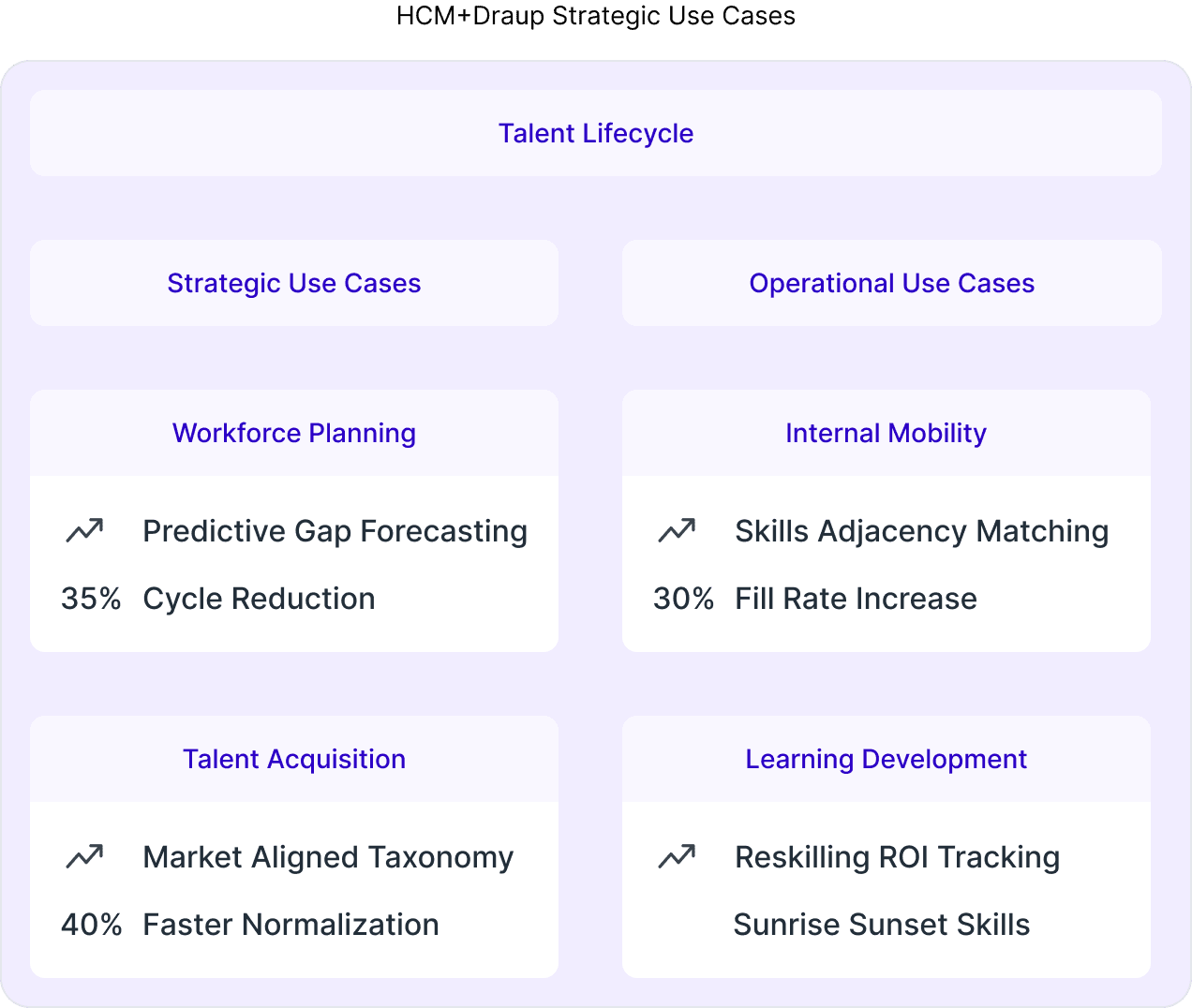
Where Draup Amplifies Your HCM Investment
These are the most common enterprise triggers for investing in a unified skills ecosystem architecture. Each use case is framed as a decision workflow supported through governed data exchange.
Market-Aligned HCM Skills Taxonomy Enrichment
Skills lists have drifted and duplicated globally
Canonical skill taxonomy + alias resolution + refresh cycles
Bulk taxonomy refresh + API enrichment
Taxonomy accuracy rate (%), skills coverage rate, duplicate reduction (%)
Skills-Based Internal Talent Marketplaces
Launching internal mobility programs or talent marketplace features
Comparable worker skill profiles matched to role requirements
Bi-directional sync between HCM skills and intelligence enrichment
Internal fill rate (%), time-to-mobility reduction, adoption rate (%)
Predictive Workforce Planning with Skills Intelligence
AI transformation changes future skill demand faster than job architecture updates
Future skill heatmaps and scenario planning integrated with current supply
Scheduled refresh cycles + planning exports
Plan-to-actual variance, critical role coverage (%), reskilling ROI
Activate Your Skills Intelligence Layer
Your HCM platform provides the foundation. Draup delivers the intelligence layer that makes skills data predictive, market-aligned, and actionable. Whether you're running Oracle, Workday, or SAP SuccessFactors, our APIs integrate in 4-8 weeks to unlock the outcomes measured in this framework.

.svg)




.svg)
