


Strengthening Global Talent Strategy Across Compensation, Workforce Intelligence & Work Models
Discover how Draup enabled a unified view of global talent supply, skill evolution, competitor positioning, talent flow, and emerging competitive threats across a complex, multi-function workforce spanning four continents.
~85000
Employees
$52B
Revenue
Semiconductor Manufacturing
Industry
Santa Clara, California
Headquarters
About the organization
A global semiconductor and advanced manufacturing enterprise sought data-driven insights to refine its talent strategy amid rising competition, evolving hybrid expectations, and complex global pay structures. Leadership needed clarity on peer compensation models, workforce design, performance frameworks, and WFA policies to strengthen competitiveness while ensuring compliance, cost discipline, and long-term sustainability.
The Core Challenges
Pay Structure Visibility
Limited visibility into competitor pays structures—including base, RSUs, bonuses, and regional benefits—created uncertainty in maintaining competitive yet cost-effective compensation models.
Talent Benchmarking Gaps
Intensifying competition for engineering and fab talent required clearer benchmarking of workforce mix, supervisor ratios, diversity, and shift structures.
Leadership Insight Gaps
Insufficient insight into peer performance and leadership frameworks made it difficult to align capability building with digital and manufacturing expansion.
Workforce Flexibility Risk
Tightening hybrid mandates and compliance-driven WFA models created uncertainty around retention risk, mobility, and long-term workforce flexibility.
The Solution
Research & Development (R&D) Manager

PROFILE
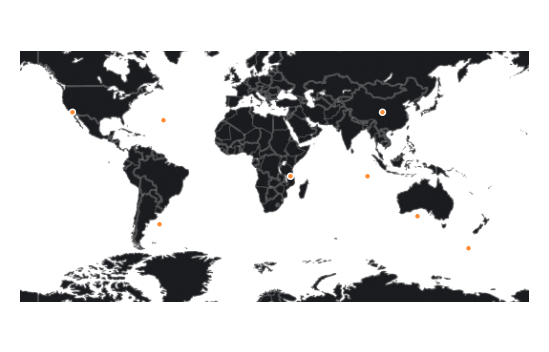
LOCATION ANALYSIS
TALENT MARKET INSIGHTS

CAREER PATHS
DATA INTEGRATION
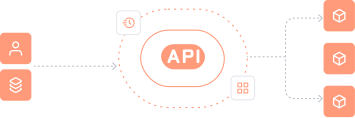
TECH STACK

The image is for representational purpose only.
01
Global Compensation Benchmarking
Conducted structured benchmarking of compensation models across semiconductor and big-tech peers, covering base salary architecture, RSU vesting schedules, bonus structures, ESPPs, and region-specific statutory benefits to assess competitiveness and cost alignment.
02
Competitor Talent Intelligence Analysis
Mapped manufacturing and R&D workforce distribution across key competitors, analyzing supervisor-to-worker ratios, diversity composition, shift models, role taxonomy, and stock/bonus allocation patterns to strengthen workforce planning decisions.
03
Performance & Leadership Framework Assessment
Evaluated peer performance management systems, grading structures, feedback cycles, and leadership development pathways to align internal capability-building initiatives with digital transformation and fab expansion priorities.
04
Hybrid & Work-From-Anywhere Policy Benchmarking
Benchmarked evolving hybrid mandates and WFA models across leading firms, assessing office attendance enforcement, cross-border limitations, compliance risks, and flexibility positioning to inform a balanced, future-ready workforce strategy.
Outcome
6,100+
Locations
4M+
Career Paths
1.7M+
Peer Group Companies
28K+
Skills
3,500+
Roles
1B+
Professionals
55K+
Universities
1B+
Job Descriptions
200K+
Courses
180K+
Technology Solutions
1.6M+
Account Priorities
Labor Market Data Contextualized with Business Intelligence for Every Decision
Analyzing 1B+ data points daily from 100K+ sources
6,100+
Locations
4M+
Career Paths
1.7M+
Peer Group Companies
28K+
Skills
3,500+
Roles
1B+
Professionals
55K+
Universities
1B+
Job Descriptions
200K+
Courses
180K+
Technology Solutions
1.6M+
Account Priorities

.svg)




.svg)
