


Workforce Planning and Talent Defense Across Global and European Markets
Discover how Draup enabled a unified view of global talent supply, skill evolution, competitor positioning, talent flow, and emerging competitive threats across a complex, multi-function workforce spanning four continents.
~67000
Employees
$20B
Revenue
Health Technology / MedTech
Industry
Amsterdam, Netherlands
Headquarters
About the organization
A global health technology enterprise operating across imaging, diagnostics, patient monitoring, and personal health solutions with a large, specialized commercial and clinical workforce across the United States and key global markets. Its Clinical Education and Training function plays a central role in supporting healthcare professionals, field sales teams, and clinical specialists, making talent quality and org design within this function strategically important.
The Core Challenges
Cross-Functional Skill Visibility
The organization sought a structured, unified view of skill evolution spanning traditional, continuing, and emerging skill clusters across five workforce personas to inform both hiring priorities and reskilling investment.
Location Strategy and Hiring Difficulty
Evaluating focused hiring locations demanded more than headcount data. The organization needed multi-dimensional scoring across growth rates, attrition, demand-supply ratios, cost of living, gender diversity, and compensation benchmarks.
Talent Flow and Attrition Risk
Key roles including Software Development Engineer and Software Technologist had seen elevated attrition in India, with talent transitioning to peers in healthcare technology, enterprise IT, and industrial technology sectors — creating a need for clearer visibility into movement patterns to inform retention and sourcing decisions.
Emerging Competitive Threat in Europe
A key competitor recorded 21% workforce growth and 94% revenue growth in H1 2025, actively hiring across 16 European countries with lateral hires predominantly drawn from the organization — underscoring the urgency of a structured competitive intelligence view.
The Solution
DevOps Engineer

PROFILE

LOCATION ANALYSIS
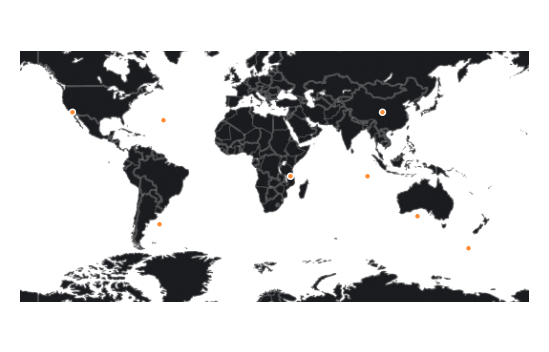
TALENT MARKET INSIGHTS

CAREER PATHS
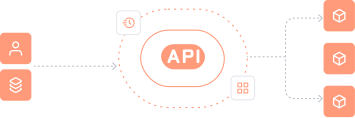
DATA INTEGRATION
TECH STACK

The image is for representational purpose only.
01
Skill Taxonomy & Workforce Architecture
Job role taxonomies were built across five Tech functions — Software Engineering, IT, AI & Data Science, Product Engineering, and R&D — plus Marketing & E-commerce and Quality & Regulatory. Skills were classified as declining, continuing, or emerging based on 2022–2025 CAGR analysis, with Cybersecurity and DevOps as the fastest-accelerating traditional skills and Generative AI and Agentic AI as rising peer priorities.
02
Global Hotspot and Location Analysis
Using a 1B+ profile database, hotspots were scored on installed talent, growth rate, attrition, and hiring difficulty. India ranked as the strongest tech hiring location; Pune and Belo Horizonte as the highest-favorability markets. Bangalore and Boston were flagged for elevated demand-supply pressure despite their pool size.
03
Multi-Persona Competitor Benchmarking
Eight peers across the MedTech and health technology landscape were benchmarked on installed talent, growth rates, in-demand roles, and skill trajectories. Software Development Engineer and Technologist roles in India recorded the highest attrition; Field Service Engineer and System Engineer roles in the US recorded net gains.
04
European Competitive Landscape Analysis
A fast-growing imaging competitor’s 300-strong European workforce was profiled across function splits, hiring demand, and expansion strategy across 16 countries. Of 40 professionals sourced laterally from leading MedTech companies, 17 came directly from the organization — with an EVP comparison confirming stronger positioning on stability, governance, career resilience, and ecosystem breadth.
Outcome
6,100+
Locations
4M+
Career Paths
1.7M+
Peer Group Companies
28K+
Skills
3,500+
Roles
1B+
Professionals
55K+
Universities
1B+
Job Descriptions
200K+
Courses
180K+
Technology Solutions
1.6M+
Account Priorities
Labor Market Data Contextualized with Business Intelligence for Every Decision
Analyzing 1B+ data points daily from 100K+ sources
6,100+
Locations
4M+
Career Paths
1.7M+
Peer Group Companies
28K+
Skills
3,500+
Roles
1B+
Professionals
55K+
Universities
1B+
Job Descriptions
200K+
Courses
180K+
Technology Solutions
1.6M+
Account Priorities

.svg)




.svg)
