


Work Redesign Framework
for the AI Era
A Strategic Guide for Enterprise HR Leaders
By filling up this form, you agree to allow Draup to share this data with our affiliates, subsidiaries and third parties


The Workforce Disruption Is Already Here
The question is no longer whether AI will reshape work. The question is whether your organization will redesign work deliberately or be forced into reactive decisions under cost and time pressure.
This framework provides a structured approach for enterprise HR and Strategic Workforce Planning leaders to move from role-based staffing reactions to task-based, financially grounded workforce design.
The transformation is already underway, and the gap between leaders and laggards is widening:
Yet most organizations lack the systematic approach required to navigate this transformation. Work redesign provides the methodology to move from reactive headcount adjustments to deliberate, AI-ready workforce architecture, preserving judgment and accountability while unlocking productivity and cost advantages.
What Is Work Redesign?
Work redesign is the systematic, task-level evaluation of how work is performed, identifying where AI can automate, augment, or amplify human contribution, while preserving accountability, quality, and trust.
However,
- Work redesign is not synonymous with headcount reduction. It also includes reskilling, upskilling, and role evolution.
- Work redesign should begin with workloads and tasks, not skills alone, because skills only create value in context.
This task-first view is increasingly echoed in external guidance: Singapore’s “Guide to Job Redesign in the Age of AI” emphasizes that AI transforms jobs task-by-task and encourages a human-centric redesign paired with reskilling.
The Three Dimensions of Work Redesign
Automate
Augment
Amplify
External evidence supports why augmentation and amplification matter. Field experiments and controlled studies repeatedly show that generative AI can lift productivity and quality in specific task contexts, often with uneven effects across skill levels.
These three dimensions- automate, augment, amplify, form the foundation of systematic work redesign. But understanding the framework is only valuable if organizations recognize the urgency: the gap between AI potential and realized value is widening, and the window for deliberate action is narrowing.
Why Work Redesign Matters Now
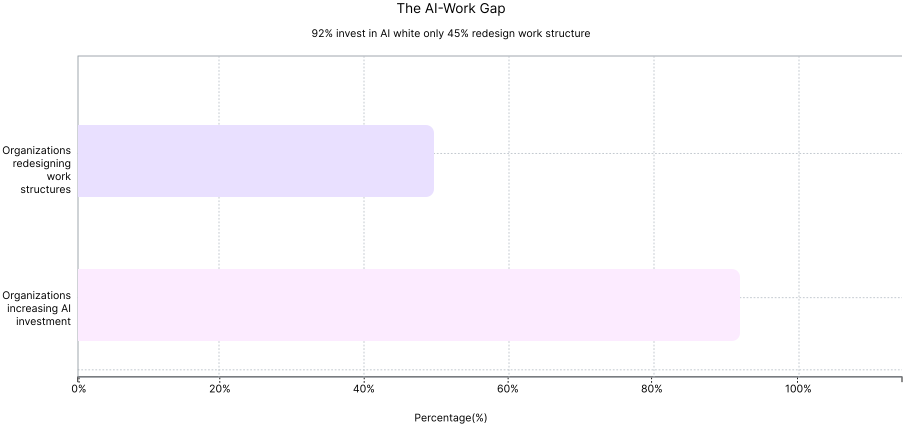
Across industries, adoption is rising, but value realization is inconsistent. McKinsey’s 2025 global survey on AI emphasizes that the value comes from “rewiring” how companies run, and that workflow redesign has the biggest effect on whether organizations see EBIT impact from generative AI.
At the same time, most organizations have not yet done the hard work of redesigning workflows. Only a minority of respondents reporting gen AI use say their organizations have fundamentally redesigned at least some workflows.
That gap is exactly where work redesign becomes a CEO, CFO, and CHRO priority: it is the mechanism that converts AI tools into repeatable operating model gains, without eroding accountability and trust.
The AI Work Redesign Productivity Gap
Three forces are widening the gap between AI potential and realized outcomes:
Organizations approaching AI through work redesign are more likely to exceed ROI expectations (source).
Work Redesign: Traditional vs. AI-Era Approaches
Traditional optimization typically starts with roles and skills. AI-era redesign starts with work. Starting at the skill level is a common failure mode, and that redesign must start at workload and task level.
In practice:
- Traditional approach: skills mapping and role rationalization, often treated as a one-time transformation.
- AI-era approach: workload decomposition, task interaction design, and continuous refresh cycles as AI capability and operating models evolve.
This logic is also consistent with broader “work deconstruction” thinking in the future of work literature: leaders need to deconstruct jobs into tasks and recompose work across humans and machines to unlock productivity.
Understanding the difference between traditional and AI-era approaches clarifies what must change. The next step is knowing how to execute that change systematically. Our 8-step methodology translates this conceptual shift into a repeatable, measurable process that moves from work visibility to workforce impact.
Work Redesign Methodology: 8-Component Framework
STEP-BY-STEP WORK REDESIGN METHODOLOGY
From Work Visibility to Measurable Workforce Impact
Purpose:
To systematically redesign roles, tasks, and skills for the AI era by combining task-level work decomposition, AI feasibility analysis, and financial impact modeling ensuring productivity gains without eroding judgment, quality, or trust.
Establish the Work Baseline (Role → Workload → Task Decomposition)
Objective:
Reveal the true shape of work beyond job descriptions
Key Activities:
- Ingest existing job descriptions as-is (no rewriting upfront)
- Add additional documents: process maps, presentations around future vision
- Map each role into: core responsibilities, underlying workloads, discrete tasks
- Normalize roles against a standardized role taxonomy for comparison and benchmarking
Outputs:
Baseline workload distribution, Role-task-skill inventory, Traceability from role → workload → tasks → skills
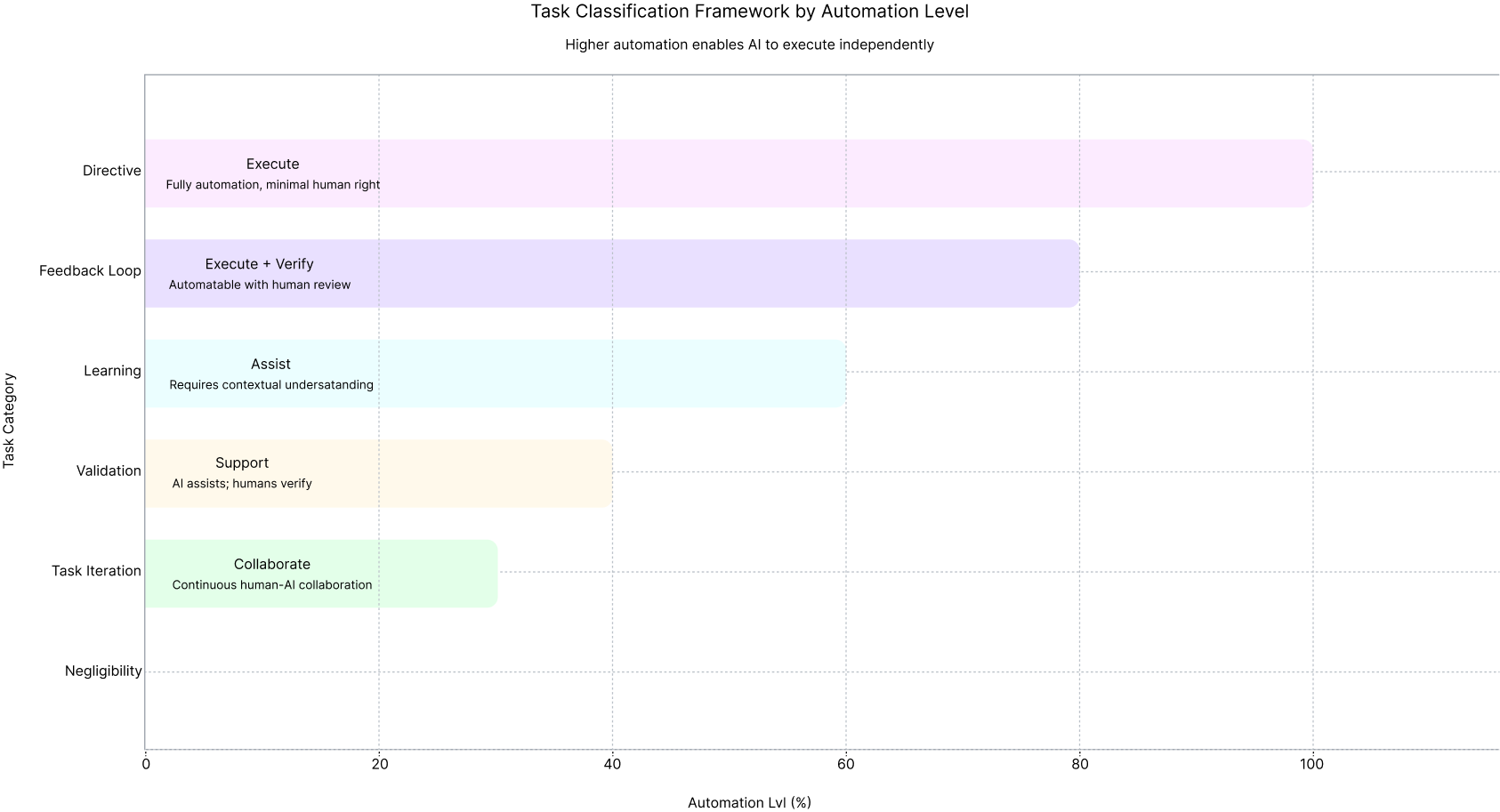
Classify Tasks by AI Interaction Model
Objective:
Determine how AI should interact with each task, not whether AI replaces the role
Task Classification Framework:
Outputs:
Task-level automation and augmentation map, Clear separation of execution/judgment/strategic tasks
Identify the "Balanced Zone" for Each Role
Objective:
Define the optimal operating model where AI amplifies human impact
Three Risk Zones:
Balanced Zone Design Principles:
- Automate volume, not responsibility
- Augment analysis, not accountability
- Preserve human decision rights for ethics, trade-offs, communication, stakeholder impact
Outputs:
Target operating model by role, Clear division of AI vs. human ownership
Quantify Impact at the Task and Role Level
Objective:
Translate work redesign into measurable outcomes
Impact Metrics:
- Automation Coverage (% of tasks touched by AI)
- Efficiency Gain (metrics impacted)
- Productivity Multiplier (output amplification)
- Human Expertise Focus (% time on high-value work)
- AI Quantification Score (composite readiness & impact score)
Outputs:
Role-level AI impact profiles, Prioritized roles for transformation
Scenario Modeling & Adaptive Planning
Objective:
Test different futures before committing to an investment
Scenario Levers:
- Degree of automation vs. augmentation
- Technology maturity assumptions
- Changes in operating model or demand
- Skill availability constraints
Outputs:
Comparative automation mix, Efficiency and capacity deltas, Workforce sensitivity analysis
Financial Translation (From Productivity to ROI)
Objective:
Convert work redesign into CFO-grade metrics
Work Redesign ROI: How to Calculate Returns
Where:
Organizations report >$20B potential workforce ROI over 3-4 years for large enterprises (source).
Financial Modeling:
- Cost savings from automation
- Capacity redeployment scenarios
- Headcount impact over time
- Productivity-driven value creation
Key Principle:
Productivity without financial translation is insight not impact
Outputs:
Multi-scenario ROI projections, Decision-grade investment views

Skills & Capability Recomposition
Objective:
Align skills to redesigned work, not legacy roles
Approach:
- Anchor skills analysis to future-state roles
- Segment skills into: Root Skills, Core skills, Digital/Tech stack skills, Soft & judgment skills
- Identify: Sunset core skills, Sunrise core skills, Skill adjacency opportunities
Outputs:
Dynamic skills architecture, Role-based skill evolution maps, Targeted upskilling pathways

Operationalize Through Future-State Job Definitions
Objective:
Make work redesign executable across HR and business systems
Deliverables:
- AI-ready future-state job descriptions
- Embedded task changes and AI enablement
- Explicit skill requirements aligned to redesigned work
Why it matters:
Work redesign only scales when embedded into hiring, workforce planning, talent mobility, and reskilling programs
The Cost of Delaying Work Redesign
Organizations postponing work redesign face compounding risks:
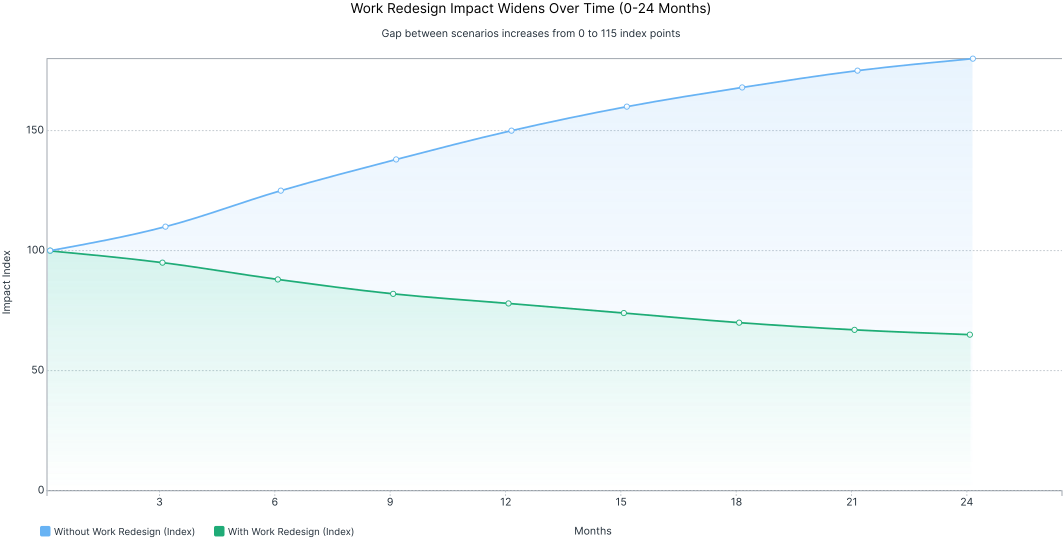
These risks make the case for urgency. But urgency without execution capability leads to rushed, reactive decisions. That's where Our platform infrastructure becomes essential: we operationalize the 8-step methodology through purpose-built models, live data, and CFO-grade analytics that turn framework into execution.
How Draup Enables Work Redesign at Scale
Draup operationalizes the 8-step work redesign methodology through three core platform capabilities:
Intelligent Work Decomposition
Purpose:
Automates the translation of roles into workloads, tasks, and AI interaction models
Key Models:
- Job Role to Metrics Model - Converts job descriptions into benchmarkable KPIs and normalizes roles against standardized taxonomies
- Workload Intelligence Model - Classifies tasks across 6 AI interaction categories (Directive, Feedback Loop, Learning, Validation, Task Iteration, Negligibility)
- Balanced Zone Analytics - Models optimal AI-human split to avoid over-automation and under-utilization
Impact:
25-30% of routine tasks identified for automation, median task time savings near 80% for automatable work
CFO-Grade Financial Translation
Purpose:
Converts productivity insights into boardroom-ready ROI models (Steps 4-6)
Key Models:
- AI Impact Model - Quantifies time savings and efficiency gains through pre/post-AI dashboards
- Financial Simulation Engine - Models cost savings, capacity redeployment, and headcount impact over time
- Scenario Planning Platform - Tests multiple futures before investment with 30-40% faster planning cycles
Impact:
>$20B potential workforce ROI over 3-4 years for large enterprises
Skills-to-Execution Bridge
Purpose:
Translates redesigned work into executable hiring, mobility, and reskilling programs.
Key Models:
- Skills Architecture Framework - Maps Root Skills, Core Skills, Digital/Tech Stack, and Soft/Judgment Skills to redesigned workloads
- Similar Role Model - Detects skill adjacencies and quantifies reskilling effort with 25% reduction in skills mismatch
- Role Ecosystem Model - Generates AI-ready future-state job descriptions with 40% reduction in redundant roles
Impact:
Job-profile update cycle time from months to days, up to 50% TA cost reduction
The Data Advantage
Real-Time Intelligence Foundation:
- 25M+ data points analyzed daily from 75,000+ sources
- 850M+ professionals, 1.5M+ companies, 12K+ skills, 4M+ career paths
- Near real-time refresh vs. static datasets
Draup’s 3 Platform Capabilities for Work Redesign
Comprehensive framework from decomposition to execution
Intelligent Work Decomposition
(Steps 1-3)
- Job Role to Metrics Model
- Workload Intelligence Model
- Balanced Zone Analytics
Impact:
25-30% tasks identified for automation
CFO-Grade Financial Translation
(Steps 4-6)
- Al Impact Model
- Financial Simulation Engine
- Scenario Planning Platform
Impact:
>$20B potential ROI (large enterprises)
Skills-to-Execution Bridge
(Steps 7-8)
- Skills Architecture Framework
- Similar Role Model
- Role Ecosystem Model
Impact:
25% skills mismatch reduction
Work Redesign as Strategic Capability
When work redesign is done systematically, organizations reduce execution risk, align workforce strategy with business reality, and move from reactive staffing to deliberate, future-ready workforce design.
With 170 million new jobs emerging by 2030 alongside 92 million displaced roles Weforum, the organizations treating work redesign as a continuous operating discipline will capture disproportionate advantages in productivity, talent retention, and competitive positioning.
We help enterprise HR leaders move work redesign from experimentation to execution through our systematic Five-Component Approach, from understanding the true shape of work through task decomposition to financial simulation and operational translation. By analyzing 25M+ data points daily from 75,000+ sources Draup, we provide the real-time intelligence and CFO-grade financial modeling that transforms work redesign from a theoretical exercise into a measurable business outcome.
For CHROs and workforce planning leaders, this means gaining control over the pace, shape, and impact of AI-driven change, not just optimizing for efficiency, but designing how work, technology, and human judgment interact for sustainable competitive advantage.

.svg)




.svg)
