


A Strategic Framework
From Sunset to Sunrise
for Rethinking Skills Across Core Business Functions
By filling up this form, you agree to allow Draup to share this data with our affiliates, subsidiaries and third parties


The Executive Case for Skills Transformation
- Skills volatility is structural, not cyclical. Employers expect 39% of workers’ core skills to change by 2030 WEF
- Automation is shifting the anatomy of work across functions. McKinsey estimates that current generative AI and other technologies could automate work activities that absorb 60%–70% of employees’ time.
- Adoption is outpacing readiness, especially in talent. Bain reports 95% of US companies are using generative AI, up 12 percentage points in just over a year.
- Value capture is uneven—and the differentiator is capability. BCG finds only 5% of firms are “AI-future built,” while 60% are seeing minimal value despite investment.
Understanding the Sunrise vs. Sunset Skills Framework
Translating Business Strategy into Talent Capability
We use sunrise vs sunset skills as an operating model translation layer between strategy and talent:
- If strategy moves to platforms, recurring revenue, data products, ecosystem partnerships, then commercial capability shifts toward analytics, digital engagement, and strategic partnering.
- If operations move to automation, AI augmentation, cloud platforms, then digital capability shifts toward AI/ML integration, data orchestration, cloud-native architecture, while routine and legacy work declines.
- If risk expands from physical to cyber and regulatory + sustainability pressures rise, then finance, procurement, engineering, and GBS each see a measurable sunrise in analytics, ESG, secure-by-design practices, and process digitalization.
Functional Deep-Dive: Where the Skills Shift is Happening
Commercial: From Transactional Selling to Digital Growth
What’s changing
Commercial organizations are shifting from transactional selling and static pricing toward digital customer engagement, dynamic pricing, ecosystem partnerships, and analytics-driven growth, with stronger emphasis on human strengths like analytical thinking and creativity.
Market signal: Gartner states 80% of B2B sales interactions between suppliers and buyers will occur in digital channels by 2025.
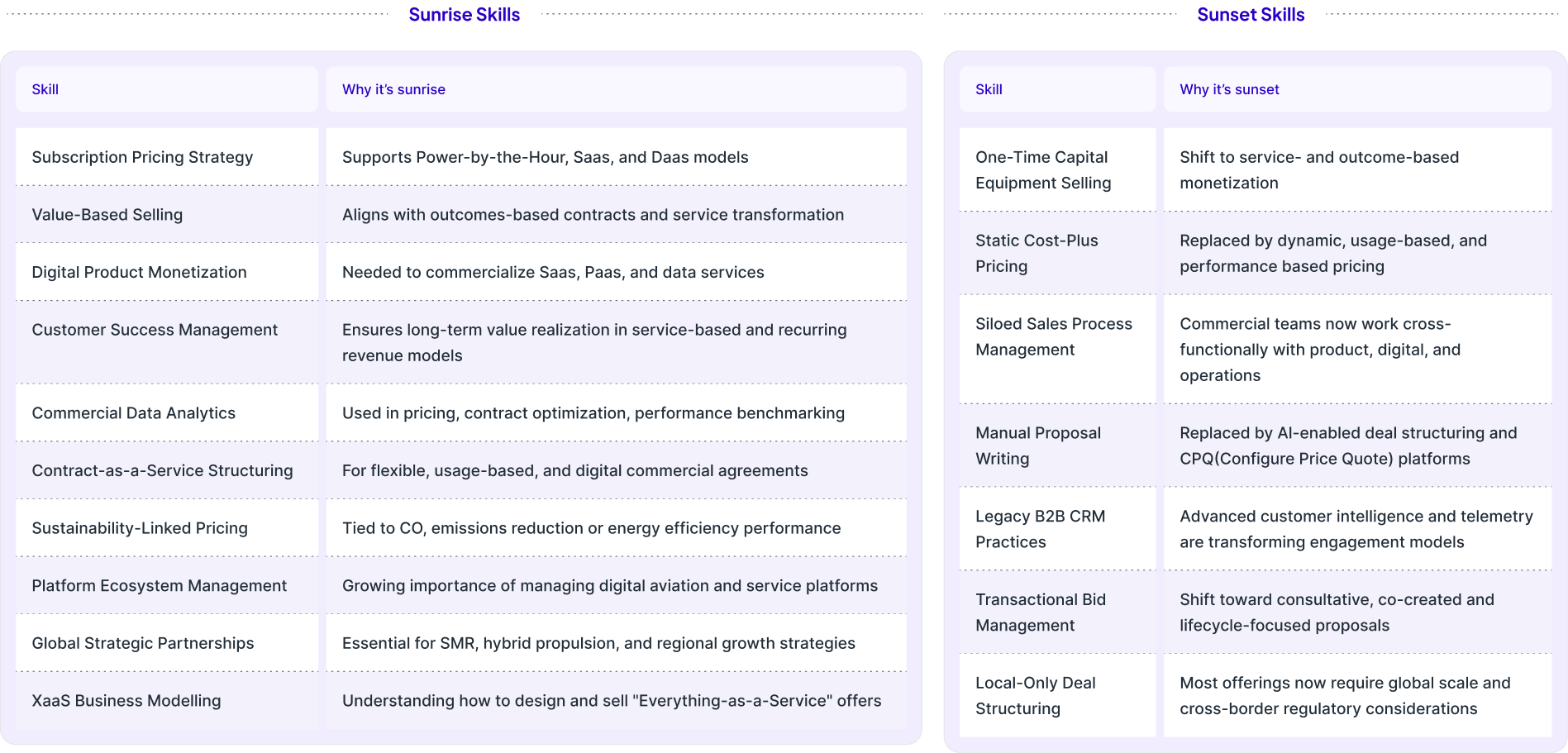
Sunrise skills we should prioritize
- Dynamic pricing and revenue analytics
- Digital customer engagement tools
- Strategic partnership management
- Advanced contract structuring
- Consultative sales leadership
Sunset skills we should redesign or automate
- Manual pricing and forecasting
- Transactional selling
- In-person only customer interactions
- Sales support tasks prone to automation
What to do next
- Treat pricing and commercial analytics as product capabilities, not just sales support.
- Rebuild customer-facing roles around digital-first engagement + consultative value.
- Update career paths so “commercial excellence” includes data literacy and contract intelligence as baseline expectations.
Digital: Shifting from Maintenance to Orchestration and AI
What’s changing
Digital functions are moving from support and maintenance to innovation, orchestration, and security. The sunrise is driven by AI/ML, cloud, real-time data, and automation; the sunset is driven by shrinking need for legacy systems management and routine IT support.
Adoption signal: Everest Group reports nearly 83% of global enterprises are either actively piloting or have adopted generative AI for production use cases.
Sunrise skills we should prioritize
- AI and machine learning integration
- Real-time data orchestration
- Cloud-native architecture and services
- Digital twin simulation platforms
- Cybersecurity and network resilience
- DevOps and automation engineering
Sunset skills we should redesign or automate
- Legacy systems management
- Routine IT support
- Skill silos (e.g., isolated DB admin, testing, support roles without automation)
What to do next
- Build “digital” capability around platform thinking: data orchestration, cloud-native delivery, automation.
- Shift from role-based planning to skills clusters (AI/ML + data + security + DevOps) to prevent silo decay.
- Align with McKinsey’s point that automation will reshape work activities at scale: 60%–70% of employee time is in scope for automation potential.
Engineering & Security: The Rise of Software-Defined Systems
What’s changing
Engineering is shifting from a predominantly mechanical orientation to software-defined systems, embedded AI, electrification/green tech, and security-by-design.
Sunrise skills we should prioritize
- Model-Based Systems Engineering (MBSE)
- Embedded AI and autonomous systems
- Electrification and green-tech engineering
- Cybersecurity engineering and secure-by-design
- Integrated safety engineering
- Additive manufacturing and rapid prototyping
Sunset skills we should redesign or augment
- Purely mechanical engineering skill sets
- Manual drafting and 2D CAD
- Isolated electrical/electronic skills
- Reactive cybersecurity practices
What to do next
- Treat security as a design input, not a downstream audit function.
- Make MBSE and embedded intelligence foundational for product teams building complex systems.
- Align engineering career development with cross-domain fluency (mechanical + software + safety + cyber).
Finance: Moving from Reporting to Strategic Decision Support
What’s changing
Finance is shifting from transaction-heavy work toward strategy, forecasting, and decision support, with technology absorbing many legacy activities.
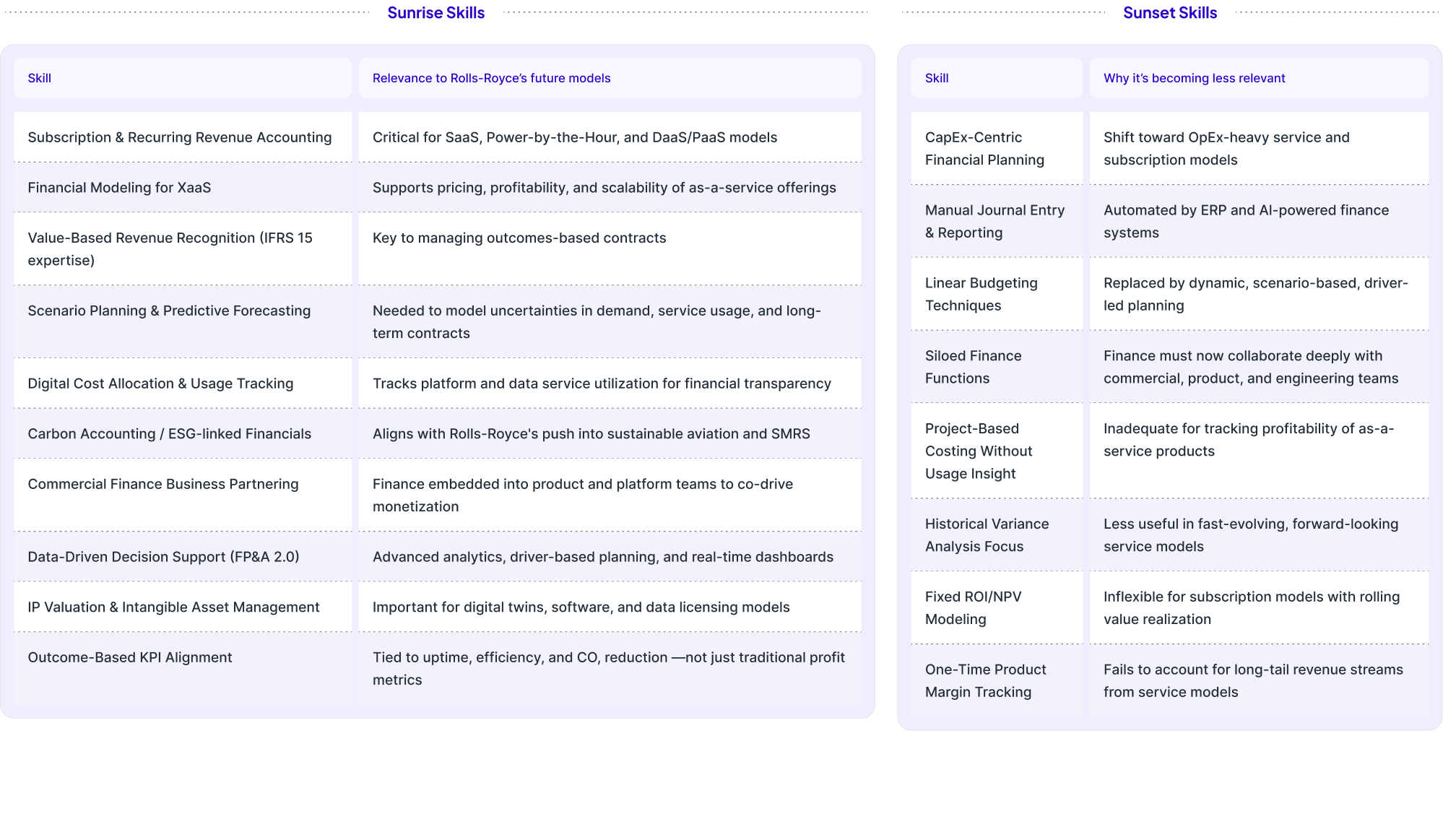
Sunrise skills we should prioritize
- Advanced financial modeling and scenario planning
- Digital finance automation
- ESG and sustainable finance
- Risk and performance analytics
- Real-time performance monitoring
- Strategic business partnering
Sunset skills we should redesign or automate
- Manual transaction processing
- Basic accounting in isolation
- Traditional report compilation
- Single-domain financial specialties
- Legacy finance software operation
What to do next
- Shift FP&A toward scenario-based, driver-led planning and real-time performance management.
- Build ESG finance capability as more than reporting—tie it to capital allocation and risk.
- Redesign close/reporting work by default through automation and redeploy capacity into strategic partnering.
Procurement: Building Resilient, Digital Supply Networks
What’s changing
Procurement is evolving beyond cost control toward resilience, digital traceability, and sustainable supply networks.
Sunrise skills we should prioritize
- Supply chain digitalization and analytics
- Blockchain and IoT supply tracking
- Supplier ecosystem management and collaboration
- Agile and lean operations
- Sustainable and circular supply chain practices
- Advanced logistics planning
Sunset skills we should redesign or avoid over-investing in
- Single-sourcing and rigid just-in-time models
- Low-tech sourcing practices (manual RFQs without digital tools or supplier analytics)
What to do next
- Build procurement capability around network intelligence (supplier ecosystems + digital traceability).
- Formalize sustainability skills as operational requirements (circularity, traceability, compliance).
- Make analytics and collaboration “day one” expectations for category roles.
Global Business Services (GBS): Optimizing Experience via Hyper-Automation
What’s changing
GBS is shifting from standardized service delivery toward hyper-automation, AI-enabled service design, analytics, and experience optimization.
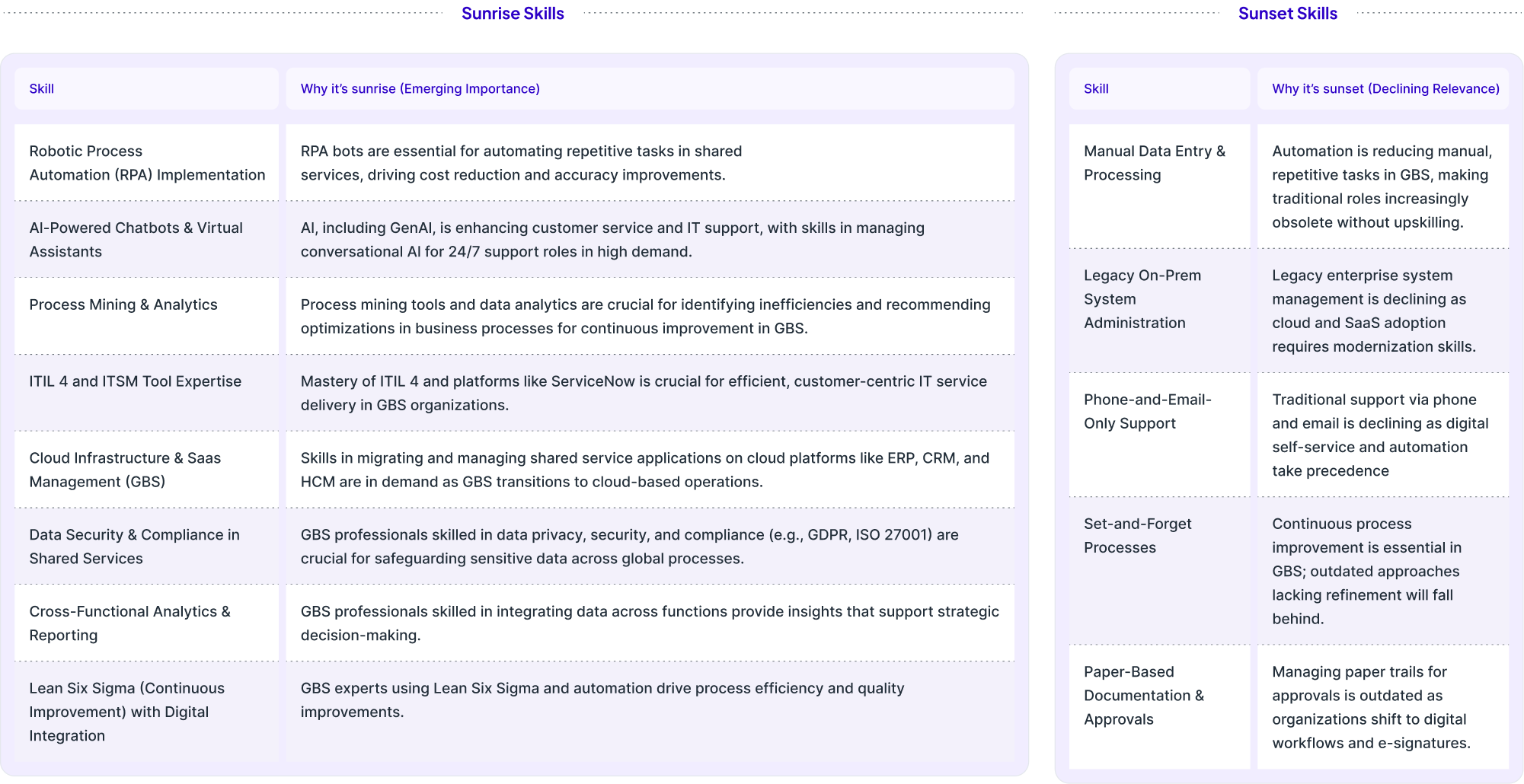
Sunrise skills we should prioritize
- Hyper-automation and RPA
- AI-enabled service design
- Data analytics and process mining
- CX/EX optimization
- Global process leadership
- Multilingual and cross-cultural skills
Sunset skills we should redesign or automate
- Scripted call handling
- Single-process roles without tech integration
- Manual report creation
- Language-only roles (translation without automation)
What to do next
- Rebuild GBS roles around exception handling, analytics, automation governance, and experience outcomes.
- Treat process mining and RPA as core capabilities—not specialist teams that sit at the edges.
- Create multilingual capability where needed, but prioritize digital enablement over translation-only scaling.
The Cross-Functional Pattern: Core Skills for 2030
Across all six functions, the sunrise skills consistently cluster around:
- Analytics and decision support (commercial, finance, procurement, GBS)
- Automation + AI augmentation (digital and GBS especially)
- Sustainability and ESG (finance and procurement)
- Security and resilience (digital and engineering)
This is why we treat “skills transformation” as a core operating model program, not an HR-only initiative.
The Playbook:
5 Steps to Execute a Skills-First Strategy
This playbook is designed to translate sunrise/sunset insights into concrete action across functions—without waiting for the next org redesign cycle.
Step 1: Map Skills to Business Model Shifts
For each function, name the operating model changes driving the shift (e.g., recurring revenue, digital channels, automation). Then map which skills are sunrise vs sunset using the function lists above.
Step 2: Prioritize Workflows Over Role Labels
Role labels lag reality. We get better fidelity by mapping:
Workflows → tasks → skills
This is also how we run skills-first talent decisions in our platform: we convert job requirements into the real work, deconstruct tasks into capabilities, and expand to adjacent skills and titles that deliver the same outcomes.
Step 3: The Build, Buy, Borrow, or Automate Decision
For each sunrise skill, choose a path:
- Build (reskill / upskill)
- Buy (hire)
- Borrow (partners / contractors)
- Automate (remove the work, not just the people)
Step 4: Redesigning Sunset Work to Unlock Capacity
Sunset doesn’t always mean “remove.” In finance, for example, many sunset skills are being absorbed into automated systems or centralized—freeing people for higher-value work.
Use the same logic in every function: automate repeatable tasks, then redeploy talent into sunrise capabilities.
Step 5: Measuring Skills Movement as a Transformation KPI
Track:
- Share of priority roles with validated sunrise skills
- Time-to-proficiency (learning velocity)
- Productivity release from automation
- Internal mobility into sunrise roles
Operationalizing the Framework with Draup
We designed our platform to support skills-first decisions with evidence and structure:
- We surface verified capabilities and adjacent skills in our profiles, along with mobility signals and real career trajectories.
- We model the work behind the role (role → workloads → tasks), then translate tasks into skills, licenses, and certifications, and expand to adjacent skills and titles that deliver the same outcomes across functions.
- We unify and clean profile data across multiple sources and break jobs down to workloads, tasks, and skills for deeper analysis; skills and career history are validated to reduce noise.
- We’re trusted by 5 of the Fortune 10.
(We recommend using this operating model—work → tasks → skills—to connect the sunrise/sunset framework to hiring, L&D, and internal mobility motions.)

.svg)




.svg)
