


Reimagining Talent Density
A Skills-Centric Framework for the AI Age
By filling up this form, you agree to allow Draup to share this data with our affiliates, subsidiaries and third parties


Executive summary
AI is reshaping work at scale, and the economic stakes are significant. McKinsey estimates generative AI could add $2.6T–$4.4T annually to the global economy. Yet as organizations pursue value, they are hitting a familiar constraint: skills visibility and skills readiness.
Gartner data underscores the gap:
- 41% of HR leaders agree their workforce lacks required skills. Gartner
- 50% agree their organization does not effectively leverage skills. Gartner
- Only 8% report having reliable data on current workforce skills and the skills that most impact business success. Gartner
- 85% of business leaders agree the need for skills development will dramatically increase in the next three years due to AI and digital trends. Gartner
This is exactly why we redefine “talent density” for the AI age. The legacy approach to talent density, often prioritizes hiring and retaining only top-tier performers. While this approach has merits in elite innovation contexts, it fails to scale across enterprise functions, especially in a world where AI is reshaping work.
In this whitepaper, we propose a skills-centric interpretation of talent density that focuses on AI readiness, task-level recomposition, and role-based skill evolution.
Why Legacy Talent Density Models Fail in an AI-Driven Economy
The legacy approach to talent density often prioritizes “hiring and retaining only top-tier performers.”
That logic can under-serve enterprise transformations where:
- Work is being decomposed into tasks,
- Tasks are being automated or augmented,
- Roles are being recomposed,
And workforce advantage depends on how quickly skills shift at scale.
We see this dynamic playing out in independent research on capability expansion. For example, the BCG Henderson Institute reports GenAI can materially improve performance even outside a worker’s existing skillset, noting consultants achieved up to a 49 percentage point improvement on complex tasks beyond their prior capabilities in an experiment.
Implication: the new unit of analysis is not just the individual “A player.” It is the role’s workload, the tasks within it, and the skills required to execute those tasks in a human–AI workflow.
Defining Talent Density for the Future of Work
Draup defines Skill Density as the concentration of high-impact, future-ready skills within a specific role, team, or function. These skills are not static but evolve in response to:
- Advances in automation and AI
- Changes in business models (e.g., shift to SaaS or outcome-based models)
- Workflow transformation across industries
Example: A finance team may not need only CPAs with 20 years' experience, but instead analysts proficient in SaaS metrics, Excel automation, and AI-based forecasting tools.
How Draup defines Talent Density
Definition: Talent Density is the measure of an organization’s concentration of AI-ready, future-relevant skills across roles, teams, and functions.
This definition is designed to support transformation programs where leaders need to answer:
- What work is changing?
- Which parts of work are automatable vs augmentable vs human-led?
- Which skills determine readiness to operate (and validate) AI-assisted workflows?
- How much of the workforce can move through adjacency vs full reskilling?
The Draup Talent Density Framework: From Data to Strategy
Our framework is built as a layered model that connects work, skills, and AI exposure, then maps that against workforce inventory and mobility.
Role Taxonomy & Workload Maps
Skills Architecture
AI Task Exposure Database
Talent Flow Graphs & JD Intelligence
Core layers
- Role Workload Layer
Decompose each job into tasks and responsibilities, powered by our Role Taxonomy & Workload Maps.
- Skill Mapping Layer
Map each task to root, core, and emerging skills, powered by our Skills Architecture.
- AI Exposure Layer
Assess tasks for automation, augmentation, or human judgment, powered by our AI Task Exposure Database.
- Talent Inventory Layer
Measure current employee skills and adjacent skill mobility, powered by our Talent Flow Graphs & JD Intelligence.
Leveraging Data Assets: Role Taxonomies and AI Task Exposure Databases
We anchor the framework in our datasets so you can move from conceptual alignment to measurable metrics.
Our data assets include:
- Role Taxonomy and Workload Maps that deconstruct 6,000+ roles into task clusters.
- Skills Architecture that categorizes skills into root, core, and emerging layers.
- AI Task Exposure Database labeling tasks as automatable, augmentable, or human-led (Etter).
- Talent Flow & Adjacency Graphs mapping role mobility and reskilling pathways.
- Enterprise Benchmarks enabling industry and peer talent density scoring.
- Job Description Intelligence capturing real-world skill demand signals.
- Learning Ecosystem Mapping connecting skill gaps to learning solutions.
- Etter-based Workload Simulations predicting skill shifts and human-AI task orchestration.
Why this matters now: Forrester’s High-Performance IT survey indicates that business and technology professionals most frequently cite problem-solving (36%), innovation (33%), and cybersecurity (32%) among the most important skills for success—illustrating how “future-ready” skills span technical, cognitive, and leadership domains.
Quantifying Readiness: 4 Essential Metrics for the AI Era
We designed our raw data to help you develop role- and function-level metrics.
The four metrics we recommend starting with
% of workforce that can shift roles with <20% reskilling
Why these metrics are board-relevant:
Bain reports material productivity movement already exists in targeted use cases. For example, Bain’s July 2024 survey of US financial services firms found respondents seeing an average 20% productivity gain across uses. Bain also notes that 57% of surveyed software engineers anticipate 20% or better productivity gains from GenAI use cases over the next two years.
Those gains aren’t “free.” They require operating-model change, task recomposition, and workforce readiness—exactly what SDI, RRS, TDS, and reskilling propensity are designed to quantify.

The Talent Density Heatmap: Prioritizing Workforce Interventions
A simple interpretation model helps leaders understand what to prioritize:
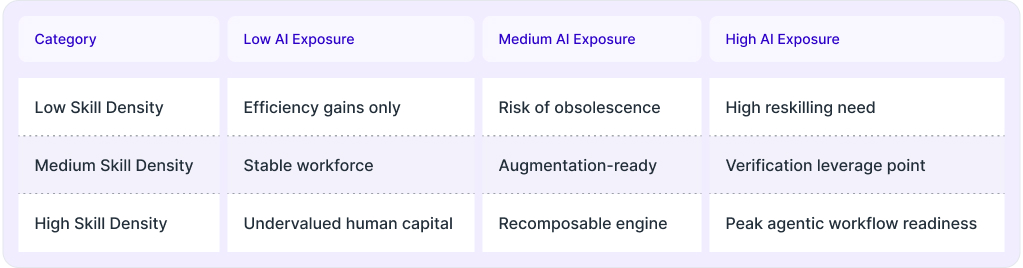
This visualization matrix is part of our framework.
How to use it (in practice):
- Start where business value and AI exposure intersect (medium/high AI exposure roles).
- Use SDI to identify whether readiness is primarily a skills gap.
- Use RRS to identify whether role work can be recomposed quickly with augmentation and task shifts.
Use Reskilling Propensity to determine whether to pursue adjacency moves or deeper reskilling.\
Draup Data Assets That Power Talent Density Modeling
We operationalize the framework in five steps:
- Role Decomposition: Break down high-priority roles into task clusters.
- Skill Overlay: Map each task to current and future skills.
- AI Task Mapping: Label tasks using our exposure scale.
- Workforce Mapping: Assess internal skill data vs our benchmarks.
- Intervention Planning: Design targeted reskilling strategies.
Research alignment: Gartner identifies “uncertainty about skills needs and assets” as a major barrier, noting only 8% of organizations have reliable skills data. Our workflow above is deliberately built to turn role/task granularity into measurable skills intelligence.
Applying talent density in workforce planning
We are explicit about what talent density is not: it is not a proxy for broad-based layoffs and replacement hiring.
Instead, workforce transformation can be more precise:
- Reassign tasks based on human–AI collaboration models
- Design reskilling pathways rooted in workload changes
- Identify roles where investments in recomposition yield the highest ROI
We position this as a surgical approach to workforce transformation, avoiding blunt tools of mass hiring or downsizing.
Talent density as a predictor of agentic workflow success
As organizations move toward “agentic AI” (software agents autonomously performing tasks), we tie talent density to three enabling capabilities:
- Verification capability: humans able to validate and refine AI outputs
- Workflow modularity: teams that understand workloads well enough to orchestrate automation
- AI governance fluency: broad understanding of how to guide AI responsibly
External context: BlackRock Investment Institute frames AI evolution in phases—buildout, adoption, and transformation—and anticipates moderate near-term productivity gains as AI reshapes specific tasks, with larger changes emerging as adoption and new business models scale
Our talent density approach is designed to help organizations move from adoption into transformation by making workforce readiness measurable at the task and skill level.
Conclusion: Making Workforce Transformation Measurable
Talent density, redefined through the lens of skill readiness and task-level agility, becomes a strategic asset for companies navigating AI transformation. With Draup’s Skills Architecture, organizations can stop guessing and start quantifying their workforce advantage.
Call to Action: Organizations looking to audit, benchmark, and enhance their talentdensity should partner with Draup to develop custom talent density models that reflect their unique operating models, transformation agendas, and human-machinecollaboration goals.

.svg)




.svg)
