


AI Transformation & Organizational Readiness Framework
A Self-Assessment Framework for Enterprise HR Leaders
By filling up this form, you agree to allow Draup to share this data with our affiliates, subsidiaries and third parties


The Urgency of Readiness:
Why Infrastructure is the New Constraint
As organizations embrace the promise of AI, HR leaders are at the center of a shift from traditional workforce management to skills-driven, AI-enabled talent ecosystems.
This guide provides a structured yet practical roadmap to assess readiness for AI transformation in the context of skills intelligence, job architecture, and workforce planning.
It is designed as a self-guided assessment to help HR teams and business leaders evaluate where they stand and what actions to take next using guiding questions, a simple 1-to-5 maturity scale, and space to record observations, next steps, and ownership.
Why readiness matters now
AI adoption is accelerating across enterprises, and HR operating models are expected to change materially as intelligent agents and LLM-centric interfaces mature. Gartner predicts that by 2030, 60% of HR work tasks will be completed through an intelligent agent or LLM-centric interface.
Meanwhile, McKinsey’s global survey found that 65% of respondents report their organizations are regularly using generative AI in at least one business function.
Everest Group reports that nearly 83% of global enterprises are actively piloting genAI or have already adopted it for one or more production-grade use cases (61% piloting; 22% deployed).
From a workforce lens, BCG reports three-quarters of workers believe GenAI will create some level of disruption, and 57% are willing to reskill.
Bain’s survey also indicates enterprise adoption is becoming widespread (e.g., 95% of U.S. companies using genAI, with production use cases doubling year over year in their findings).
These signals point to a common conclusion: readiness across data structure, ownership, context, systems integration, and change capability has become the practical constraint on scaling AI in HR.
Core Objectives: Building Your AI Transformation Roadmap
The outcome is a holistic, actionable readiness map HR leaders can use to align stakeholders, secure sponsorship, and plan AI transformation with confidence and clarity.
The Methodology: Five Pillars of Organizational AI Maturity
This framework is structured around five readiness pillars:
1
Foundation
How structured and accessible your talent and skills data are
2
Governance
Clarity of ownership, leadership sponsorship, and data stewardship
3
Workforce Context
Alignment of job/skills data to operating model, strategy, and learning pathways
4
Technology Readiness
HR systems and integrations required for AI-driven insights
5
Change Readiness
Leadership alignment, communication, and pilots to act on insights
Diagnostic Scoring: Measuring Your Path to Maturity
Use the 1–5 scoring scale consistently across each criterion:
1 = Not Started, 2 = Early Exploration, 3 = Partially Established, 4 = Well Implemented, 5 = Fully Mature & Stable.
AI Transformation & Organizational Readiness Assessment Framework
Pillar 1: Data Architecture & Foundations
What it evaluates: whether your job and skills data are structured, consistent, and accessible.
Why it matters: this is the groundwork for any AI or skills-intelligence initiative.
Guiding questions (score 1–5):
- Do we have a clear and complete job catalog (families, roles, profiles, descriptions)?
- Are job descriptions current, well-structured, and stored in one place?
- Do we have an internal skills inventory or taxonomy?
- Is the taxonomy mapped to a global/industry standard (e.g., ESCO or O*NET)?
- Is data stored in one place (in an HR system) and not in spreadsheets?
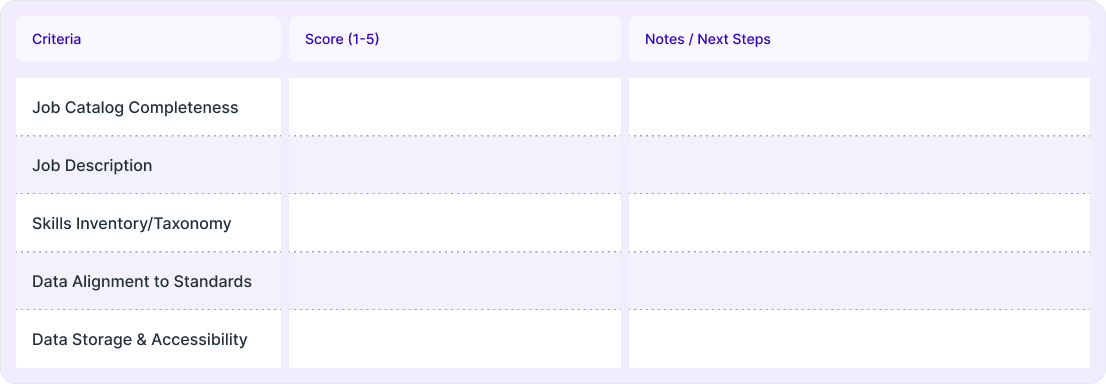
Output: A clear view of where your job and skills data stands — complete, partial, or inconsistent.
Pillar 2: Governance, Ownership, and Strategic Stewardship
What it evaluates: who owns, maintains, and champions skills and AI initiatives.
Why it matters: AI transformation requires clear ownership and cross-functional collaboration.
Guiding questions (score 1–5):
- Who owns the job catalog and skills data (HR Ops, Talent Management, etc.)?
- Do we have identified AI/Skills Champions in each BU/region?
- Do we have a central governance group/steering committee overseeing skills and AI initiatives?
- Is there executive sponsorship for AI in HR, and analysts/data stewards to support insights?
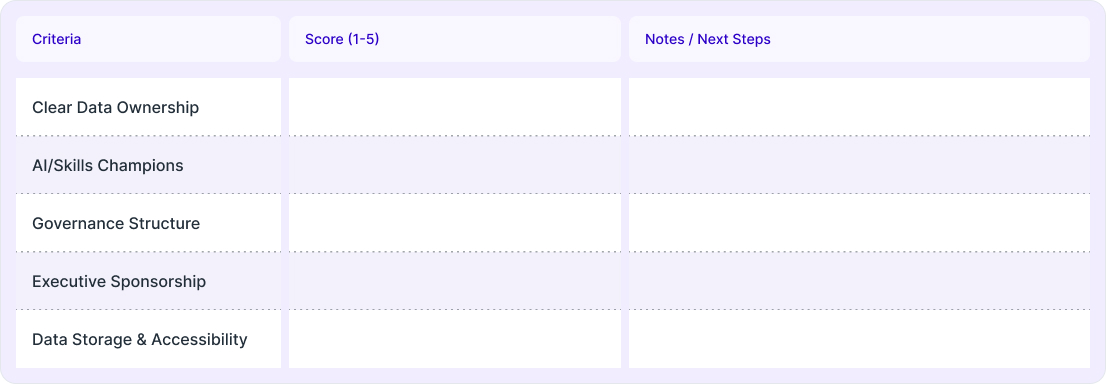
Score 1 = Not Started, Score 2 = Early Exploration, Score 3 = Partially Established, Score 4 = Well Implemented, Score 5 = FullyMature & Stable
Output: Defined roles and responsibilities so decisions don’t get stuck.
Pillar 3: Contextual Alignment & Operating Model Fit
What it evaluates: whether job and skills data reflects your organization structure and needs so AI insights are meaningful in your internal context.
Guiding questions (score 1–5):
- Do we have career paths and job levels for major roles (e.g., Data Scientist I–III)?
- Are there competency/proficiency frameworks for key roles?
- Do we know our preferred technologies?
- Do we have defined learning partners?
- Have we mapped skills to strategic initiatives (e.g., digital fluency, AI adoption)?
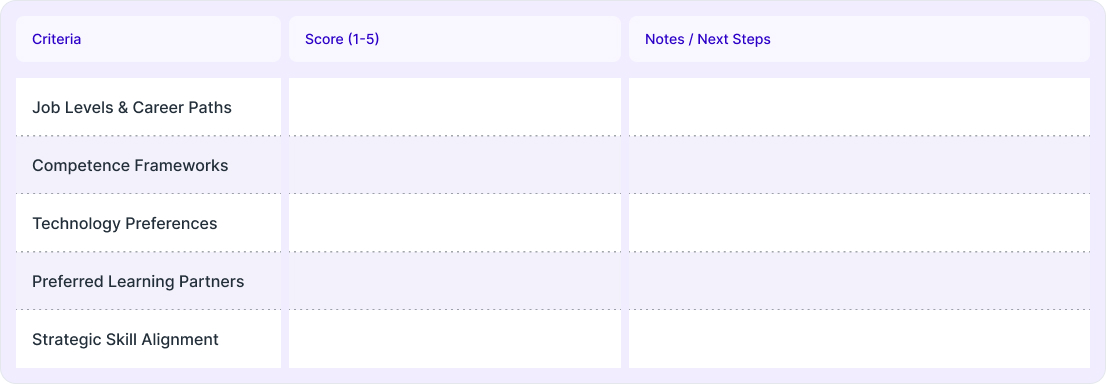
Score 1 = Not Started, Score 2 = Early Exploration, Score 3 = Partially Established, Score 4 = Well Implemented, Score 5 = FullyMature & Stable
Output: Clear alignment between skills data and your operating model or learning strategy.
Pillar 4: Ecosystem Integration & Tech Stack Maturity
What it evaluates: whether systems can support AI-driven insights, including your tech stack’s ability to host, integrate, and act on skills data.
Guiding questions (score 1–5):
- Which platforms hold HR, learning, and talent data today?
- Can these systems integrate with external AI platforms or data sources (like Draup)?
- Do we have data security and access protocols defined?
- Are there gaps or duplications in where job and skills data are stored?
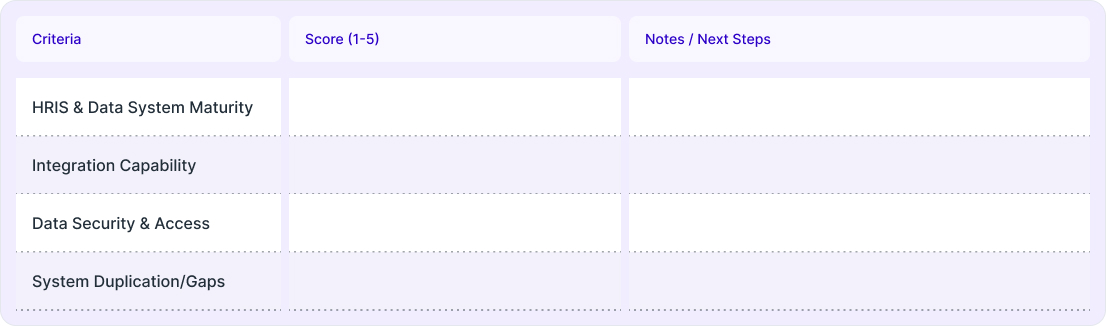
Score 1 = Not Started, Score 2 = Early Exploration, Score 3 = Partially Established, Score 4 = Well Implemented, Score 5 = FullyMature & Stable
Output: A tech map showing systems, integrations, and readiness for AI tools.
Pillar 5: Change Capability & Leadership Alignment
What it evaluates: whether teams are prepared to act on AI insights, because technology alone won’t transform work; people and process will.
Guiding questions (score 1–5):
- Do we have executive sponsorship for AI transformation in HR?
- Is there clear communication about AI transformation?
- Have we identified early pilots/use cases (e.g., AI-driven workforce planning, learning personalization)?
- Are HR teams trained to interpret AI insights?
- Are business and HR leaders aligned on what “AI-ready” means?
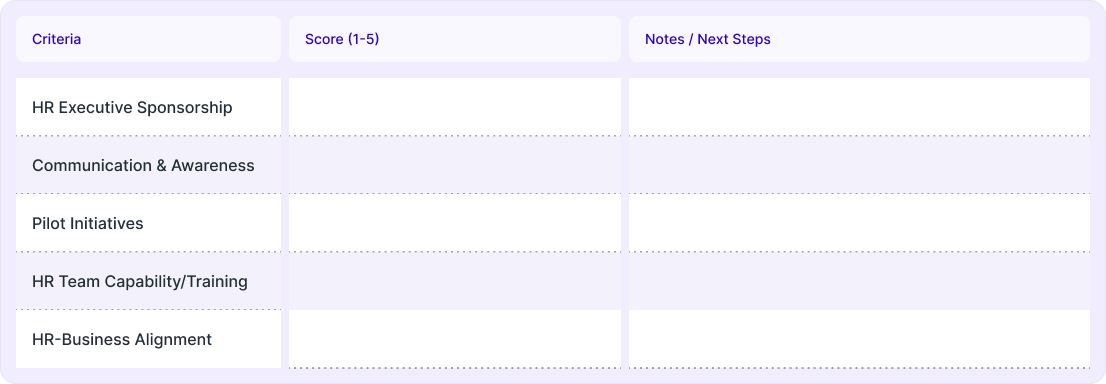
Score 1 = Not Started, Score 2 = Early Exploration, Score 3 = Partially Established, Score 4 = Well Implemented, Score 5 = FullyMature & Stable
Output: A prioritized roadmap: what’s ready today, what needs to evolve, and who leads each step.
Analysis: Identifying Your Organization’s Readiness Zone
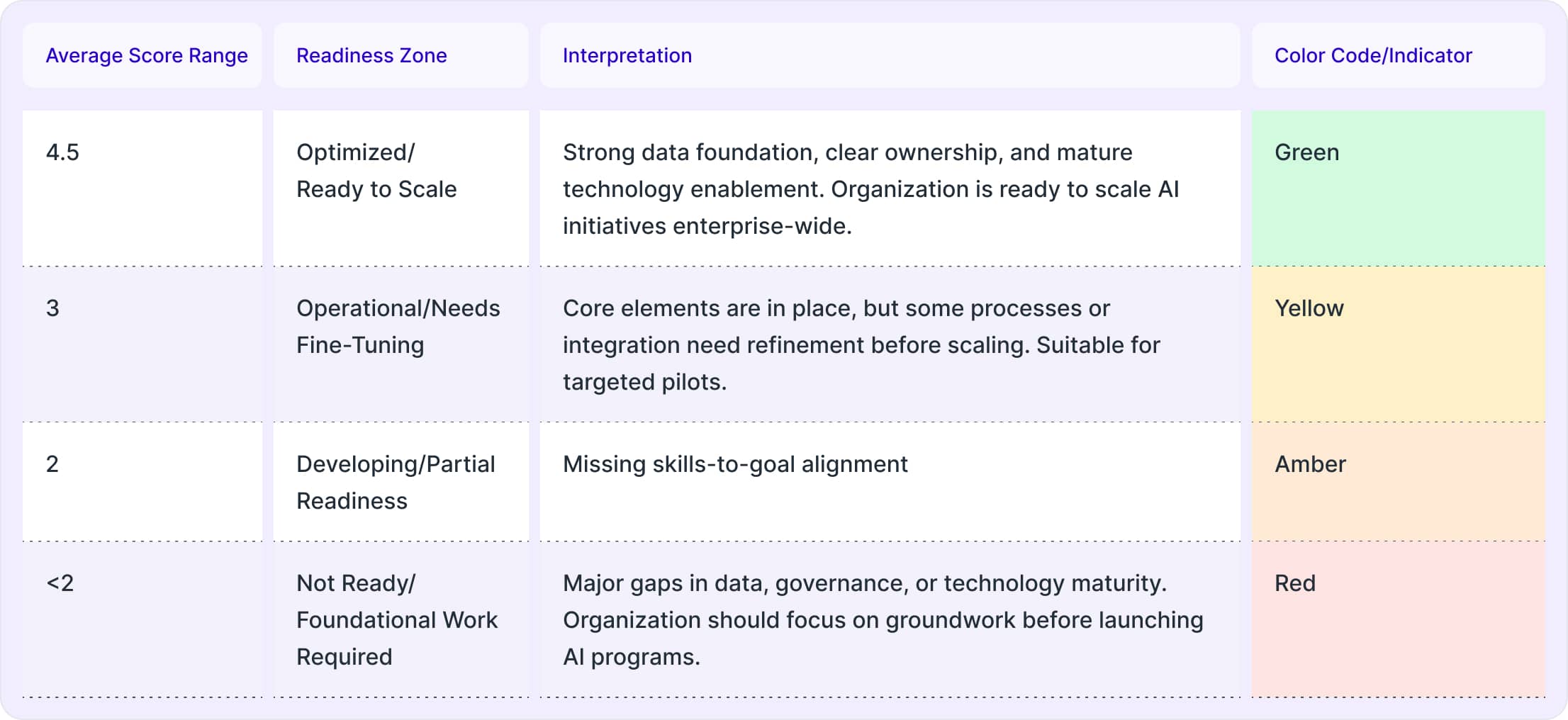
Before interpreting pillar scores, translate your overall average score into a readiness zone:
4–5: Optimized / Ready to Scale: strong data foundation, clear ownership, and mature technology enablement; ready to scale AI initiatives enterprise-wide.
3: Operational / Needs Fine-Tuning: core elements are in place, but processes or integrations need refinement; suitable for targeted pilots.
2: Developing / Partial Readiness: foundational components exist, but data quality/ownership/change readiness are inconsistent; structured improvement required.
<2: Not Ready / Foundational Work Required: major gaps in data, governance, or technology maturity; focus on groundwork before launching AI programs.
Preparing a Leadership Dashboard
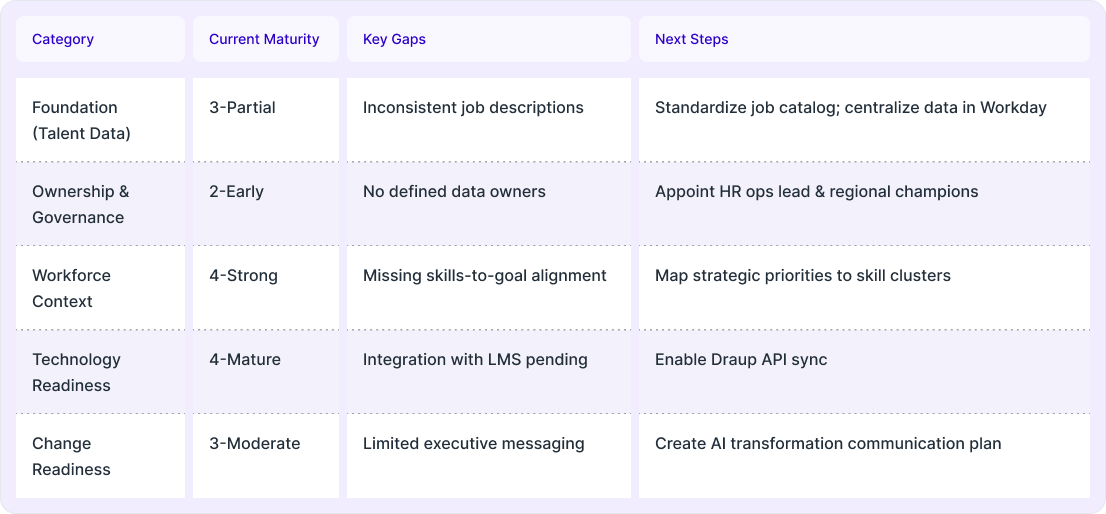
We recommend producing a one-page leadership dashboard that visualizes overall maturity, scores each pillar, and defines clear next steps.
Create a one-page visual dashboard for leadership. Example one-page summary template to visualize overall maturity, score each pillar, and define clear next steps.
AI Readiness Zone Classification: Before interpreting the scores, it’s helpful to understand how each average score translates into a readiness zone. The table below defines the four readiness levels that indicate how prepared an organization is for AI transformation.

Download the AI Transformation & Org Readiness Scorecard
A one-page PDF template that you can fill out to assess your org readiness
By filling up this form, you agree to allow Draup to share this data with our affiliates, subsidiaries and third parties


The Action Plan: Bridging the Gap from Assessment to Execution

Start with quick wins, e.g., centralize job descriptions and appoint a data owner.

Run pilot projects with one function or geography.

Use AI platforms (like Draup) to map roles to future skills and benchmark externally.

Reassess quarterly to track improvement.
Conclusion
AI transformation in HR is not a technology project, it’s a strategic capability shift. Organizations that succeed will be those that combine structured data, strong governance, contextual understanding, scalable technology, and empowered people. Once your organization completes this assessment, you’ll have a clear picture of:
- Where your job and skills data are mature
- Which processes and ownership structures need strengthening
- How ready your technology ecosystem is for AI enablement
- What change levers (communication, training, pilots) can accelerate adoption
To move from assessment to action, Draup can serve as your strategic partner in building and scaling your AI-driven talent framework. Through its Skills Intelligence Platform, Draup enables HR and business leaders to:
- Map current and future skills across roles and functions
- Benchmark against industry and peer organizations
- Identify reskilling and learning pathways aligned to business priorities
- Integrate insights directly into your HRIS and workforce systems
Draup can work with you to help your organization transform readiness into impact, accelerating your journey toward a future-ready, AI-empowered workforce.

.svg)




.svg)
