
Transforming Workforce Strategy for a $300B Pennsylvania-based Pharmaceutical Leader
Discover How Draup Enabled AI-Driven Workforce Transformation for a National Healthcare giant
~40,000
Employees
$300B
Revenue
Healthcare
Industry
Pennsylvania, US
Headquarters
About the organization
A global healthcare distribution and services enterprise supporting biopharma manufacturers, providers, and patient-care organizations via large-scale logistics, commercialization support, and supply chain operations. Expanding across North America, Europe, and emerging markets, it focuses on resilient supply chains, frontline workforce availability, and scaling digital talent for complex, cross-border operations.
The Core Challenges
Widening Talent Supply Gaps
Rapid logistics and e-commerce growth is widening demand – supply gaps - projected shortfalls reach 3.75% in Turkey (by 2030), 17.9% in Birmingham, and 52% in Cincinnati, straining hiring and continuity plans.
Scalable Global Hiring Strategy
Variability in experience mix, cost structures, English proficiency, and gender diversity makes it difficult to design scalable, cost-effective global hiring strategies.
Competitive Talent Benchmarking
Employers like Amazon, DHL, FedEx, Deutsche Post, Evri, and UPS offer strong pay and structured benefits, demanding deeper benchmarking to attract and retain talent.
Integrated Pipeline Intelligence
Data on Turkey’s 1.1M frontline workforce, West Midlands’ 16,000+ supply-chain graduates, and Cincinnati’s university partnerships wasn’t integrated, limiting long-term pipeline planning.
The Solution
Supply Chain Supervisor

PROFILE

LOCATION ANALYSIS
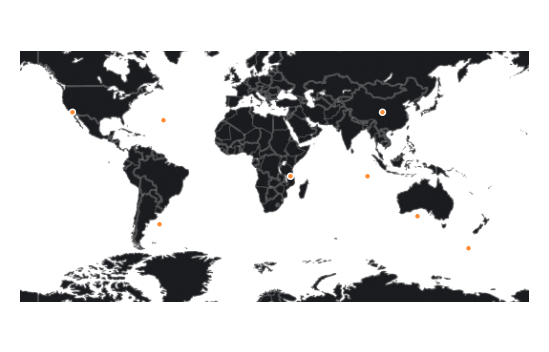
TALENT MARKET INSIGHTS

CAREER PATHS
DATA INTEGRATION
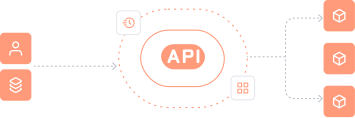
TECH STACK

The image is for representational purpose only.
01
AI-Driven Workforce Intelligence across Turkey, U.K. & U.S.
Integrated views of installed talent, experience mix, gender diversity, migration, and demand cycles across Turkey, Birmingham, and Cincinnati pinpointing where shortages would hit and how to stage proactive hiring.
02
Location Prioritization & Hiring Benchmarking
A multi-market decision model compared Pune, Kuala Lumpur, Dallas, Philadelphia, and Vilnius on hiring difficulty, talent depth, supply-demand balance, and growth producing data-backed recommendations for scaling digital and enterprise teams.
03
Supply chain & automation engineering deep-dive
Built job-family taxonomies, demand supply forecasts, peer benchmarks, and compensation models for hubs like Birmingham and Cincinnati; highlighted high-demand roles
04
Academic pipeline & early-career strategy
Mapped university ecosystems Turkey’s 1.15M graduates, West Midlands’ 72K, and Cincinnati’s 38K to target vocational programs, supply-chain majors, and high-engagement employers, strengthening long-term pipeline planning.
Outcome
6,100+
Locations
4M+
Career Paths
1.7M+
Peer Group Companies
28K+
Skills
3,500+
Roles
1B+
Professionals
55K+
Universities
1B+
Job Descriptions
200K+
Courses
180K+
Technology Solutions
1.6M+
Account Priorities
Labor Market Data Contextualized with Business Intelligence for Every Decision
Analyzing 1B+ data points daily from 100K+ sources
6,100+
Locations
4M+
Career Paths
1.7M+
Peer Group Companies
28K+
Skills
3,500+
Roles
1B+
Professionals
55K+
Universities
1B+
Job Descriptions
200K+
Courses
180K+
Technology Solutions
1.6M+
Account Priorities

.svg)




.svg)
