
Transforming tech workforce strategy for a Hudson based Fortune 250 financial services leader
Discover How Draup’s Talent Intelligence Accelerates Tech Workforce Transformation for a $106B Financial Leader
~9000
Employees
$106B
Revenue
Financial Services & Insurance
Industry
Hudson , New York
Headquarters
About the organization
A Fortune 250 financial services enterprise specializing in insurance, protection solutions, and digital-first customer experiences, the company is undergoing a large-scale modernization effort across data, engineering, cloud, and cybersecurity. With 9,000+ employees and $106B in revenue, it is accelerating AI-enabled operations and distributed tech workforce models across the United States.
The Core Challenges
Job Taxonomy
Standardize job families and skills taxonomies to enable consistent tech workforce planning.
Hub Strategy
Identify scalable U.S. tech hubs by balancing capability depth, cost, and growth potential.
Career Pathways
Develop clear career pathways aligned to emerging AI, data, and engineering roles.
STEM Pipeline
Strengthen STEM talent pipelines through improved visibility into university ecosystems.
The Solution
Data Scientist

PROFILE

LOCATION ANALYSIS
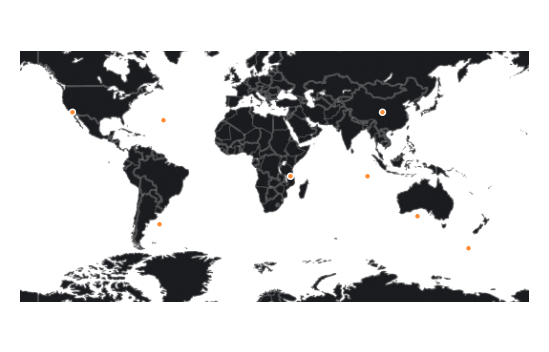
TALENT MARKET INSIGHTS

CAREER PATHS
DATA INTEGRATION
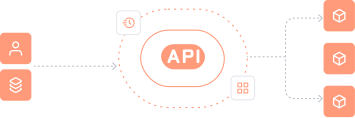
TECH STACK

The image is for representational purpose only.
01
Tech Talent Intelligence & Market Mapping
Benchmarked U.S. tech talent supply, demand, cost, and attrition across data, engineering, cloud, and cybersecurity roles using insights from 850M+ profiles and 450M+ job descriptions.
02
Location Feasibility & Hub Prioritization
Evaluated U.S. MSAs on capability, cost, scalability, and ecosystem strength to identify top hubs and Centers of Excellence.
03
University Talent Pipeline Assessment
Assessed STEM graduate output across major regions to pinpoint talent-rich ecosystems for long-term hiring.
04
Career Pathways & Skills Architecture
Standardized job families and built 6–7-month pathways enabling data roles to progress into consultant positions.
Outcome
6,100+
Locations
4M+
Career Paths
1.7M+
Peer Group Companies
28K+
Skills
3,500+
Roles
1B+
Professionals
55K+
Universities
1B+
Job Descriptions
200K+
Courses
180K+
Technology Solutions
1.6M+
Account Priorities
Labor Market Data Contextualized with Business Intelligence for Every Decision
Analyzing 1B+ data points daily from 100K+ sources
6,100+
Locations
4M+
Career Paths
1.7M+
Peer Group Companies
28K+
Skills
3,500+
Roles
1B+
Professionals
55K+
Universities
1B+
Job Descriptions
200K+
Courses
180K+
Technology Solutions
1.6M+
Account Priorities

.svg)




.svg)
