
Modernizing Talent Strategy for the Largest Healthcare & Supply Chain Leader in Texas
Discover How Draup Enabled Workforce Modernization for a $280B Healthcare & Supply Chain Leader
~70000
Employees
$280B
Revenue
Healthcare
Industry
Irving, Texas
Headquarters
About the organization
A global healthcare and supply chain enterprise operating across pharmaceuticals, medical products, and patient services. The company delivers advanced logistics and care solutions while accelerating digital, automation, and AI-driven workforce transformation. Its business priorities include building future ready
The Core Challenges
AI-Skills Gap
AI adoption outpaced internal skills, making it hard to identify evolving roles and skill needs.
Selective Talent Market
Technical talent became more selective, reducing acceptance rates and slowing hiring.
No Maturity Model
Leadership expectations expanded without a clear maturity model.
Inconsistent Metrics
Productivity metrics varied widely, limiting cross-functional performance visibility.
The Solution
Customer Success Manager

PROFILE

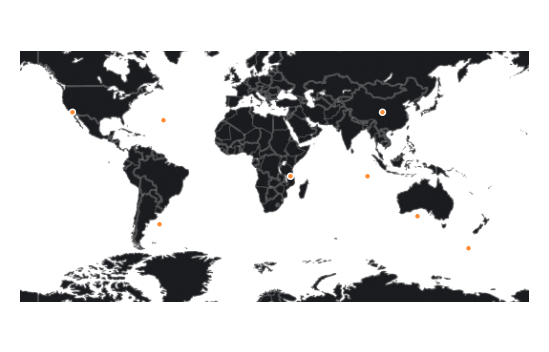
LOCATION ANALYSIS
TALENT MARKET INSIGHTS

CAREER PATHS
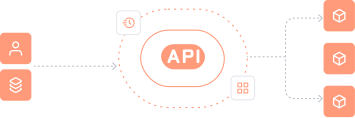
DATA INTEGRATION
TECH STACK

The image is for representational purpose only.
01
AI/ML Talent & Workforce Impact Modeling
Assessed automation vs. augmentation exposure, AI adoption trends, and high-growth roles across 20+ functions to clarify where tasks would be automated, enhanced, or require upskilling.
02
Offer Acceptance Benchmarking
Analyzed 230K+ applicant decisions to uncover acceptance rates, role-level differences, and decision timelines- highlighting lower Offer Acceptance Rate for technical roles and enabling targeted hiring strategies.
03
Leadership Competency Evolution Framework
Built a leadership taxonomy using 750M+ profiles and 350M+ JDs, mapping how skills shift from manager → director → executive across areas like agility, emotional intelligence, ethical judgment, and AI literacy.
04
Cross-Functional Productivity Benchmarking
Synthesized practices from leading companies to create a unified model covering engineering velocity, sales KPIs, marketing ROI metrics, and operations productivity levers.
Outcome
6,100+
Locations
4M+
Career Paths
1.7M+
Peer Group Companies
28K+
Skills
3,500+
Roles
1B+
Professionals
55K+
Universities
1B+
Job Descriptions
200K+
Courses
180K+
Technology Solutions
1.6M+
Account Priorities
Labor Market Data Contextualized with Business Intelligence for Every Decision
Analyzing 1B+ data points daily from 100K+ sources
6,100+
Locations
4M+
Career Paths
1.7M+
Peer Group Companies
28K+
Skills
3,500+
Roles
1B+
Professionals
55K+
Universities
1B+
Job Descriptions
200K+
Courses
180K+
Technology Solutions
1.6M+
Account Priorities

.svg)




.svg)
