About the Company

The organization is a global leader in software and technology services for the communications and media industry, serving the world's largest service providers across revenue management, network operations, and digital transformation. Operating in over 85 countries with more than 30,000 employees and annual revenues exceeding $4.5 billion, it sits at the intersection of enterprise technology and industry-wide transformation. As 5G, cloud-native infrastructure, and AI reshape the communications landscape, the organization has made building a future-ready workforce — particularly at the graduate level — a strategic priority.

The Core Challenges

Icon: Robot

Entry-Level Demand Collapse

Entry-level tech hiring had declined sharply since 2022, with global job postings down approximately 63% from peak. The organization needed a structured view of which roles were most affected and whether the trend was cyclical or structural.

Icon: Skill

Role Transformation Ambiguity

The workloads of Software Development Engineers, QA Engineers, and DevOps professionals were being reshaped by AI — but the precise shift from automated to augmented to human-led tasks was not well mapped, making it difficult to calibrate graduate expectations and onboarding programs.

Icon: Bulb

Campus Hiring Intelligence

The organization lacked a consolidated, data-backed view of hiring volumes, placement patterns, and recruiter trends across Tier 1 and Tier 2 B-schools in India — making it difficult to prioritize campus investment and identify which institutes offered the best talent-to-cost fit for different functional needs.

Icon: Skills

Employer Category Position

The organization had limited visibility into its hiring presence relative to peers — including IT services firms, Big Tech, hyperscalers, and telecom software competitors across both Tier 1 and Tier 2 campuses, making it difficult to identify strategic whitespace for early campus engagement.

The Solution

PROFILE
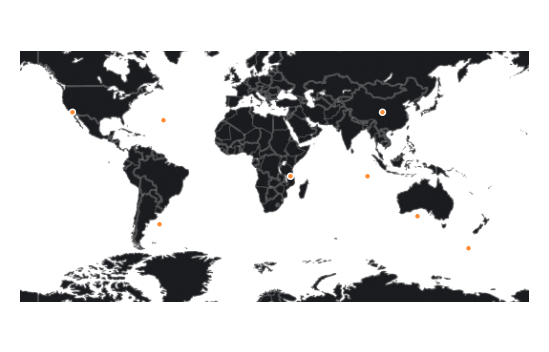
LOCATION ANALYSIS
TALENT MARKET INSIGHTS
CAREER PATHS
TECH STACK
The image is for representational purpose only.
01
Icon: Stats
Hiring Trend & Market Intelligence
Mapped the structural shift in entry-level tech hiring across the U.S., UK, Germany, India, and France — with job postings still 50% below early-2022 peaks. India’s top IT services firms recorded a 20-year low in fresh graduate intake, with two of the largest pausing campus placements entirely. Of active tech roles, 53% now explicitly require AI skills. Profiled the fastest-growing emerging roles — Prompt Engineer (~300% demand growth in two years), AI/ML Engineer, Cybersecurity Analyst, and GRC Analyst.
02
Icon: List
Role-Level Workload Transformation
Delivered a granular workload transformation map across five core early-career engineering roles — SDE, Test and QA Engineer, DevOps Engineer, Systems Engineer, and AI/ML Engineer — distinguishing AI-automated tasks from AI-augmented responsibilities and human-led work. With AI now generating 30–60% of routine code at major tech firms, the entry-level SDE role is shifting from code writing toward reviewing, refining, and validating AI outputs. Regression execution and test case creation have shifted substantially to AI for Test Engineers, with the human role moving up the value chain.
03
Icon: Tree chart
Campus Hiring Landscape Mapping
Mapped placement volumes, top domains, prominent roles, leading recruiters, and hiring locations across all 51 institutes. Nearly half of Tier 1 placement offers are concentrated among the top IIMs and ISB — with the leading three institutes recording 870, 590, and 576 offers respectively. Among Tier 2 institutes, the top three led placements at average CTCs of INR 12–18 LPA, offering meaningful cost leverage for high-volume operational and analytics hiring.
04
Icon: Graph-up
Employer Category Intelligence
Assessed campus hiring intensity across four employer categories: IT Services firms (very high presence), Big Tech (selective and declining), Hyperscalers (under 2% of disclosed MBA offers at Tier 1 campuses in 2024), and telecom software peers (fewer than five recorded MBA hires across Tier 1 institutes). This limited peer presence in management pipelines was identified as a clear first-mover opportunity for the organization.

Outcome

Icon: Map

Structured Market Intelligence

The organization gained a data-backed view of where early-career tech demand is contracting, where it is growing, and how AI is reshaping the composition of graduate hiring across functions and geographies — enabling more targeted campus strategy decisions.

Icon: Robot

Role Transformation Roadmap

Detailed workload-level transformation maps for each core engineering role gave the organization a clear framework for recalibrating graduate job descriptions, onboarding programs, and early-career expectations to reflect AI-augmented delivery models.

Icon: Skill

Tiered Campus Prioritization Framework

The organization gained a data-backed view of where to direct campus investment by tier, institute, domain, and cost band — enabling a differentiated strategy that uses Tier 2 institutes for cost-efficient operational and analytics hiring and Tier 1 institutes for leadership and high-impact strategy roles.

Strategic Whitespace Identification

Employer category intelligence confirmed that telecom software peers have negligible campus presence at both Tier 1 and Tier 2 institutes — identifying a clear first-mover opportunity to build brand recognition, initiate pre-placement engagement, and develop management talent pipelines ahead of competitors.

Powered by unparalleled global labor & market data

26K+
Skills
1B+
Professionals
5700+
Locations
1.6M+
Peer Group Companies
1B+
Job Descriptions
4M+
Career Paths