





Inside Microsoft’s Agentic AI Strategy for Sales with Vijay Raja Gopalan
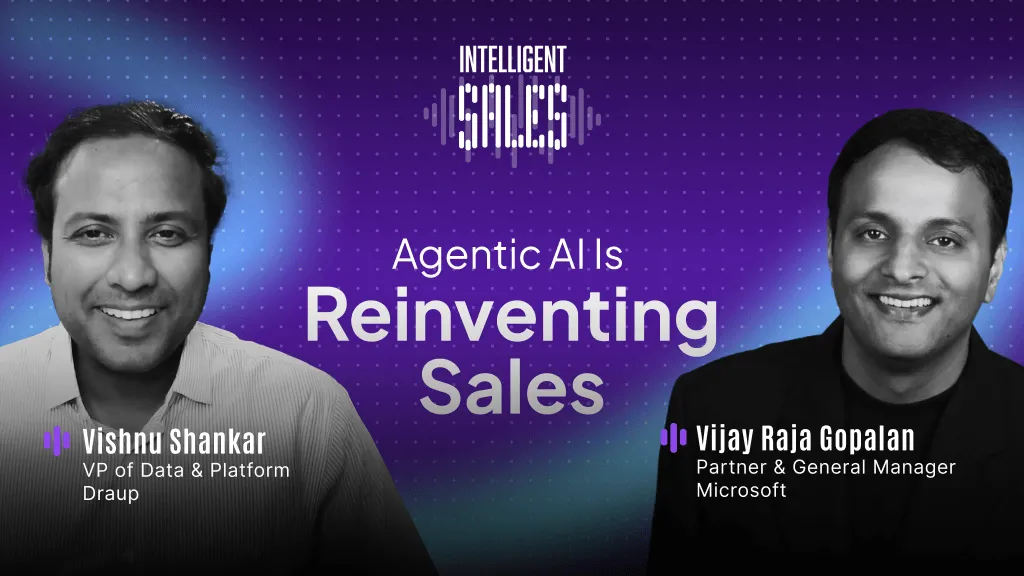
In this episode of the Intelligent Sales Podcast, Vijay Raja Gopalan, Partner & General Manager at Microsoft, joins Vishnu Shankar, VP of Data and Platforms at Draup, to unpack Microsoft’s multi-year transformation toward agentic sales workflows—and what it takes to move from CRM-first selling to AI-first selling experiences.
Vijay shares how Microsoft evolved from AI as a “companion” (recommendations and next-best actions) to agent-driven flows that can help acquire customers, nurture leads, and accelerate deal velocity, especially in complex enterprise licensing environments. He also breaks down the biggest adoption lesson: sellers don’t instantly build “prompting muscle memory,” so product teams must design for habit loops, great first-run experiences, and seamless transitions between sales chat and CRM when needed.
The discussion includes topics such as how the consistency of the customer data is non-negotiable in terms of the agentic strategies, how AI enables new opportunities in creating inclusive selling experiences in terms of voice and language, and how AI, as an enabler of new-age products, asks business leaders to embrace non-determinism, speed, and the concept of continuous improvement rather than perfection.
Don’t start with the technology. Start with what’s the business problem we’re trying to solve.
[When] we shipped something… sellers would use it for a few days and then disengage and go back to CRM.
Having a really strong data strategy is very important… a single source of truth is key to any agentic strategy.
- 02:10Fully agentic vs assisted agentic flows (and where each works)
- 03:30The early adoption surprise: prompts, habit loops, and seller behavior change
- 06:10Why “single source of truth” data is critical for trust in AI experiences
- 10:00Leadership lesson: shipping in a non-deterministic world
- 11:05The “Know Your Customer” starting point and account research agents
- 15:10Governance + evals + interoperability: scaling agentic transformation
Adoption is a product + behavior problem:
Sellers need guided prompts, great first-run experiences, and incentives to build new “habit loops” in sales chat.
Agentic selling is a spectrum
Some segments can be fully autonomous, while others work best with assisted agent flows to accelerate core tasks like deal creation and quoting.
Trust begins with data
If there is a disconnect between CRM and the agent experience, trust is not there for sellers.
AI-first products require a new leadership mindset
Drop the need for perfection, determinism, and switch to speed, iteration, and fast-follow improvements.
Governance and Interoperability are scaling levers
Well-functioning evals, deployment discipline, and agent-to-agent protocols are helping large enterprise adoption scale faster.
More About Vijay Raja Gopalan & Microsoft Customer Zero
Microsoft’s Customer Zero program makes Microsoft the first large-scale user of its own products. Microsoft Digital (internal IT) deploys new technology across the company, tests it in real-world conditions, and shares feedback with engineering teams to improve the product before and after it reaches customers.
[00:00:00] Vishnu Shankar: Hello and welcome to the Intelligent Sales Podcast. This is a series that brings together industry leaders to share their views on how they leverage data and intelligence to accelerate revenue and growth. , Vishnu Shankar, VP of Data and Platforms at Draup. I'm thrilled and honored to be joined by Vijay Raja Gopalan here today.
He is a partner and general manager at, Microsoft. And, throughout his, journey of almost three decades at Microsoft, Vijay has led innovation across products like Azure. He's led marketplace platforms, and now the co-pilot, I'm thrilled to have Vijay here. Vijay, thank you so much for your time.
Before we get started, Vijay, would you like to quickly introduce yourself and share a little bit about the work that you do at Microsoft?
[00:00:47] Vijay: First of all, thank you so much Vishnu, for having me in this forum. I'm really excited to share, all of our learnings here. as you introduced I lead, you know, seller and customer success experiences at Microsoft, specifically Customer Zero, which is Microsoft's largest sales organization.
I'm responsible for product management and engineering to transform, our sales organization. through the Power of Agentic solution, we are in the third year of our agentic transformation of sales. we are learning a lot. it's been very exciting.
[00:01:27] Vishnu Shankar: Right. let's just kick into the discussion then.
Vijaya, you know, it's sales seller workflows have always been dashboards and CRMs and things like that. How is this shift to agentic workflows working out? Would be great to hear, what experiences you're having during this transformation. So,
[00:01:47] Vijay: yeah. So when we started our journey, couple of years back with this AI transformation, at that time, AI was a companion for sellers to get better recommendation, next best action to help them with their task completion, what we call as the jobs to be done.
We have evolved in that journey right now. segments, customer segments where fully leverage the power of AI to acquire a customer, nurture a lead, manage the end-to-end life cycle of a deal, and complete the proposal and quoting and selling to a customer. The, all of this happens through agent flow.
Then there are. assisted, agentic flows where we still have our sales team. Through the power of agentic flows, they're able to, improve their productivity, complete core tasks that used to be long, running as an example, in Microsoft because of the complexity of our license agreements.
Creating a deal itself is a laborious task. And through the power of Agentic, assisted agentic solution, they're able to accelerate the dealux velocity a lot. So it is a journey, every. in every segment, we are learning new things, right? and we are boldly experimenting in customer segments where we did not have any sellers.
So we can, really use the power of AI, to acquire customers and do the end-to-end life cycle of selling in those segments.
[00:03:23] Vishnu Shankar: Got it, got it. So is there a interesting story that you would like to share? Something be an early experience that you had when you started off with this you know, running these agent workflows, some, surprises or some early experiences that could help some of our listeners understand.
What they might have to go through.
[00:03:40] Vijay: Yes, absolutely. One of the early learnings with this overall conversational co-pilot, the like of chat GPT style, conversational prompting based, journey, I think. Our sellers, had to be guided and they had to be provided with really good, intelligent leading trailing prompts.
Really good first run experience. Nobody has a muscle memory. So we have to develop this habit loops with our users to, start using this sales copilot. So this has been a really good journey. We shipped something, sellers would use it. For a few days and then totally disengage and go back to CRM systems.
So, this was initial learning for us to drive habit loops drive behavioral changes from CRMs to sales chat, which is a conversational prompting experience, and also improve the fidelity of, making sure they're able to complete their tasks end to end through the power of AI in a conversational copilot.
So, improving our trailing prompts after a particular prompt is responded by the AI agent, what do they do need to do next?
[00:05:02] Vishnu Shankar: Right?
[00:05:02] Vijay: If that capability does not exist chat experience, how do we transition them to CRM to complete that? So been a journey. So initially. We had to have this really rich continuum experience between CRM to sales, chat back and forth, develop habit loops, improve the first run experiences, lots of awareness campaigns, right?
In fact, our sales organization ran a really good a campaign to drive leaderboard of how many people, what are the top prompts coming from sellers, how do we incentivize them, motivate them to use sales chat frequently. So we had to do a combination of product focused improvements as well as behavioral and cultural changes as well.
[00:05:46] Vishnu Shankar: Super. Super. That's super interesting to know some of these adoption tactics that you had to use. You also mentioned there's a CRM workflow, and then there is the agent workflow, but generally, seller workflows are also crowded with multiple tools. There could be some data that they're leveraging, there could be other tools.
Was that another challenge that you had to come across where you had to tie up all of these tools into the, and give a more unified experience for the seller?
[00:06:13] Vijay: Absolutely. think, developing trust. And making sure you have a system of truth, single source of truth with respect to data, is key to any agentic strategy.
So, for example, if the seller gets a particular response in CRM and if the agentic experience gives a different output, they're gonna get confused. So having a really strong data strategy is very important. So we have, we had to consolidate data. that's useful for sellers, not only from CRM standpoint, but also from revenue, third party data, Draup, that we partner closely with and bring them into a single, data mod.
And based on which we could write mission learning models to reason on the data and to provide consistent experience between CRM as well as with the agent experiences. So having a really strong data strategy is key.
[00:07:12] Vishnu Shankar: Got it. Alright. Quickly switching gears a little bit. There's LinkedIn post of yours that I was reading where you say, AI makes us all beginners again.
[00:07:21] Vijay: Yes.
[00:07:22] Vishnu Shankar: Which open space for creativity and inclusion. Right. So are there some inclusion? opportunities that you came across during this adoption of AI? You know what I'm trying to ask is, how do you see AI enabling inclusion, inclusivity as a part of your workflows?
[00:07:41] Vijay: No, it's a great question.
In full transparency, we are learning here, copilot based, UI experience itself is a new paradigm shift and this is a place where conversational prompts, autonomous agentic flows, will all culminate and also help the sellers. so gravitating from a conventional user journey where you think about, building for, you know in a person with disability, in consideration for standard vanilla UI experience to conversational prompts. We had to think about so many, new ways. We are, to be honest with you, we are barely scratching the surface there. For example text to speech in prompt response instead of typing for somebody who's, for a disabled individual, how could we make it easier for them to get things done?
When an autonomous agent completes a task, how does it notify end users in a very inclusive way? And support for language, personalized languages. I could be speaking in Hindi or, or any other languages. How could we support multi-languages from a conversational prompt? Not only for, really good, rich, prompt sets, but also for responses, task completions, and all of that.
So. I would say that , we are still learning. We have, there's a lot of opportunity for us to develop that empathy and compassion for making this agentic selling inclusive for every person.
[00:09:23] Vishnu Shankar: Super. continuing on that learning thread, Vijay, what's one leadership lesson that you would wanna call out through this journey? You know, from your experience?
[00:09:35] Vijay: I think, I used to have a serious obsessive compulsion, OCD for thinness in user experience. it's a very deterministic problem solving mindset. Typically, you know, you expect very strong, product development followed by testing quality and all of this.
This world is switching AI first model, first experience as a non-deterministic experience. So I have, improved my patience, and I have improved, in terms of seeking perfection always and rather, be more compassionate about, you know, rough edges in, in our product, but focus more on agility and speed and continue to have a fast follow mindset after we ship how do we iterate and improve the
experience is a big learning. I have developed over the last, year or so, and I'm continuing to coach my team in this, in this pursuit.
[00:10:42] Vishnu Shankar: Great. Great. again, catching that learning thread, for AI sales leaders listening to this, what would be a good AI powered sales toolkit that you would say that people should be starting off with if they pursue a journey like this and I believe they should be?
So,
[00:11:00] Vijay: Clearly, would say one, one of the most, lowest common denominator scenario in selling is knowing your customer. And really, think today with the help of researcher agent that ships from M 365 copilot, as well as with sales chat that my team the larger, product teams are working on is helping
customers to deepen the understanding of the customer through the account research agent, that is a really good starting point to get a 360 degree view of customers footprint in your product, their utilization, and also third party recommendations and insights thanks to the partnership with Draup.
we can now reason on all the changes that are happening to a customer, and really help our sellers to, be action oriented. So I would say the, with the help of researcher and the account, intelligent agent that we are shipping in sales chat, it's a really good place to start.
[00:12:09] Vishnu Shankar: Got it. Got it.
Again, a very broad industry level question and would be glad to hear your thoughts on this. vi is what other trends are you seeing? you know, AI pushing, for seller tools or what do you think is coming up towards, the next couple of years in terms of what AI is going to push seller workflows?
And,
[00:12:32] Vijay: Again, as I said, I think are gonna be rapidly iterating from conversational, prompt based user experiences where AI is used as an assisted, selling to scenarios where. sellers will be managing agents for specific task completion. I to you about deal agent at Microsoft,
[00:12:57] Vishnu Shankar: right?
[00:12:58] Vijay: So couple of commercial executives can run multiple deal agents to help them, sell between Microsoft Enterprise Agreement, which is a legacy licensing model to new commerce, modern commerce based, consumption based selling to our customers at ease through the help of agents. So I think. I just wanted to recap one important point, which is identifying opportunities where you can leverage agents, help sellers to automate, those scenarios would be one, one area.
Then identifying customer segments where you can run bold experiments and where really you can make it fully agentic, completely autonomous could be another opportunity. I also see the notion of, CRM less faceless, copilot based sales experience is, not too far out, right? I think while the system of truth will con continue to, be stored in database systems and CRMs and others, user entry point could gravitate out of CRM to more, agentic solutions as well.
so in the moment of the seller journey. Got it. So, I see this, up to the organization to fully identify where they wanted to go. Fully autonomous. Some organization will consider, okay, in this, customer segment acquiring acquisition will be done completely through an agent autonomous flow.
but deal management could be an assisted experience. So it's case by case, I would say.
[00:14:37] Vishnu Shankar: Got it. Got it. And, I'm sure you've gone through this journey where, There's, been challenges around adoption, been challenges around behavioral change. What are some of the new challenges that you see coming up, as you continue to push this?
For example, is it, are there challenges around ecosystem that you would like partners to solve for? Or are there challenges around. The workflow itself that you're still working on, battling, I think. Any insight around that?
[00:15:07] Vijay: There are a couple of points I wanted to highlight. The first and foundational thing is for a large organization that's in this a transformation journey, is to have a really strong governance model in terms of ability to, have a really tight processes in terms of, you know, understanding.
Consistent experiences, whether it's response time, quality of the response, quality of the agent, task completion that are done autonomously. Having a really good evals built around it to measure, the performance of the AI models and quality of the experiences consistently will be very key.
Having a really strong governance through the engineering as well as deployment is number one. Two. you're gonna buy something, you're gonna build something, you're gonna interop of these agentic flows. So understanding the protocols, interoperability models is very key. And identifying the specialization agents to leverage and making sure it blends well this agentic transformation is also key because that's time to market is of essence was telling you earlier about are. Interoperating with multiple agents within Microsoft, which are developed by different teams. As an example, there is an agent that, that we, leverage called Know Your Customer. and that is a beautiful job of creating a very, nice PDF document about the customer and.
You know, provide a really rich, prompt experiences, but if you want a dossier in a PDF form, we had to leverage another agent. So we were able to interpret freely because we speak agent, agent protocol as well as, model context protocols. So we are able to interpret. So combination of strong governance ability to, leverage out of the box, build some interoperate with others, is also key to, AI transformation strategy.
[00:17:08] Vishnu Shankar: Super, super fantastic. I'll quickly switch gears again, almost at the end of the session, but, this is like a typical, podcast. must have mandatory. We have a rapid fire with three questions, would appreciate quick answers from you. what's your favorite tech innovation right now? Vijay
[00:17:28] Vijay: I think the coding agent from GitHub.
[00:17:31] Vishnu Shankar: Fantastic. One productivity hack that you think you can't live without.
[00:17:36] Vijay: Figma Figma make or V zero for prototyping, really helps us to articulate our solution as a product manager quickly. so that's, been my favorite.
[00:17:50] Vishnu Shankar: I'm sure my CPO would agree with you. one leader who inspires you and why.
[00:17:57] Vijay: Clearly it's, right now it's Sam Altman, in terms of speed of innovation and, ability to solve big, bold problems, and clarity of thinking speed. it's really, a privilege to, right now be in the tech industry when all these, disruptions are happening.
[00:18:16] Vishnu Shankar: Super. that's all I had.
And, thank you so much Vijay for making time and sharing these experiences with us. Your, experiences around implementing the agent workflows to enable sellers. I think it's, and I'm sure it'll be a, a big learning experience, rewarding experience for our listeners as well. thank you so much for your time.
[00:18:36] Vijay: Thank you. Thank you Vishnu. Thank you for having me.

.svg)



.svg)
