Enterprise-Ready Talent Insights with Oracle Fusion Cloud HCM + Draup

AI-powered skills and job architecture intelligence for enterprise HR leaders, transforming Oracle from a system of record into a living, market-aligned talent intelligence platform.

What Draup and Oracle Enable Together

Without disrupting your existing Oracle workflows, Draup continuously enriches your environment with real-world market intelligence; turning static HR data into dynamic workforce strategy.

  • 01Market-Aligned Job Profiles Automatically enrich Oracle job profiles with up-to-date role definitions, responsibilities, and skill expectations drawn from Draup's global labor intelligence. Your job architecture reflects what the market actually demands today, not what was written three years ago.
  • 02Smarter Skills Libraries Automatically enrich Oracle job profiles with up-to-date role definitions, responsibilities, and skill expectations drawn from Draup's global labor intelligence. Your job architecture reflects what the market actually demands today, not what was written three years ago.
  • 03Competitive Benchmarking Benchmark your job roles and skill requirements against industry peers and competitors. Understand where your capability frameworks lag or lead, and course-correct before it impacts your talent pipeline and hiring outcomes.
  • 04AI-Driven Talent Insights From skill gap heatmaps to workforce readiness forecasts, Draup delivers analytics that surface directly back into your Oracle environment, so your team acts within the tools they already use, without switching contexts.

The Business Problems We Solve

HR teams in Oracle environments face persistent data quality challenges. Draup closes the gap between internal records and the market reality.

The Gap The Impact How Draup Closes It
Job profiles written years ago, rarely updated Misaligned hiring, inflated job expectations, failed searches Continuous enrichment against live global role definitions
Skills library missing emerging and inferred skills Talent reviews and gap analyses built on incomplete data Adds market-sourced and inferred skills; creates new Oracle Skill Content Items when needed
No external benchmark for skill requirements No way to know if your standards are above, at, or below market Compares internal requirements against global labor signals by role and industry
Workforce planning based on internal data only Blind spots around future skill needs and role evolution Predictive models for skill trajectories and role adjacency built into the platform
Taxonomy maintenance done manually by HR teams Slow, inconsistent updates; effort spent on admin, not strategy Automated sync between Draup and Oracle Fusion Cloud HCM on your chosen schedule

How It Works

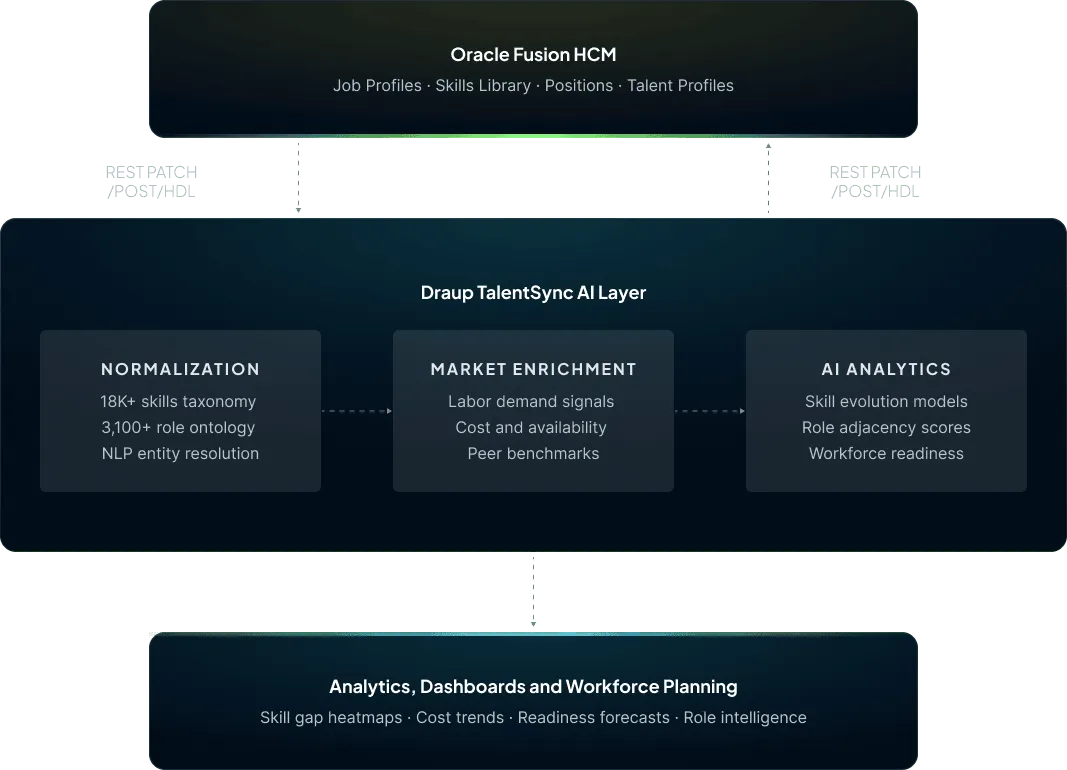
Draup follows a structured pull-process-push model that keeps your Oracle environment clean and current, operating invisibly alongside your existing HR workflows.

  • 1Secure Ingestion Draup ingests your Oracle job profiles, skills, and work structures via secure APIs, reading your existing configurations without modification
  • 2AI Normalization & Enrichment Draup's AI normalizes your data against its global taxonomy, enriches it with live labor market signals, talent demand, availability, cost, competitor benchmarks, and applies predictive models for skills evolution and workforce readiness.
  • 3Clean Return to Oracle Enriched, validated data flows back into Oracle fully conforming to Oracle schemas and skill structures, ready to use in Talent Profile, Talent Review, and Workforce Planning workflows.

Implementation Journey

Draup follows a 9-step deployment model built to protect data integrity and move at your pace, from discovery through live production sync.

  • 1Discovery Technical and functional assessment of your Oracle HCM environment, existing data structures, and integration requirements.
  • 2Use Case Alignment Selecting the integration scenarios that match your organizational priorities and workforce strategy objectives.
  • 3Data Export One-time bulk export of job profiles, skills, and relevant employee data from your Oracle HCM instance.
  • 4Data Import Ingesting and normalizing your exported data within Draup's AI engine against the global talent taxonomy.
  • 5Draup Analysis AI processing against global labor signals to surface skills gaps, enrichment opportunities, and market benchmarks.
  • 6Recommendations Detailed proposal for taxonomy updates, skill additions, and field mappings tailored to your Oracle environmentI
  • 7Review and Finalization Collaborative sign-off on recommended changes with your HR and IT stakeholders before any data modifications.
  • 8Dry Run Full integration test in a sandbox environment with a detailed validation report before any production changes are made
  • 9Production Deployment Live sync activated between Oracle HCM and Draup; your environment is now continuously enriched and market-aligned.

Use Cases

Across the talent lifecycle, Draup intelligence activates within Oracle's native workflows to improve every HR decision.

  • Job Profile Enrichment Bring your Oracle job profiles up to market standard with updated descriptions, responsibilities, and role definitions sourced from Draup's global talent intelligence, eliminating stale, manually maintained content.
  • Skills Enrichment for Job Roles Automatically populate Oracle job profiles with relevant, market-validated skills from Draup's global taxonomy, reducing the manual burden on HR and compensation teams during annual reviews.
  • Emerging Skills Identification Stay ahead of workforce transformation by identifying skills the market is demanding before they become critical gaps in your organization, enabling proactive L&D investments.
  • Skill Gap Analysis Compare your internal job skill requirements against global market benchmarks to pinpoint where your workforce is under-skilled and where to prioritize learning investment and hiring.
  • Job Architecture Standardization Achieve consistency across job roles and skill taxonomies organization-wide, using Draup's global job architecture as the reference foundation to reduce duplication and ambiguity.
  • Workforce Planning & Reskilling Support transformation initiatives by identifying the skills your future roles will require, and updating job profiles to reflect where you need to build, buy, or borrow talent.

What You Will See After Integration

Tangible improvements across your Oracle HCM environment from day one of production deployment.

  • Enriched Job ArchitectureOracle job profiles enhanced with Draup's detailed role and occupation intelligence, reflecting what the market actually expects from each position.
  • Living Skills Library Skills and competencies continuously updated from market signals, not frozen at implementation or last year's HR review cycle.
  • Better Workforce Visibility Clearer picture of job structures, skill requirements, and internal capability gaps, enabling data-driven talent decisions at scale
  • Consistent Job Data Standardized profiles across your entire Oracle environment, reducing duplication and ambiguity that leads to hiring mismatches.
  • Automated Synchronization Fewer manual updates, Draup handles the data exchange on your chosen schedule so your team can focus on strategic decisions, not admin.
  • Stronger Talent Programs Recruitment, L&D, and workforce planning all grounded in enriched, accurate role data, driving measurable improvement in hiring quality and retention.

Technical & Security Requirements

Enterprise-grade architecture built on Oracle’s native APIs with full compliance alignment.

Oracle Requirements

  • Oracle Fusion HCM tenant with Profiles and Skills/Content Library enabled
  • API access via REST, SOAP, or HDL/UCM file-based integration
  • JWT Bearer authentication using RSA private key
  • Required roles to read, create, and update Job Profiles and Skills
  • Sandbox environment available for dry-run validation

Draup Requirements

  • Draup Talent Intelligence License or ISV integration subscription
  • TalentSync API for secure, bidirectional data synchronization
  • Integration configuration supported by Draup Professional Services
  • Configurable sync frequency: real-time, scheduled, or batch
  • Secure File Transfer Protocol (SFTP) for file-based integrations

Frequently Asked Questions

What is the Draup × Oracle Fusion Cloud HCM integration?

The integration enables synchronization of job profiles, skills, competencies, and job architecture data between Draup and Oracle HCM; enriching your Oracle HR data with Draup's global talent intelligence insights without disrupting existing workflows.

Can additional fields be synchronized from Draup to Oracle HR?

Yes. During the solution design phase, Draup Professional Services reviews specific use cases, designs required workflows, and identifies the relevant objects and fields that need to be synchronized. Custom field mappings are fully supported.

How are job profiles identified for updates?

Job profiles are identified using a unique job code or job profile identifier available within the Oracle HCM instance. This ensures precise targeting without unintended overwrites across the profile catalog.

How often does the integration sync data?

Sync frequency is fully configurable based on business needs: real-time event-driven sync, scheduled intervals (daily, weekly), or on-demand batch updates. The configuration is agreed upon during the requirements discussion.

How are sync conflicts handled?

Conflict resolution rules, such as source of truth priority or latest-timestamp-wins logic, are defined during the mapping and requirements discussion phase. All conflict resolutions are logged for audit purposes.

How do we ensure new objects are correctly integrated?

A full dry-run in a sandbox environment validates mapping, syncing, and processing before any production deployment. The validation generates a detailed report for stakeholder sign-off, ensuring zero surprises at go-live.

What happens if there is an error during sync?

Errors are logged, categorized, and reported. Administrator alerts can be configured for immediate notification. Detailed diagnostic logs support rapid troubleshooting, and no partial writes are committed without resolution.

Is data change audited?

Yes. All synchronized data changes are tracked in immutable audit logs, providing full transparency, traceability, and compliance evidence for internal reviews or regulatory requirements. Role-based access control limits who can view or export audit records.