

Reskilling at Scale: A New Recruitment Blueprint for the Skills-First Future
Vijay Swaminathan
3
min read
March 2, 2020
Share
Recruitment Organisation Blueprint
One interesting analysis we are beginning to look at is if the reskilling models can be applied to a broader supply talent. Let us say we are interested in hiring Women python developer. This supply talent pool is limited. As a result can we evaluate how many Women R developers are and quantify that. So in a way we can build a feasibility map. The training to move from R to Python may be 3 to 4 months in this case. We are internally calling it a Chess Board Model.We would love to do any prototypes for you in this regard
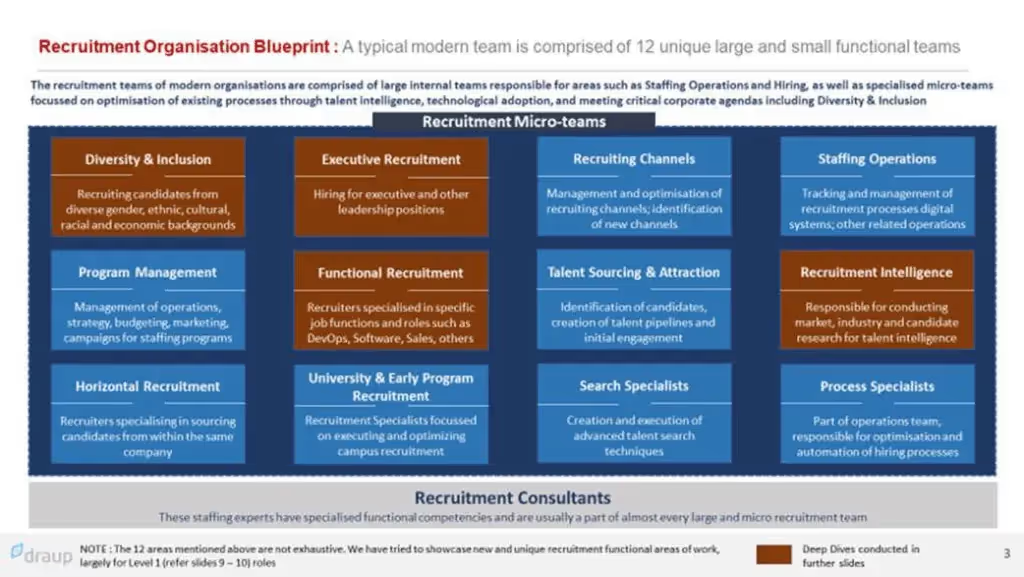
Our analysis on how Recruitment function is evolving provided some interesting insights. Recruitment function is going through a Micro Team transition where there are specialists handling very specific areas. We largely studied tech companies and enterprises going through digital transformation in this regard (if you are interested, I can send the full report
Many HR leaders are extremely passionate about Reskilling but are unable to translate into tangible actions. So one thing we are proposing to do is to arrive at the laundry list of Skills by JD and develop an overall Skills Balance Sheet
For the Skills Balance sheet, we will be rank ordering skills by degree of intensity and arrive at the top 10 or top 20 skills that the organization should train their existing employees on. I am personally very excited about this model.
On a rewarding note, one of the senior HR leaders told me that Draup reports helped gain “new respect” from their tech group people with the amount of taxonomy mapping we had done. These are the moments for which we live for at Draup so that was great to hear Thanks again and hope you find these insights helpful
Draup, an AI-first company, upholds global standards like SOC 2, GDPR, and ISO 27001. As an EAIGG member, we audit for bias and build trustworthy AI.
Data Trust & Methodology at Draup
Draup uses a structured methodology to reduce inaccuracies and prevent misleading information, with a focus on transparency and responsible data practices.
Data Transparency and Coverage
Draup sources data from diverse, vetted global inputs including public datasets, labor information, professional ecosystems, and industry research. Coverage varies by region and role, and we supplement limited areas with alternative sources and analyst-led modeling.
Profiles Behind the Numbers
All aggregate insights related to buyers, roles, skills, and locations are grounded in structured, anonymized human and organizational profiles rather than pure extrapolation. This ensures context, reliability, and protection of personal identities.
Data Hygiene and Integrity
We maintain a clean, accurate data environment by removing duplicates, outdated entities, and invalid records. Automated checks powered by ML models and analyst reviews work together to ensure clarity and accuracy for every entity, such as buyer, role, skill, technology, or company.
AI Governance and Bias Mitigation
Our governance framework combines automated evaluations with Human-in-the-Loop reviews. We use statistical checks, audits, and cross-source comparisons to reduce demographic and structural bias before insights reach the platform.
Compensation Guardrails
Compensation insights use blended, directional inputs such as aggregated ranges, benchmarks, modeled distributions, and market signals. We distinguish clearly between modeled and reported data and apply guardrails to prevent over-interpretation.
Hourly and Frontline Workforce Coverage
For hourly, frontline, and blue-collar roles where digital visibility is limited, we incorporate government datasets, localized labor information, and specialized partners to build a more complete and balanced view of workforce supply and demand.