


Redesigning Commercial Roles Around Emerging Work: A Guide for CHROs

We set out to answer a straightforward question: is commercial work converging across industries, or diverging? The assumption built into most enterprise job architecture is convergence. Sales is treated as one family, differentiated mainly by level and territory, and a strong performer is expected to move across products and markets given time and training.
The evidence points decisively toward divergence. A Trauma Sales Representative in Medical Devices, a Solar Sales Consultant in Energy, a Hospice Account Executive in Healthcare and an Enterprise Account Executive in Software may sit inside the same broad job family, but they increasingly require different buyers, different credentials, different skill stacks and different career paths.
We ran this question through Draup Curie's deep research capability against commercial job demand across fifteen industry verticals, August 2025 to August 2026. I want to be careful about whose problem this is. It looks like a sales problem. It is a job architecture problem, and that makes it ours.
The mislabel sits in the job architecture, not in the sales team
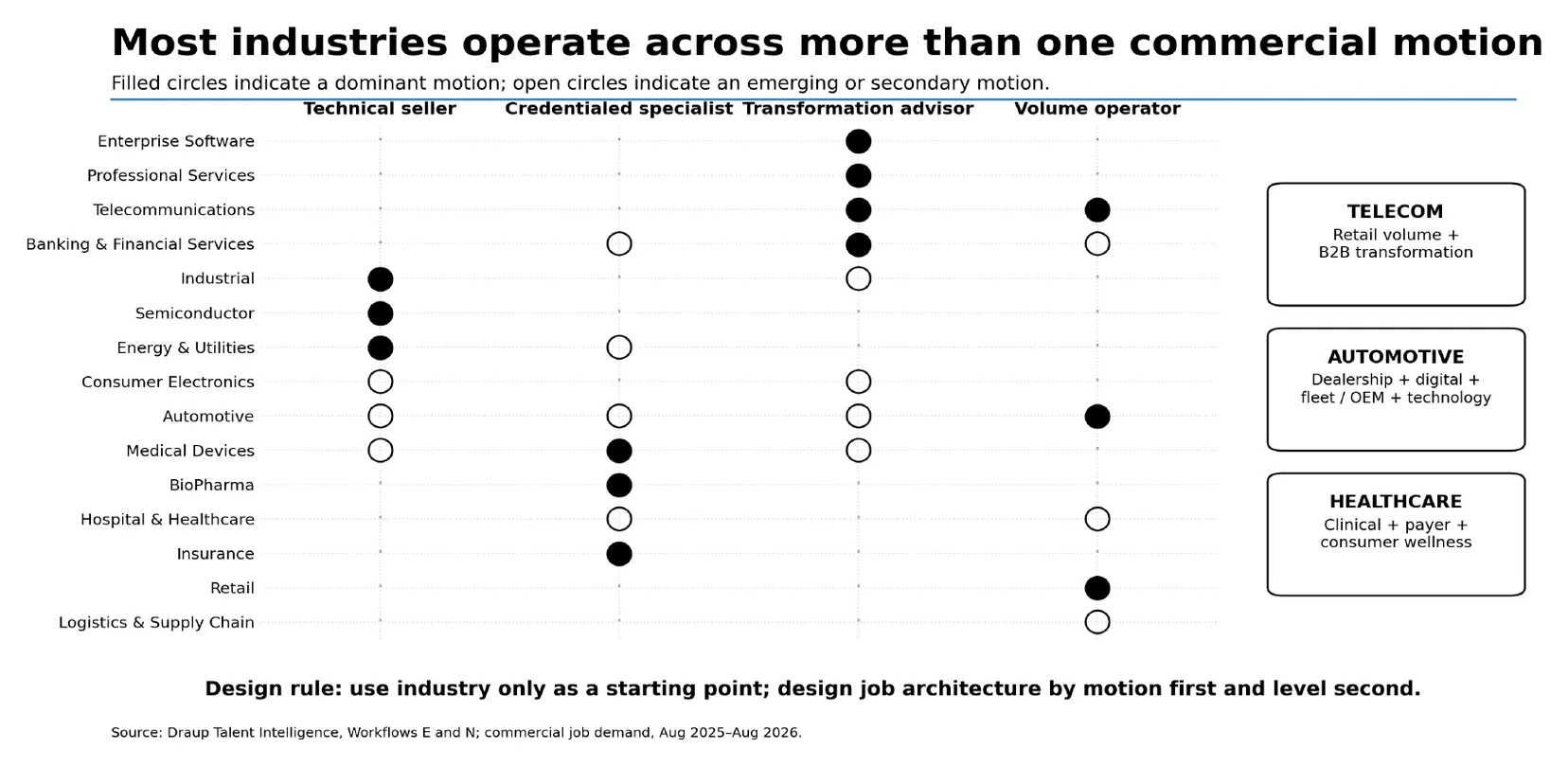
Four patterns recur across the fifteen verticals. The technical seller, who must carry systems literacy across automation, controls, IoT and edge AI. The credentialed specialist, whose credibility is a therapeutic area, an anatomy, a Medicare rulebook or a state license. The transformation advisor, who is asked to explain the customer's future operating model rather than a product. And the volume operator, running omnichannel execution at scale.
Most industries contain more than one. Telecom, Automotive, Healthcare and Consumer Electronics each contain at least two that should be planned and enabled separately. Grouping them inside one generic family creates a structural mismatch that training alone is unlikely to resolve, and that sentence is the whole argument. If the mismatch is structural, the fix is not a better curriculum. It is a different unit of design.
Talent acquisition is sourcing against a profile that does not exist
Industrial shows what happens when the requirement moves and the requisition does not. Across the study period, Sales Engineer demand of 8,508 nearly matches Sales Manager at 9,111. Selling there is embedded in solution delivery rather than added after it. The emerging signals underneath are engineering signals: IoT appears 1,630 times, PLC 1,393, Industrial Automation 1,314, SCADA 1,111, Edge AI 542, Value Engineering 463.
For a talent acquisition leader that changes the pipeline and the assessment, not just the job description. The source is engineering schools, and systems fluency has to be tested directly rather than inferred from a sales track record. Medical Devices makes a harder version of the same point. Its taxonomy is the most granular in the study, mapping roles to anatomy and procedure: Clinical Sales Specialist at 629, Trauma at 506, Neuroscience at 371, Electrophysiology at 99, Vascular Access at 75. Moving a person across those lines is not a territory change, and misalignment can damage buyer trust before enablement has any chance to help.
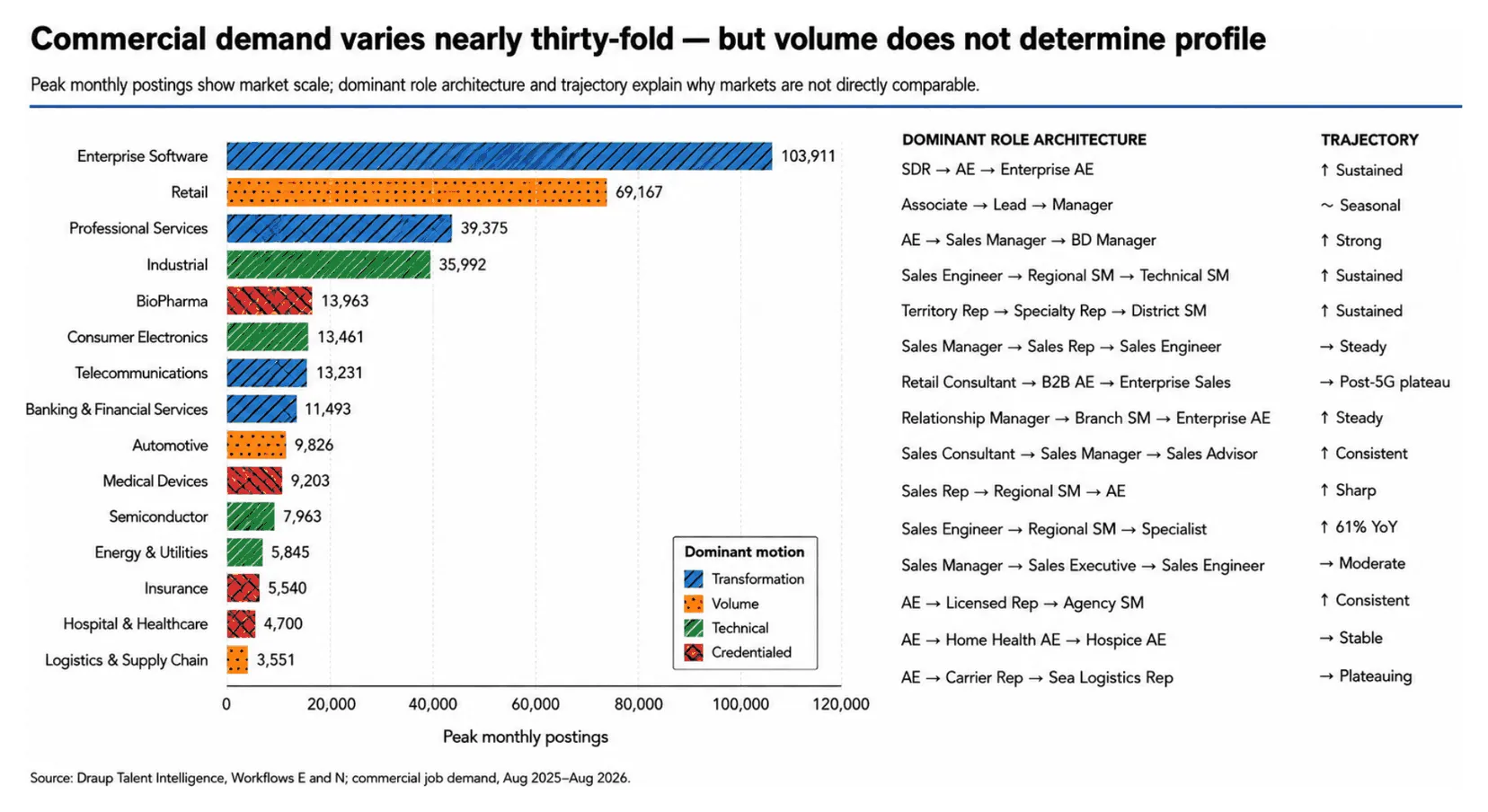
Scale compounds the problem. Enterprise Software peaks at 103,911 monthly postings while Logistics and Supply Chain peaks at 3,551, which makes Enterprise Software roughly 7x BioPharma and 13x Semiconductor. Sourcing strategy, compensation benchmarks and recruiter capacity cannot be shared across that range. Volume also tells you nothing about the profile. Industrial and Semiconductor post fewer roles than Software or Retail, but each hire carries a narrower and more technical success profile, and different time-to-fill economics.
The practical failure here is quiet. Recruiters are calibrated to distinctions hiring managers assume they already understand, and speed-to-fill keeps reading as success while the profile is mismatched.
One AI learning spine, fifteen industry modules
Every vertical carries AI and digital signals. None carries them in the same form. Enterprise Software emphasizes proof of concept development, which appears 4,654 times, and names its tools: ChatGPT at 2,140, Claude at 1,552, Gemini at 1,053. Semiconductor emphasizes inference and edge AI. Medical Devices emphasizes robotics and digital pathology. Retail emphasizes AI-assisted service and omnichannel execution, with Retail Technology at 9,009.
The reading we take from this is that a common AI learning spine is useful and a common AI program is not. Model literacy, qualifying the buying conversation, validating value and governing risk transfer across industries. The application does not. A generic program creates awareness without commercial application, which is an expensive way to look busy.
Workforce planning cannot see the motion that matters
This is the finding I would take into a planning review. In almost every vertical, the motion carrying the future is numerically tiny next to the motion carrying the headcount.
• Telecommunications · Retail Sales Consultant: 4,575 roles · Cybersecurity Sales AE: 33 · SASE Sales Specialist: 48
• Insurance · Employee Benefits named 1,356 times in job descriptions · Cyber Liability, 36
• Consumer Electronics · Smart Home Consultant: 573 roles, evidence of a distinct ecosystem-selling role
• Retail · Sales Associate: 89,107 roles · Account Executive: 1,533, inside one family
A planning process built on percentages will never surface those. And Semiconductor shows what it costs to miss one: demand rose from 4,950 postings in August 2025 to 7,963 in March 2026, a 61% increase concentrated around AI infrastructure and hyperscaler accounts. That is not more of the old motion arriving. It is a new one, arriving at a size that only shows up if you are watching low-volume signals deliberately.
Rewards is where scarce capability leaks out
The last system is the one most easily deferred and the most expensive to defer. When a specialist has taken years to build electrophysiology credibility, or a benefits license, or the systems fluency to sell industrial automation, and the only visible route to progression is people management, the enterprise loses that capability precisely when it becomes productive. Insurance is the sharpest case, because it is the only vertical in the study where a regulatory credential is a hard prerequisite for most commercial roles. That vertical cannot flex headcount quickly whatever the plan says, which makes retention a planning input rather than a nice outcome.
The ninety-day test for the next talent review
Four questions make this practical. Does the role serve a different buyer or buying committee? Does it require a different technical, clinical, regulatory or operating credential? Does it use a different workflow, channel or partner ecosystem? Would success in one motion predict success in the other without material retraining?
When the first three answers are yes and the fourth is no, you are looking at separate commercial roles rather than variants of one role. Name them, separate the sourcing pipelines, keep the AI spine and build the industry module, and design the specialist ladder before the specialists start leaving. The goal is not an enterprise redesign. It is to stop making decisions with a job architecture that hides materially different work.
One honest limit on how hard to lean on this. The data observes hiring demand. It does not measure incumbent skill levels, candidate supply, sales performance, attrition or realized automation displacement, and the source studies do not state that the corpus is restricted to US postings. Read it as directional enterprise-market signal rather than a census, and apply a US-specific filter before making US workforce decisions. The workforce implications here are our interpretation of what the demand signals mean. That is still enough to act on, because the mismatch is structural and the cost of ignoring it is paid in mis-hires and lost specialists.

.svg)




.svg)
