
How Operations Teams Protect and Grow Revenue in the Age of Agentic AI

A manufacturer's warranty team keeps the real claim rules in a veteran's head. A telecom's provisioning fallout gets fixed in side spreadsheets that no system sees. The brief finds the same pattern wherever operations run at scale: the documented process no longer matches how the work actually flows.
This week's brief looks at what that gap does to AI programs. It follows an operations organization at the core of a multibillion-dollar enterprise that entered 2025 with heavy automation investment, dozens of AI pilots and almost nothing in production. More than sixty improvement initiatives were in flight, and fewer than a third had shipped anything a frontline team used. The organization is an illustrative composite rather than a single named company. The program details and outcome figures are representative and aligned with published industry benchmarks for each process area.
The organization's answer was a small Forward-Deployed Engineering (FDE) function: engineers embedded inside operational teams, chartered to ship working improvements against real transactions in weeks. The brief is written for operations leaders and the CHROs who partner with them, because the model it describes succeeds or fails on a talent decision.
Why operations AI pilots stall before production
The organization ran four process towers, covering quoting and pricing, channel partner programs, global order flow, and billing and collections, alongside a three-region customer care function.
Ideas traveled from tower staff to business analysts to a central IT backlog. By the time anything was built, the requirement had drifted, and pilot-to-production conversion sat below 30%. Tower experts knew every exception path, while central engineers who could build sat three layers away from the transactions. Process mining repeatedly showed that the actual flows, with their workarounds, side spreadsheets and approval shortcuts, bore little resemblance to the documented ones.
Agentic AI raised the stakes on that gap. Where a bot on a misunderstood process would simply break, an agent acts on it, confidently and wrongly. As the paper puts it, an agent built to the official process automates the fiction. Leadership concluded that the constraint had become the ability to ground AI in the granular reality of the organization's own processes, safely and fast.
How the Forward-Deployed Engineer model closed the distance
The model came from the software industry. A Forward-Deployed Engineer is a full-stack engineer stationed inside the environment where the work happens, shipping working software against real data and iterating daily with the people who do the work. The organization placed five FDEs across a workforce of several thousand, one per major tower, reporting to the digital experience and insights function rather than to central IT or any single tower.
Each FDE had three commitments: ship a first working improvement on live or shadowed data within 30 days, discover the process as it is rather than as documented, and measure success on production adoption and the tower's own metrics. Each embed ran a repeating eight-week cycle that began with two weeks of discovery on one measurable slice, then build and hardening. Ownership then transferred to the tower, with updated role descriptions and training for the people whose work had changed.
The governance was agreed with finance, security, internal audit and HR before the first build. Margin floors, credit limits, payments and ledger actions stayed hard-coded. Autonomy was graduated from shadow mode to human-in-the-loop, and then to full autonomy only for transaction classes with error rates below the human baseline. When a graduation changed how a role was performed, the tower's HR partner joined the decision. Because the gates were pre-agreed, no build needed its own risk negotiation.
How the first-year builds protected and grew revenue
Eleven of fourteen FDE builds reached production in the first year, against a historical conversion rate below 30%. The builds that shipped protected and grew revenue as much as they cut cost: they recovered rebate and billing leakage, sped up quotes and approvals, and reduced the disputes that delay cash. Exhibit 1 shows the representative year-one outcomes of the production FDE builds.
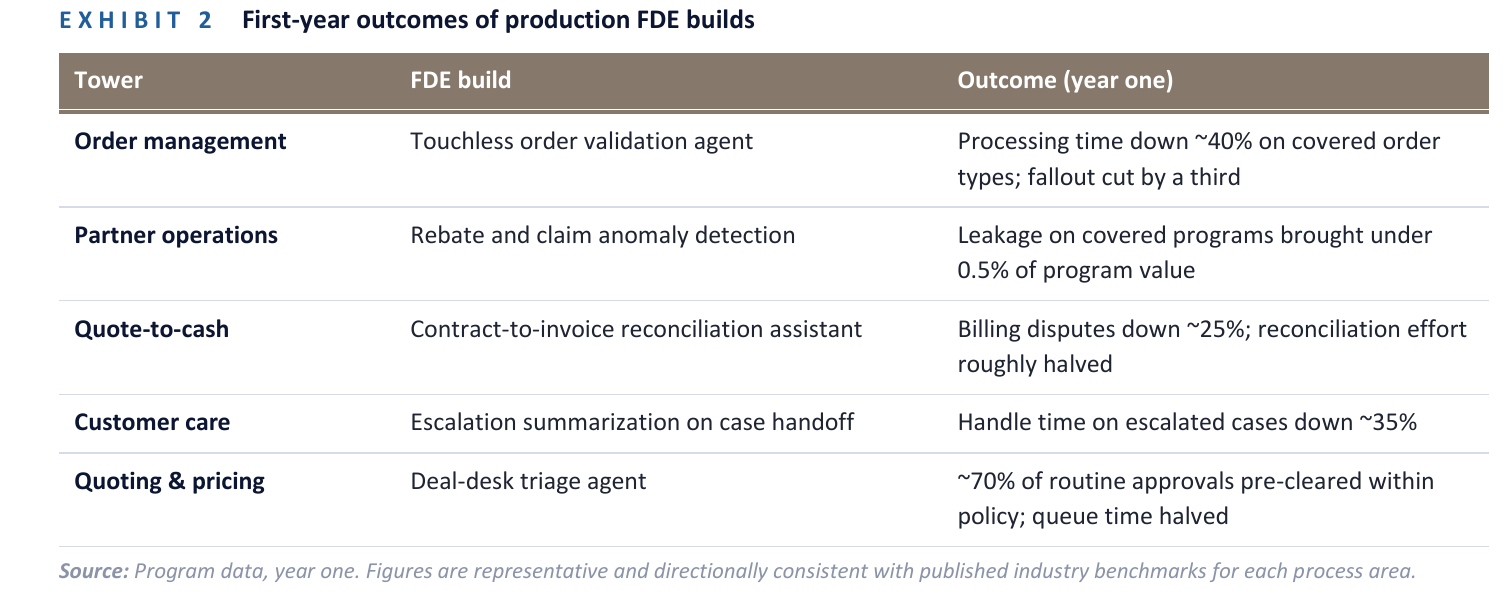
The touchless order validation agent cut processing time by about 40% on covered order types. Rebate and claim anomaly detection brought leakage on covered programs under 0.5% of program value, and the contract-to-invoice reconciliation assistant reduced billing disputes by about 25%.
By mid-year, towers were competing for FDE time and arriving with their own mined evidence. The organization also got better at deciding what not to automate. Three builds were deliberately stopped at the gate because discovery showed the process needed redesign, and leadership publicly counted those as successes. After one engagement, every tower cited the discovery map as worth paying for on its own.
Why the FDE is a talent decision for HR
The program rests on three talent decisions: who to hire, where to find them, and what happens to the roles around each build. The organization's first hire, technically excellent but averse to working on the floor, failed. The best FDEs could sit with an analyst for a day, extract the unwritten rules and keep the operator's trust while challenging the process.
The brief recommends testing the analyst half of the role as seriously as the engineering half, because a floor-shadowing exercise reveals more than a coding screen. External hires bring that engineering depth but compete with AI companies for the same profile, at the same pay. Internal feeders such as RPA developers, business analysts and strong citizen developers bring process knowledge and trust but need engineering uplift. The brief suggests a first cohort that mixes the two.
The third decision concerns the roles around each build. When an order-validation agent cuts processing time by 40%, the order team's work shifts from keying and checking toward exception handling and customer-facing resolution. Deciding in advance whether that released capacity is redeployed to revenue work, absorbed through attrition or reinvested in new builds, and telling the teams, is what keeps operators willing to show the FDE their real process. Discovery depends on that trust. The brief also recommends planning the career path before the first hire, with clear leveling, a route into product, architecture or transformation leadership, and pay benchmarked against the AI talent market rather than the internal IT scale.
How the model applies across thirteen industries
The brief maps the approach onto thirteen industries, and the mechanism stays the same in each. Exhibit 2 shows the archetype towers, representative first FDE builds and autonomy ceiling for each industry.
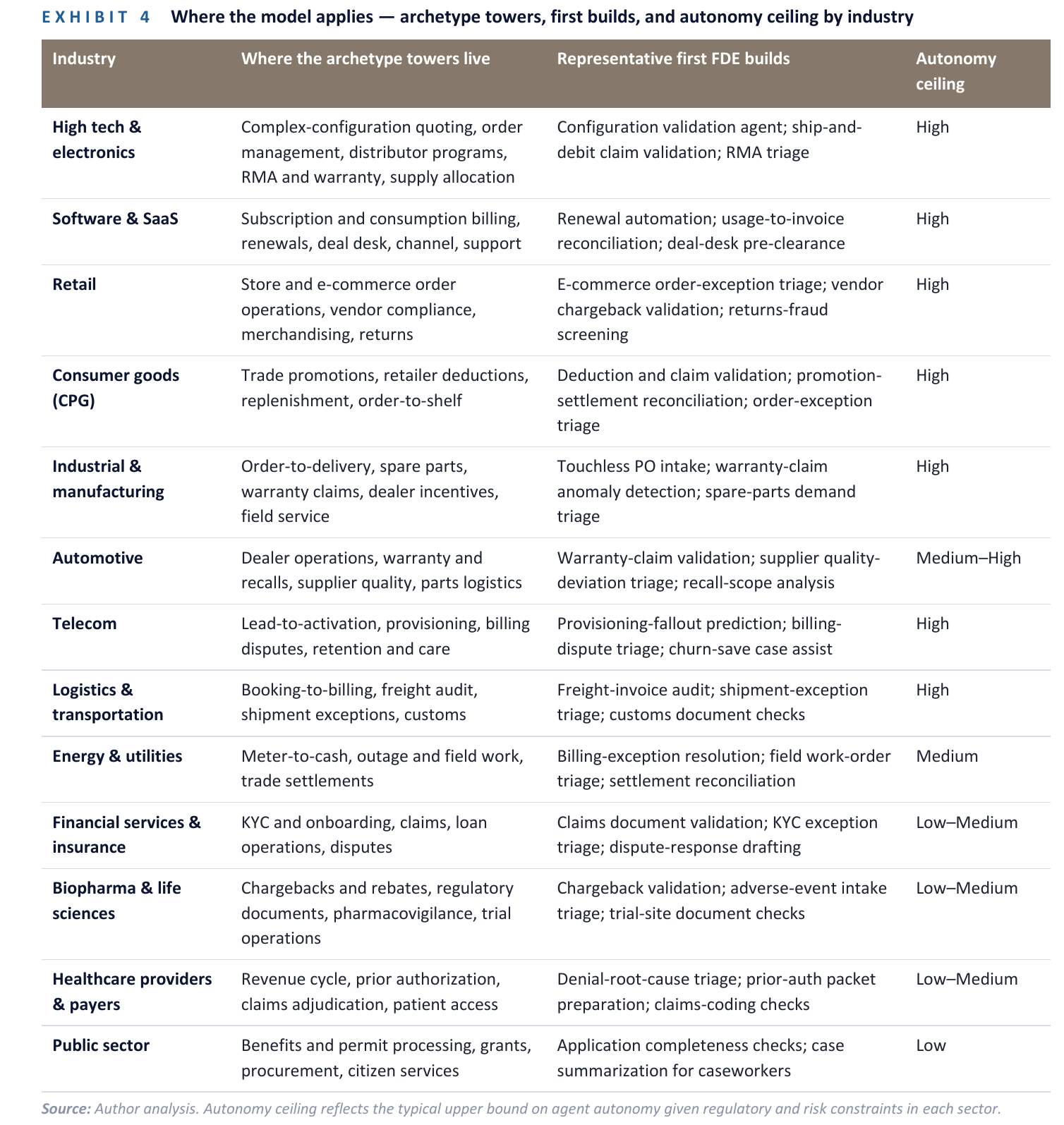
Regulation sets how much autonomy an agent can ultimately have. In biopharma, healthcare, financial services and the public sector, many builds stay human-in-the-loop permanently, because an adverse-event report, a prior authorization or a benefits decision may never fully graduate. The governance is identical, and the graduation bar is higher.
The best first builds share three traits in every sector: high transaction volume, a measurable leakage or cycle-time cost, and a clear human fallback. In practice that points to warranty claims in manufacturing and automotive, deductions in consumer goods and document-completeness checks in regulated industries, where the agent prepares and a human decides.
What to agree with your COO before the first engineer is hired
The brief closes with a replication checklist for an operations transformation program in any industry:
- Start with a diagnostic that confirms the failure mode is the distance between the work and the people empowered to change it.
- Start small and embedded, with one FDE per major process area reporting to a neutral transformation owner.
- Lead with timeboxed process discovery and treat the map as a deliverable.
- Negotiate the governance spine once, before the first build.
- Bring HR in at design, and agree the role profile, the sourcing mix and what happens to changed roles before the first engineer is hired.
- Measure production adoption rather than demos.
- Celebrate the builds you stop.
For CHROs, the brief describes the talent side of the model as the conversation to have with the COO before the first engineer is hired.
To get the full report, subscribe to the newsletter and our representatives will reach out to you.

.svg)




.svg)
