

Building Talent Architecture in AI Era with Leonardo
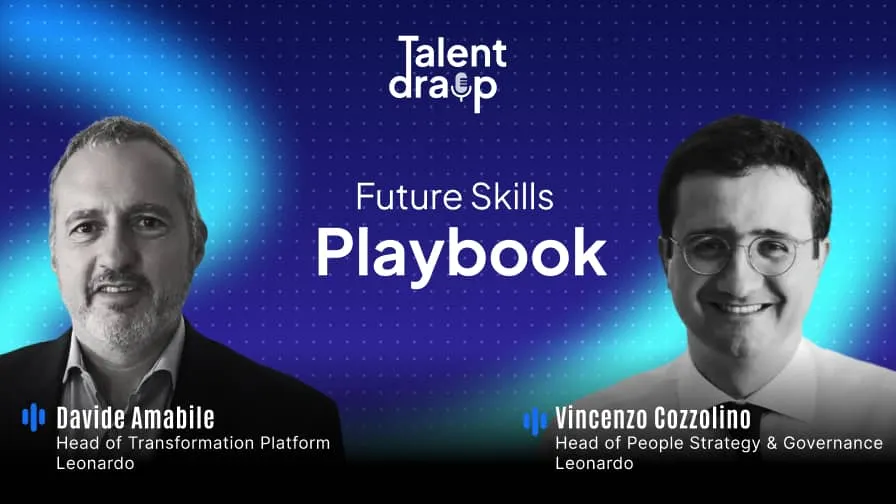
In this episode, Vijay Swaminathan sits down with Leonardo’s people strategy leader Vincenzo and digital transformation leader Davide to break down what it takes to retain talent, modernize HR workflows, and scale skills in an AI-accelerated world.
Leonardo shares how employee experience (EX) and self-employability sit at the heart of retention enabled by hybrid work, flexibility, and lifelong learning. The conversation then shifts to the operating model behind transformation: a fully integrated talent management architecture that connects performance, learning, skills visibility, and continuous feedback across the employee lifecycle.
The leaders also unpack the reality of adoption: why an AI recruiting tool can underdeliver without change management, and why immersive learning (like AR simulations for behavioral skills) can outperform expectations when it helps people become better at their jobs fast.
Innovation and transformation are not a straight line. Sometimes you have to rethink and reimagine. Learn. Try again.
Rather than separate systems, we embed performance, learning, and succession into one talent architecture.
In AI recruiting, the constraint wasn’t technology, it was adoption.
- 01:01 AI reshaping early-career learning and apprenticeships
- 05:34 Learning in the flow of work (microlearning + champions)
- 08:50 Measuring learning impact beyond completion (KPIs + 360 + managers)
- 11:04 “Cold feedback” 6-8 months later to validate real impact
- 12:28 Compliance vs personalized learning paths and why you need both
- 15:51 Accelerating early-career onboarding with checkpoint-based journeys
- 19:25 Upskilling across generations using simulations, digital twins, and partners
Retention is built on autonomy + growth
Hybrid work, flexibility, and lifelong learning enable employees to perform and stay.
Integrated talent architecture beats disconnected programs
Unifying performance, learning, skills, and succession improves visibility, engagement, and execution.
Adoption is the real bottleneck in AI HR tools
AI recruiting requires training data, strong inputs (like job descriptions), and change management to succeed.
Immersive learning drives faster behavior change
AR-based simulations can accelerate leadership and feedback skills when the value is immediate and obvious.
Future-ready skills are both technical and human
Leonardo highlights quantum computing and programming, paired with critical thinking and human-machine collaboration.
About Leonardo
Leonardo is a global aerospace, defense, and security company focused on advancing innovation through cutting-edge technologies and transformation initiatives. With a strong presence across Europe and worldwide, Leonardo invests in future-ready skills and talent strategies to stay ahead in an increasingly competitive market.
[00:00:00] Vijay: My name is Vijay Swami. I'm CEO of Draup. Super privileged to have, two fantastic leaders, Vincenzo on the people strategy side. Davidee on the digital transformation side from Leonardo engineering company. It's a global engineering company. It needs no introduction across the sectors of aerospace, defense, and security.
You guys have done great many things. So today for the next 20 minutes or so. I have the honor of discussing with you, and draw from your rich experience. Let me get started with Vincenzo first. I know how passionate you are about. Employee experience and retention and, with AI coming in, in a very big way, what are some of the strategies that have worked well for you in retaining the most precious asset?
The humans in the enterprise.
[00:00:52] Vincenzo: Thanks for the question, Vijay. I am also super privileged to join you in this podcast and thanks to Draup or the Draup team for this kind opportunity we have to be together today. Thanks for your question. I think that it's very important to talk about these things, so central for our for our work in, HR department in Leonardo as well as worldwide, I think that, it's important, to set two things for people that are, where they are, the working ecosystem and, their future, what they can do. Over their own career, and life in, firsthand we can talk about, something, so important in, building a modern, satisfying, stimulating work environment that is the remote working, the agile working, the hybrid working and the flexibility. That is how we can do people opportunity to set up the work life, their, daily routine, for the best as they prefer to build their own routine in such a way that they can express the best of themselves and to express the best of themselves is also what, fundamentally people ask every company how.
Can I try my best? I can express all my talents, all my potential. How can I be the best version of myself? And it is possible to realize this. Aspiration just, on, self employability. everyone of us would like to be the main character in, our own story, so we can and must give people the, opportunity to set up their career with, basically a lifelong learning attitude. And so, in order to build real self employability, we should give everyone the opportunity to, make a better self with, learning initiatives, development initiatives that will, last for all the, career. I think that is how we can really make, a better place, for our company where people can be their best self.
[00:04:14] Vijay: Got it. That's beautifully said because if you bring out the best version of me, it makes me feel like I want to come and work for you because you beautifully said that you gotta be the best version of yourself in your own movie. Switching gears a little bit, but aligned to that theme,
[00:04:34] Davide: yeah.
[00:04:35] Vijay: We've been dealing with, digital transformation every day, and then now AI has come in and hit it with
[00:04:41] Davide: Exactly.
[00:04:41] Vijay: Even bigger force. So what sort of processes, principles, workflows, are essential in this kind of a complex journey that we are under?
[00:04:52] Davide: Yeah. Thank you for the question, Vijay. We tried to build a fully integrated talent management architecture.
The key point is having all the HR talent processes embedded together in the same architecture with several workflow that can empower and engage our workforce. So our solution try to cover the entire employee lifecycle and the processes, we found very good improvements, for example, in performance management because the architecture simplify and support touch point between the employees and the supervisor having so continuous feedback. We
[00:05:46] Vijay: Got it.
[00:05:47] Davide: Increased number of people empowered in self-learning because the architecture integrate a full learning measurement system so they could choose their training path to support their career evolution. We embedded a section for their self updated or CV and experiences. So we have a clear picture of what skills they are growing, what they are making, some project experience that can be useful in the future.
So this is. Probably the best approach, try to integrate all the key processes, succession planning, performance management, learning management together in the same digital platform.
[00:06:31] Vijay: Got it. So is it safe to say that you said that, I'm just, if I can rephrase that a little bit to say that you're looking at the people architecture across the employee life cycle.
Yeah. And make sure. We focus on quick wins and,
[00:06:49] Davide: Exactly.
[00:06:50] Vijay: Got it. Got it. No, that's fantastic. But how do you do that in a complex geopolitical changes that we are facing, whenever I use this word geopolitical, it's hitting every company in a different way. Like you have global, sensitivities, many times you have global workforce.
How do you handle all that? So that all of these initiatives will be successful.
[00:07:21] Vincenzo: You know, Nardo has got over 6,000 people worldwide and, just enough, work in Italy. So we are a global company with, spread workforce and this opportunity. It is not easy, but it is a huge opportunity. Generally speaking, we try, not to adopt, used multinational approach, in which you, it's risky to be a little bit flat on how you manage people worldwide. You lost Great, richness of opportunities because our approach instead is a sort of a global approach in which we can try to manage different people according to the countries, background, heritage, legacy, culture, language, way of working, way of thinking. And this is, a great opportunity to us discover, talent, also so many skills, both, technical hard ones or, and soft ones worldwide. Thanks to the difference we, we find in the countries. As a matter of fact, there is also some difference in our approach, due to the different line of business, we have
[00:09:02] Vijay: Very true, very complex, different businesses.
[00:09:05] Vincenzo: Yeah. It's maybe it, there are much more difference between the military, lines of business and civil ones, then, on the different countries, because, you know, we are, not so many constraints in some civil businesses such as, space or, cybersecurity, even in ai, for example.
[00:09:36] Vijay: Mm-hmm.
[00:09:37] Vincenzo: The constraints are many for, the military lines of business, and we try to manage them in terms of security, safety also, in terms of geopolitical constraints. Generally speaking, when we try to, think about some new initiatives such as, an international engineering app we would like to set up in some countries in order to face the, shortage of, engineering or generally speaking STEM profiles in Europe.
Build some demographics, academic cultural aspects that are affecting Europe or the Western world. we are trying to identify the best countries where we can settle, a new presence in terms of, business, manufacturing, commercial or in this specific case and engineering app, potential engineering app.
Yeah. Speaking the main constraints we take into consideration
[00:10:48] Vijay: Got it.
[00:10:49] Vincenzo: Are, for example, the participation of the country in our geopolitical alliance that is O-T-A-N-N. That is important because this is the main, geopolitically landscape in which we can.
[00:11:09] Vijay: Okay.
[00:11:09] Vincenzo: Foster the alliance or the presence of, some important university tech universities or, center for research, the number of, STEM profiles present in the labor market.
And finally, also the geography in terms of distance between the country and Italy. Or rather domestic market. Thato are, us, UK, and Poland. And in terms of internal mobility or mobility, from inside or outside the country, it easy to make mobility, abroad that is important to foster the connection with the, the corporate center.
[00:11:58] Vijay: So, it's fascinating how, I didn't know this before I, started this, but, before I heard you, So it looks like the geopolitical constraints can play very differently across different lines of businesses, which is fascinating for me. Within the same company, it's like having multiple companies in such a complex game of you know, people, processes, technology processes, geopolitical sensitivities, multiple lines of business.
Davide, you know, you have seen, success in digital transformation, but you've also seen failures and challenges. so what are the key lessons you have learned from, from either a challenge or a short-term failure, I should say, in this journey?
[00:12:46] Davide: Yeah. Vijay, you, you know very well. Innovation and transformation is not a straight line.
Sometime you have to rethink and reimagine. Learn. Try again. We have a recent example. In January we released the solution to support our recruiting team with the AI based recruiting tool.
[00:13:09] Vijay: Okay?
[00:13:09] Davide: And we expect a fantastic result in few weeks, after six months. It didn't succeed so much because probably the technology's quite good. Of course, you know better than me. This semantic model need to be trained, so more data you provide, more quality of data you provide better is the answer you receive from the system. But what we see is that, no, the technical issue. Is limiting the success. It is probably the adoption by our recruiting team.
They maybe see the solutions, a competitor for the future job as recruiters. Sometimes they expect the system immediately screen, they find. The right candidate in few seconds without providing so much elements or the job description we provided are not the best one to fit with the supportive technology.
So you have to learn that this kind of system requires time to be implemented, requires a good approach in collaboration between the AI agents and the humans, and we need to invest. A lot in terms of change support for change management on the other side, another successful example where we do not expect big result was when we provide our people a solution for a training based on augmented reality to simulate critical discussions on.
Key behavioral skills, like silent task, providing feedback, leading a team, etc. Wow. In this case, very good results. So the technology has been immediately approved and adopted by our people because they funded this kind of simulation is a useful, for them to develop their skills.
[00:15:13] Vijay: Got it. It's a brilliant point you're making kind of, What Vincenzo was saying, like the tools and the processes that bring out the best in themselves to be the better version of themselves seem, you seem to have a lot more success in those areas than if they somehow think that this is gonna take away my job. Then some challenge challenges seem to come, which sort of in making sure that people can be the best version of themselves, as you said, Vincenzo, what are the skills.
At a high level, you think, Leonardo is going after in the next, say, two to three years? Because defining that, library seems to be our priority of scale seems to be one of the most important thing right now to do.
[00:16:01] Vincenzo: Thanks for the question. Vijay, it's so important to to think in these terms. We have identified two couples of skills, large skill couple and, soft one that is so relevant for our people strategy in the midterm. The technical skills are. Algorithm design and programming and, high performance computing, in particular quantum computing. Our CEO is very focused on this point because, you know, quantum computing is the main enabler. also for the AI revolution, we are expecting, and in particular, Leonardo. He's, very focused and aimed at achieving, leading positioning in Europe and not only Europe at a worldwide level in, quantum computing. So many investments have been made in, the last years in order to, have a, high, performance computing capability. Owned by Leonardo, in which we can really make a difference, across Europe, for this kind of, technology evolution. As well as we need also some strong soft skill, human skill, that maybe are also, defining our, humanity, our human identity and, this couple of skill are. Critical thinking that is our compass in the age of AI that is coming because, you know very well that, for example, your country, India has, been able to create artificial intelligence, in 10 years and it took, 5,000 years to create artificial wisdom.
So it is. Very important to, have a critical thinking approach in managing this revolution that can be risky for human, if you do not adopt this kind of, typical human thinking, human centric. And the second one is, a consequence because is the competency , in managing the creation of an ecosystem. In which you can really realize the human machine integration, a workplace where, people and machine and artificial intelligence can work together, can cooperate, for the best, of humanity and not you order to create any risk.
[00:19:22] Vijay: Fantastic, fantastic. Little bit of hard skills, little bit of soft skills. Thank you for that. So, Davide, day one, of the challenge in this transformation journey, right people always, you have, you are not only building technologies to sort of upskill existing employees, but you're also. Also need some talent that you may need to even enable that.
So this conundrum of should I build, should I buy? So what is your perspective on that?
[00:19:57] Davide: It's a very important point. I think that the best strategy combine both the approach, we usually, we. Try to choose the upskilling approach because, we see that, provide immediate results in terms of, retention, internal engagement on people. Even sometime you have to make some action because someone could resist to a change could be also cost effective. But in the long term, The problem is that sometime you need to find a highly specialized skill that you don't have in your organization or you need for a project that's very important in the short term, and in this case, you have to hire externally.
From my perspective of transformation, sometime hiring externally or that means also sometime internally, but from other business, other division, it's extremely powerful because you can bring fresh perspective, different point of views and transformation. If you want to really disrupt or innovate, you need having big diversity of point of views.
So. We will try to combine both those approaches.
[00:21:24] Vijay: Got it. You are big enough where you can put AI to find that one talent in some other business. Got it. Got it. That's a a great flick luxury you have. That sort of concludes the main part of my, questions, but. Don't go yet because I have some rapid fire, type of questions. One of the thought process I have, Davide, you have seen so many technologies you are a leader in that what is sort of real and hype in this. Your quick view on what is the most hyped up technology that may or may not live up to its expectation.
[00:22:02] Davide: Simulation for training in aircraft is one of the most important trend for the future, especially in our business when sometime for sustainability reason, we want to reduce number of hours flight.
Having powerful simulation system that can support pilot training at the ground level, but also in the near future in hybrid way flying with a real aircraft.
[00:22:33] Vijay: Got it.
[00:22:33] Davide: Where you can with holograms or other tools simulate all the situation, can speed up training of pilots. Training for the pilot is a big investment.
Technology in this case is the most powerful tool to really change the game.
[00:22:51] Vijay: Got it.
[00:22:52] Davide: Just to give you an example, we, sign an agreement with, Gaming com video gaming company.
[00:22:58] Vijay: Got it.
[00:22:59] Davide: Trying to combine technology from different tools to speed up this evolution.
[00:23:04] Vijay: So you are very excited about gaming, simulation, those types.
[00:23:07] Davide: Yeah. Could be a powerful,
[00:23:09] Vijay: Awesome
[00:23:09] Davide: accelerator. Yeah.
[00:23:11] Vijay: Got it. In terms of what do you think, we talked so much about machines, ai, all that, but what is the one human skill you think is gonna be very important for us to reach that human machine collaboration.
[00:23:30] Vincenzo: I think, that is, creativity,
[00:23:35] Vijay: creativity
[00:23:35] Vincenzo: even if you, yeah, you know, there are so many, picture you can find everywhere in web, in which you, may think that, they can, create with the machines something that, is better than, human creation. The point is what is, creation and generally speaking, you know, that the creation is an idea coming from nothing.
[00:24:09] Vijay: Got it.
[00:24:11] Vincenzo: And this is very important because with no data, with no previous, peaks, with no, background, with no, data storage, a machine cannot, create anything.
Human can create for themselves intuition and from, in a strange intuition, something coming from the, the sky. I dunno. But we are able to create something brand new. And this is I think, something that, machines has not, developed yet. I don't know if in the future there will be artificial creativity in these times.
I think that creativity is still something that, just human.
[00:25:11] Vijay: Got it. No. Well said. Well said. And, We know, Davide is really focused on the simulation and all that, so we know where you'll put the money. If you have unlimited budget for your HR, where will, for your people strategy, where will you put it?
[00:25:31] Vincenzo: Maybe in, you know, maybe in, learning about, technology innovation about technology evolution because we have to be prepared. I do think that HR is anticipation.
[00:25:52] Vijay: Got it.
[00:25:52] Vincenzo: And we have to anticipate the world that is coming. We see that it's coming and we are a little bit scared, but you know, fear does not help anything anymore.
We, we should be also curious. We should be. Much more, empowered to prepare ourselves and our peoples to what is coming.
[00:26:19] Vijay: Got it.
[00:26:19] Vincenzo: You know, that is something,
[00:26:20] Vijay: Support prediction models.
[00:26:21] Vincenzo: Yeah. 'Cause that's something that, machine, cannot have and that will be forever, remains something very human that are need.
You know, the most intelligent, research model in the world will forever remain. Silent because no artificial intelligence will ever be a need. It be a need, a need for wisdom, a need for knowledge, a need for competence, need for revolution. Will the, need to, make a better word, it's something that is just human.
No other, forms or life in the world. Has got need, such as humans. So we have to use these to be prepared,
[00:27:15] Vijay: Fantastic.
[00:27:16] Vincenzo: And to also be able to manage, whatever it is coming. And I think that is the good things coming are much more than the
[00:27:30] Vijay: Got it,
[00:27:31] Vincenzo: the bad things.
[00:27:31] Vijay: Got it. So we be, we can predict ahead and be ready, I guess. Yeah. One last question and then I'll, wrap up here. Who's sort of your role model and why? We'll start with Davide.
[00:27:46] Davide: I think that the role model is busy in strong competencies, so we need the people in the HR, but also in the role with strong competition, but with some characteristics we found absolutely fundamental.
First one, strong problem solver strong problem solver with a strategic view, not just, with the typical manager approach we have for fighting planning.
[00:28:19] Vijay: Got it.
[00:28:20] Davide: Control task management. We must create people with the more strategic approach.
[00:28:24] Vijay: Mm-hmm.
[00:28:25] Davide: Second one. Big, big big flexibility adaptation to change. We don't, can forecast any, behavior we, probably will change our part many ways we have people that is flexible, is fluid, is open to change and can upset and be happy of this. Third. Most important characteristics in we want to develop in all our people and all our middle measure that at this time are very worried for the future.
Got it. Because they say, the administrative task will be. Probably covered by a AI agents mm-hmm. Leadership, what's our role In the middle? No.
[00:29:14] Vijay: Right.
[00:29:15] Davide: What we are trying to do with the support of all our HR team is trying to transform this middle manager in real. Coaching of people that could empower collaboration, that support the development of the young generation that create connection inside the organization.
So our role model is evolving this way.
[00:29:40] Vijay: Got it. No, I, you, you answered that very differently, so thank you for that.
[00:29:44] Davide: Yeah.
Yeah.
[00:29:46] Vijay: What about you Vincenzo
[00:29:49] Vincenzo: I think about, adjust master.
[00:29:54] Vijay: Okay.
[00:29:55] Vincenzo: Because it's something very very human, you know, that, I generally quote always, a movie that I think that, everyone working in HR should see at least once in life.
That is we pledge a 2011 movie American movie Damien Chazelle. That is the story of, just master teaching to a young genius, young potential, high potential, person. And it is very important how, we can define an nature role model. I, if you see the how in the film is very well highlighted, the dynamics between knowledge, because that is something usually speaking related to improvisation that is very specific human competence. There will be never be an artificial improvisation.
[00:30:56] Vijay: Got it.
[00:30:57] Vincenzo: And but really improvisation is based on knowledge. You can be a great master in improvisation only if you are a very very very strong knowledge and competence on the fundamentals, on the basics, on history, on the heritage, the background, what is behind our back.
And if you are strong in this kind of knowledge, you can find your own way. To express you can find your talent, your creativity, and put this, small or big part of your life on this competence to begin a master such as Liz Armstrong or Charlie Parker. Got it. Last days. And this is a way of, working in HR that can also be a way of living.
[00:31:53] Vijay: Got it. Fantastic. And also, congratulations to Italy on the Wimbledon win.
[00:31:57] Vincenzo: Thank you so much.
[00:31:58] Vijay: Fantastic thing.
[00:31:59] Davide: Thank you.
[00:32:01] Vijay: Thank you so much for your, time. I know how busy you are. You're globally traveling. So thanks a lot for, making the time and we appreciate, sharing this beautiful insights because I'm sure whoever is listening to this will be tremendously benefited at this complex time of people and AI journey.
Thank you.
[00:32:18] Vincenzo: Thank you so much.
[00:32:19] Davide: Thank you.

.svg)




.svg)
