


Small Towns, Global Talent: The Enterprise Guide to Non-Metro Workforce Strategy
How Non-Metro Talent Is Reshaping Enterprise Hiring Globally
By filling up this form, you agree to allow Draup to share this data with our affiliates, subsidiaries and third parties


The Metro-Centric Talent Model Is Holding Enterprises Back
Most enterprise workforce strategies are built around the same narrow set of cities. New York. London. Bengaluru. Shanghai. Beijing. The assumption has been simple: the best talent lives in the biggest cities, and that's where you hire.
That assumption is no longer accurate, and the enterprises that act on this earliest will lock in structural advantages that late movers will struggle to close.
Across the world's four largest economic blocs, the United States, Europe, India, and China, small towns and non-metropolitan regions are emerging as critical nodes in the global talent supply chain. Over 1.5 billion working-age adults live outside traditional Tier-1 metropolitan centers. They are increasingly connected, increasingly skilled, and almost entirely underleveraged by the enterprises competing hardest for talent.
Our analysis across over one billion job descriptions, combined with city-level talent data from more than 30,000 locations globally, documents this shift in granular detail. This guide presents what we found, and what it means for how enterprises should build workforce strategy for the next decade.
Why the Talent Geography Is Shifting Now
This is not a gradual trend. Five structural forces are converging simultaneously, decentralizing talent faster than most enterprise workforce models are adapting:

12% of US jobs are now fully remote and 24% are hybrid. Nordic countries lead EU adoption. This has severed the link between job location and worker location for a significant share of white-collar roles.

EV battery and semiconductor manufacturing generated 35% of all announced US manufacturing jobs in 2024, with $102.6 billion in capital investment flowing overwhelmingly to rural and small-town locations across the Southeast and Midwest.

India's UPI and Aadhaar ecosystem has enabled Tier-2 and Tier-3 participation in the digital economy at scale. Sweden's broadband investments have reached 98% of the population. The EU's Cohesion Policy is actively funding rural broadband expansion.

Tier-2 and Tier-3 operations in India offer 20–35% lower talent costs with 10–12% lower attrition compared to Tier-1 metros. Eastern European secondary cities offer developer rates 55–61% below Western European equivalents.

China's Rural Revitalization Plan, India's GCC National Framework, and the EU's regional development programs are all directing investment toward exactly the non-metro talent pools enterprises have historically ignored.
Together, these forces are creating a widening gap between where talent actually exists and where enterprises are still looking.
The Scale of the Opportunity, by Geography
Across all four geographies we analyzed, the headline finding is consistent: small-town and Tier-2/3 talent pools offer 15–35% cost advantages over metropolitan equivalents, and up to 55–60% in Eastern Europe's East-West corridor, with comparable or improving skill quality and significantly lower attrition.
Source: US Census Bureau, Eurostat, India Census and NSSO, China National Bureau of Statistics. Draup analysis, 2026.
United States: The Battery Belt and Beyond
Rural America is home to approximately 46 million people across more than 1,960 counties, accounting for 71% of the US land mass and nearly 10% of GDP. The talent story here is no longer just agricultural, it is industrial, digital, and rapidly growing.
The most dramatic development is the emergence of a manufacturing corridor stretching across the Southeast. EV battery and semiconductor manufacturing generated 35% of all announced US manufacturing jobs in 2024, with capital investment of $102.6 billion concentrated in rural and small-town locations.
State-level investment snapshot:
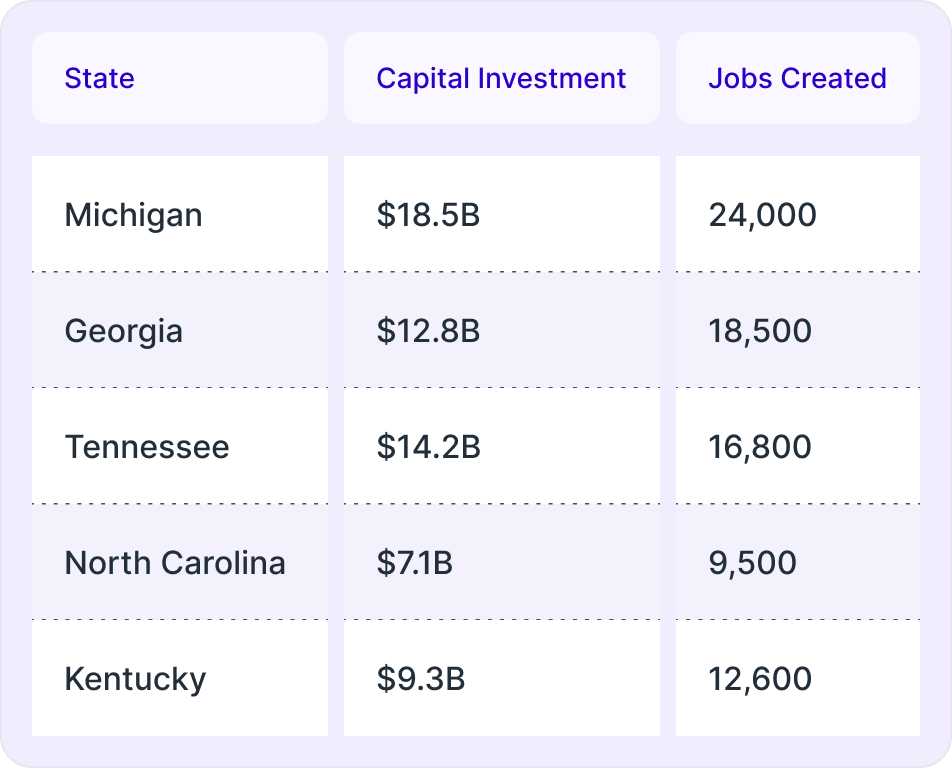
Source: ASSEMBLY Magazine, Reshoring Initiative, state economic development agencies. Draup analysis, 2026.
Beyond manufacturing, remote work is driving reverse migration. Small metro areas with fewer than 250,000 residents gained 100,000 net new residents aged 25–49 in each year from 2022 to 2024. University of Virginia research found that 59% of rural areas that had been losing population between 2010–2019 reversed into growth between 2019–2021, directly correlated with remote work adoption.
Meanwhile, nearly 500,000 manufacturing positions remain unfilled across the US, with the most acute shortages in digital skills, robotics, and AI competencies. The talent gap is real, and public workforce programs like Georgia Quick Start (ranked #1 in Area Development's 2024 survey, having trained 1 million employees across 6,500 projects) and Alabama Industrial Development Training (AIDT) (training approximately 1 million Alabamians, average post-training salary $78,800) are already closing it for the enterprises that engage them.
Europe: Two Talent Stories in One Continent
Europe's small-town talent landscape features a striking duality that most enterprise workforce planners treat as a single market, incorrectly.
Western Europe
Western Europe possesses world-class vocational systems embedded in manufacturing towns. Germany's Mittelstand alone employs approximately 33 million people, overwhelmingly in small towns and secondary cities. The Stuttgart-Karlsruhe corridor is sustained by hundreds of precision engineering firms in smaller cities. Kaiserslautern's talent costs run 35–40% below Munich. Jena's talent costs are 30–35% below Frankfurt. Yet 40% of German manufacturing firms report difficulty finding AI and robotics talent, creating an urgent upskilling and hiring opportunity.
Eastern Europe
Eastern Europe has built globally competitive IT hubs in secondary cities that most Western enterprises have yet to fully leverage:
Source: Index.dev, Alcor BPO, Eurostat. Draup compilation, 2026.
The regional IT recruitment market grew from $9.93 billion in 2020 to $14.39 billion in 2024, projected at $23.69 billion by 2028. Talent is increasingly concentrated in secondary cities, not just capitals, and the cost advantage relative to London, Munich, or Paris is structural, not cyclical.
Note on Lviv: Despite its compelling talent proposition, enterprises operating there must factor in meaningful operational risks due to the ongoing conflict, including business continuity exposure, infrastructure disruption, and elevated talent flight to neighboring EU countries. These risks require robust contingency planning and distributed delivery models.
India: The Tier-2 and Tier-3 Talent Surge
India's small-town talent story is the most dynamic of any geography. With 70% of the population outside Tier-1 metros and 65% at working age, the demographic dividend is concentrated precisely where enterprise workforce strategies have historically underinvested.
Several indicators signal this is no longer a future trend — it is happening now:
- GCC presence in Tier-2/3 cities grew from 5% in FY2019 to 7% in FY2024, with projections of 15–20% by 2027 and 25–30% subsequently
- 110 new GCCs launched in 2024–2025; India is expected to approach 2,500 GCCs by 2030
- 54% of employers now plan to hire from Tier-2/3 cities
- Hiring surged 25–35% in 2023–2024 across multiple sectors in these locations
The cost and retention case is compelling:
Source: NASSCOM, Zinnov, NLB Services, Randstad India. Draup platform analysis, 2026.
Cities like Coimbatore (45,000 IT professionals, 25–30% cost advantage below Chennai, attrition of 12% vs. 18–22% in Bengaluru), Mysuru (home to Infosys's largest global training campus), Jaipur (fastest-growing GCC destination in North India), and Kochi (42,000 IT professionals, 350 companies across two major tech parks) are no longer overflow locations. They are primary talent hubs
China: The World's Most Systematically Planned
Talent Expansion
China's approach to non-metro talent is the most coordinated of any country. Second-tier cities employ 36.4% of China's manufacturing workers; third-tier cities account for 31.1%. Combined, non-first-tier cities house over two-thirds of the national manufacturing workforce, a fact largely invisible in Western enterprise workforce planning.
Key manufacturing clusters driving demand include Dongguan (650,000 manufacturing workers, producing 20% of global mobile phones), Foshan (480,000 workers, 5th nationally in manufacturing output), and Jingmen, Central China's emerging battery manufacturing capital, where EVE Energy has committed up to CNY 30.5 billion ($4.2 billion) in investment, drawing nearly 100 upstream and downstream companies into a single integrated battery industrial chain.
China's Comprehensive Rural Revitalization Plan 2024–2027 is placing talent at the center of national strategy. The government aims to train 30 million workers between 2025 and 2027, with 40 new vocational programs introduced in 2024 spanning aerospace, precision manufacturing, EVs, AI, and drone technology.
Important note for enterprise leaders: Enterprises evaluating China's Tier-2/3 talent clusters must weigh these opportunities against significant geopolitical headwinds, ongoing trade tensions, technology export controls, and data governance requirements. These factors do not eliminate China's talent advantages, particularly for enterprises with existing China operations, but workforce strategy must be developed in close coordination with legal, compliance, and geopolitical risk functions.
Seven Strategies for Capturing the Non-Metro Talent Advantage
Based on our analysis across all four geographies, seven enterprise strategies organize into three dimensions:
Talent Sourcing
1. Build Distributed Talent Hubs
Establish small, specialized centers of 100–150 professionals in high-potential non-metro clusters, India's Nano-GCC model is the clearest template. A Coimbatore GCC with 80 AI engineers delivers 30% lower cost than its Bengaluru equivalent with materially better retention.
2. Design Remote-First Roles Systematically
Identify and redesign roles that can be executed outside metro locations. The US and Nordic Europe demonstrate this at scale, Finland has explicitly integrated remote work into rural depopulation strategies, with measurable workforce and population effects.
3. Build Distributed AI and Software Teams
Establish globally distributed engineering teams across Tier-2/3 locations for software, AI, and data roles. India's Tier-2 cities now support full-stack, ML, and data roles at scale, at 30–50% lower cost than equivalent metro teams.
Talent Development
4. Partner with Local Ecosystems
Leverage existing workforce development infrastructure. Georgia Quick Start trained thousands of battery manufacturing workers at no cost to SKBA. India's PMKVY has trained 16 million candidates since 2015. China's vocational system is training 30 million workers through 2027. These programs exist, enterprises that engage them reduce training costs and accelerate ramp-up.
5. Invest in Targeted Upskilling
Build digital and AI skills on top of existing local industry strengths. The Battery Belt's community college network is already retooling for EV manufacturing. Miskolc, Hungary is restructuring university programs around automation and mechatronics in response to nearby BMW supplier demand.
Ecosystem Engagement
6. Engage Government Programs Proactively
Access incentives, subsidies, and talent pipelines through India's GCC National Framework, China's rural revitalization subsidies, and EU Cohesion Policy programs. Most enterprises underutilize these resources.
7. Leverage Cost Arbitrage With Clear Eyes on TCO
The salary and real estate savings are real, but they are not the complete cost picture. Enterprises building distributed hubs in non-metro locations should expect longer onboarding cycles, increased management overhead in the first 12–18 months, and upfront infrastructure investment. In our experience, these transitional costs typically reduce net first-year savings to roughly half the headline salary arbitrage, but diminish substantially by Year 2 as hubs mature. The long-term advantage, compounded by lower attrition and growing local pipelines, remains structurally favorable.
How to Build a Distributed Talent Hub: A Four-Phase Model
For enterprises ready to act, the distributed hub model is the most immediately actionable path. Here is the implementation sequence derived from enterprise deployments across all four geographies:
The Window Is Open-But Not Indefinitely
The global talent landscape is undergoing a structural shift. Across the United States, Europe, India, and China, the center of gravity is moving away from Tier-1 metros toward smaller cities and non-metro regions. What was once peripheral is becoming foundational to enterprise workforce strategy.
The implications are clear: 15–60% lower costs depending on geography, significantly lower attrition, and rapidly improving skill quality, across talent pools that remain largely underleveraged. Yet most organizations continue to operate with metro-centric talent models, creating a growing disconnect between where talent exists and where enterprises are looking.
The question is no longer whether non-metro talent matters. It is whether your organization will capture it before the talent markets in these locations become as competitive as the metros you are already fighting in.
We help enterprise workforce and talent leaders identify exactly where the opportunity is, by location, by function, by skill cluster, and by cost band, with the granularity needed to act, not just assess.

.svg)




.svg)
