
AI in Shared Services
Where to apply AI, what to avoid, and how to make it stick. Practical design principles from Draup field observations across Finance, HR, Customer Service, and Procurement.
By filling up this form, you agree to allow Draup to share this data with our affiliates, subsidiaries and third parties


The Gap Between Shared-Services Strategy and Shared-Services Execution
Most shared-services AI guidance talks about what is theoretically possible. This guide talks about what actually happens when organizations try. The seven findings below come from observing how shared-services organizations succeed - or stall - when they actually deploy AI. They are practical, sequenced, and specific.
Read them as design principles, not as a maturity model. The distinction matters: a maturity model implies stages you must pass through in order. These findings are independent. A function can be at finding 6 and still fail finding 1. They are also not aspirational. Every finding describes something Draup has observed going wrong in the field, and the correction that fixed it.
Source: Draup field observations across Finance, HR, Customer Service, and Procurement / IT / Corporate Services functions, May 2026.
The State of AI in Shared Services Today
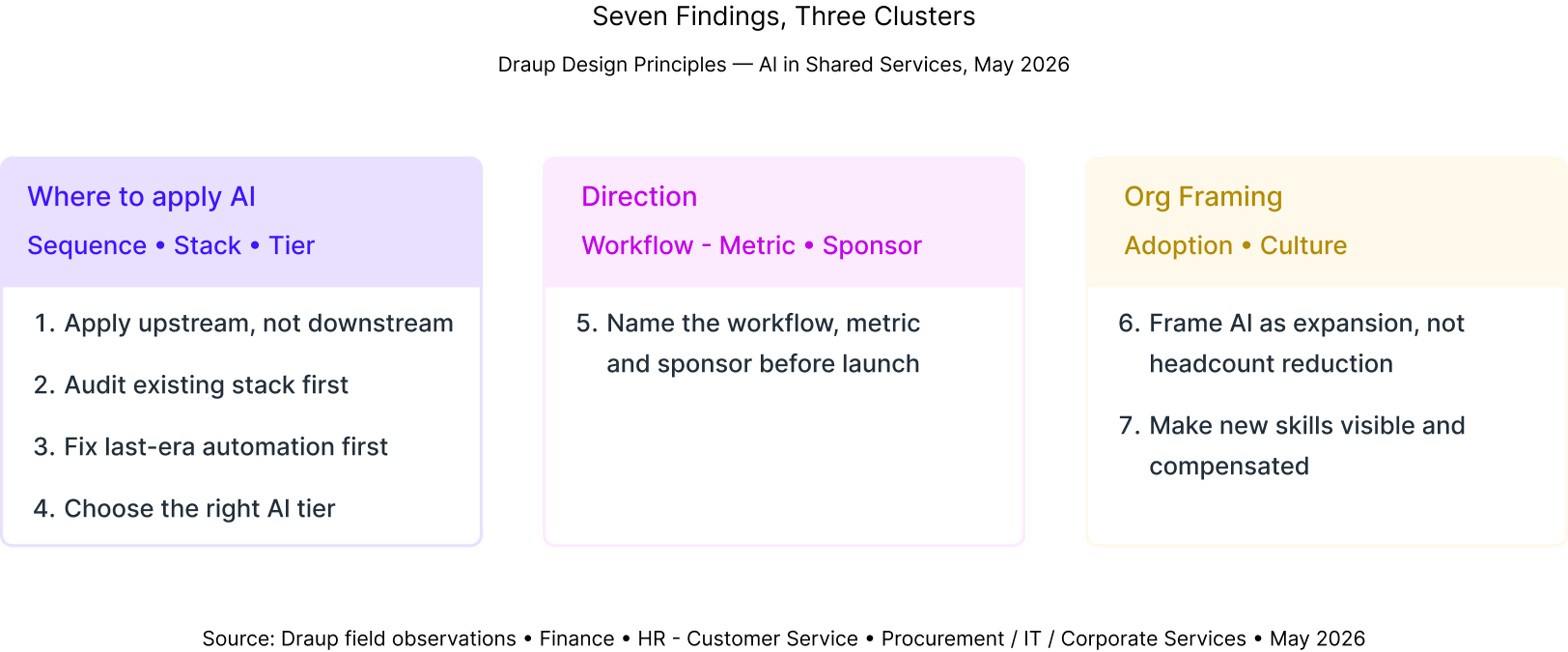
Shared-services functions are under pressure to show AI returns. The pressure is producing the wrong choices: pilots that impress in demos but move nothing in the business, AI layered on top of automation that is already broken, and org frames that make adoption feel like a threat rather than an opportunity.
The seven findings below address the specific failure modes Draup has observed most consistently. They cluster into three lessons:
The shared-services workforce of 2028 is being built - or lost - in the choices made this year.
Seven Design Principles for AI in Shared Services
The Sequence of Where You Apply AI Is Critical
The Finding:
The single most important design choice in any shared-services AI deployment is whether to intervene upstream or downstream in the process. AI applied early in a process compounds its value across every transaction that follows. AI applied late only audits costs that have already been incurred.
Key Examples: Upstream vs Downstream
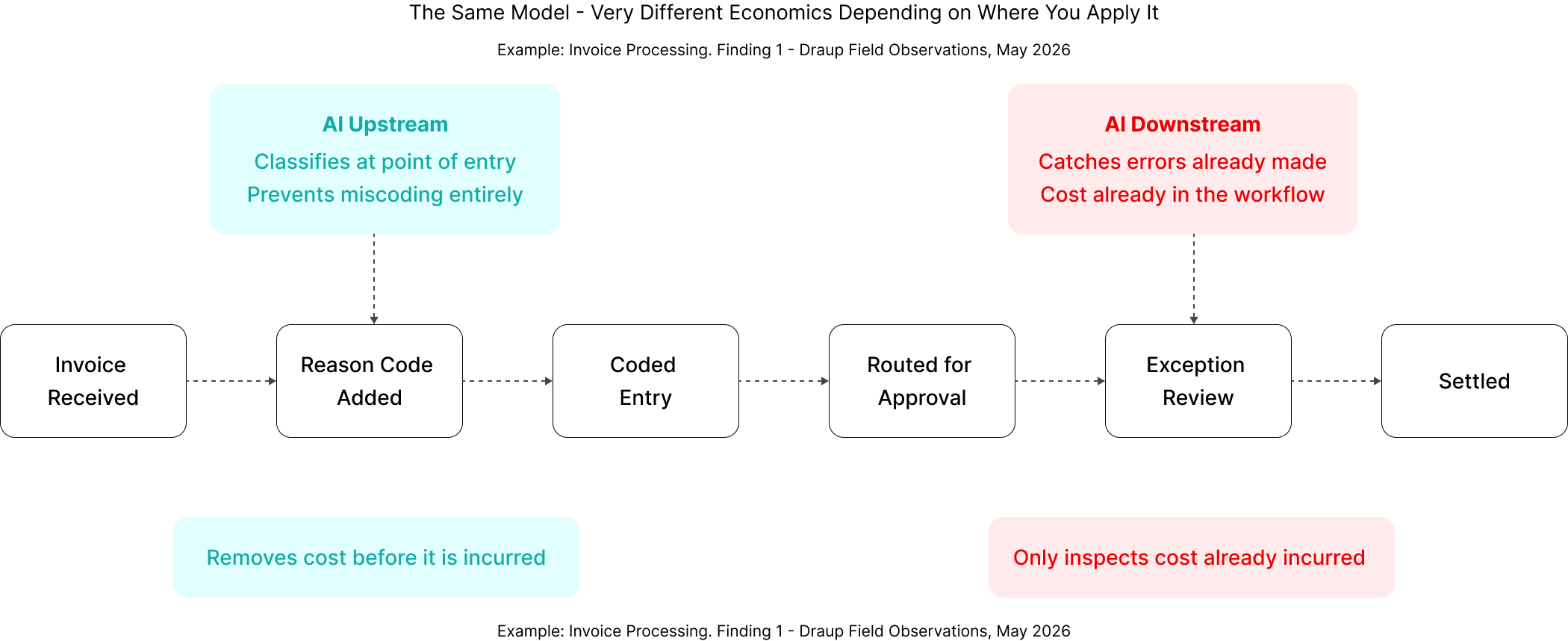
- Invoice processing: Applying AI at the moment a reason code is first added - the upstream act of classification - prevents miscoding altogether. Applying the same AI as a downstream quality check only catches errors that have already entered the workflow. Same model, very different economics: one removes cost, the other only inspects it.
- Customer service: AI at intent classification beats AI at post-call summarisation. Classification shapes what enters the workflow; summarisation processes what already happened.
- Procurement: AI during supplier onboarding beats AI in invoice exception handling. Onboarding shapes the data quality of every downstream transaction; exception handling processes the consequences of poor upstream data.
- HR: AI at job description generation beats AI at résumé re-ranking. The quality of intake determines the quality of the pool; re-ranking only sorts the debris of a poor intake.
What It Means:
The further upstream the intervention, the more leverage it carries. This is not an argument for deploying AI at the start of every process regardless of readiness. It is an argument for mapping process sequences before selecting intervention points, and consistently choosing the earliest viable point over the most visible one.
Strategic Implications:
Inventory Your Existing Tech Stack Before Adding AI
The Finding:
Most shared-services functions already carry years of automation investment: RPA bots, ETL pipelines, rule engines, OCR layers, workflow tools. Layering AI without an inventory of what already exists creates redundancy at best and conflict at worst. The new model duplicates a rule that already runs, or contradicts a bot that runs every Tuesday.
Key Data Point:
A disciplined tech-stack audit almost always reveals that 30 to 40% of proposed AI use cases are already partially solved by existing automation. The audit is unglamorous and almost always the highest-return activity before any AI initiative launches.
What It Means:
The audit is not a gate. It is a filter. Its purpose is to identify what is genuinely broken or unmet - the cases where AI is the right tool for a gap that existing automation cannot fill. Without it, AI budgets fund duplication rather than net-new capability, and the integration surface area grows without clarity on what each layer owns.
Strategic Implications:
Sometimes the Answer Is Not AI - It Is Making Last-Era Automation Work
The Findings:
AI is fashionable, but much of the shared-services pain is still RPA pain. Automation projects from the 2018 to 2022 wave often stalled, drifted out of compliance with upstream system changes, or were never fully adopted by the operating teams. Reviving and completing those projects routinely delivers more value, faster, than building a new GenAI pilot on top of the same broken foundation.
Key Design Rules:
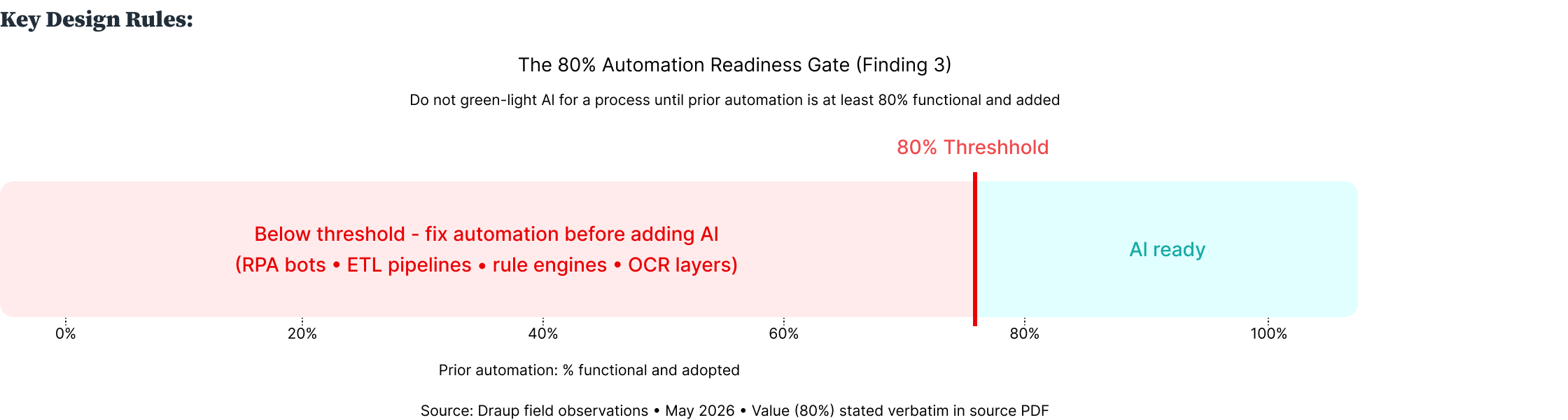
- The 80% rule: Do not green-light an AI initiative for a process unless its prior automation is at least 80% functional and adopted. Below that threshold, the AI initiative will inherit the dysfunction of the layer beneath it.
- The honest diagnostic test: If the AP/AR cycle time is high because three RPA bots silently fail every Tuesday, no AI model will fix that. Fix the bots. Reconnect the pipelines. Get the foundation right. AI then has something solid to sit on.
What It Means:
The pressure to show AI progress can produce a perverse outcome: GenAI pilots built on broken RPA foundations, which produce impressive demos and no durable value. The sequencing discipline required here is organizational, not technical. It requires leaders to say no to AI green-lights when the foundation is not ready, which is rarely the politically easy call.
Strategic Implications:
AI Without Direction Produces Wishlist Work That Looks Great but Does Not Matter
The Findings:
When teams are told to use AI without a clear set of priority workflows, they gravitate to the AI workloads they personally find interesting - items from a wishlist rather than items on the critical path. The output is often impressive in demos. The business impact is invisible at quarter-end.
The Three-Part Requirement:
Every AI initiative needs three things on day one. Without all three, the initiative will drift.
A specific workflow it must move. Not a function, not a department. A named workflow with a defined start and end point.
A named metric it must shift. Not "improve efficiency." A number with a baseline and a target that someone checks at quarter-end.
A sponsor who owns that metric. Not a champion who is enthusiastic about AI. A sponsor whose performance review includes the metric the AI initiative is meant to move.
What It Means:
Without that triangle, AI work drifts toward the curious and away from the critical, leaving the function with a portfolio of pilots no one will defend when budget pressure arrives. The fix sits upstream of the technology. This is a governance problem, not an engineering one.
Strategic Implications:
Optimization Is About Expansion, Not Staff Reduction
The Findings:
The most common framing of AI in shared services - "we will reduce headcount" - is wrong. It produces defensive teams that hide work, slow change, and treat every AI rollout as a threat to be neutralized. The more useful framing is capacity for expansion: the same team now supports twice the business volume, absorbs a new geography, or carries an M&A integration that would previously have required a hiring cycle.
The Framing Contrast:
- Reduction framing: Teams protect the workflows they have. Every AI rollout is experienced as a threat. Adoption slows. Information is withheld. The technology compounds against resistance.
- Expansion framing: Teams actively look for the next workflow to absorb. AI rollouts are experienced as career leverage. Adoption accelerates. The technology compounds with cooperation.
What It Means:
Both framings can be financially true. A function that doubles its output capacity without adding headcount achieves the same cost ratio whether it frames that as a cut or as an expansion. Only one of them produces a learning organization. The choice of frame is, in practice, the choice of pace. Organizations that frame AI as capacity tend to move faster because their teams are pulling in the same direction.
Strategic Implications:
Distinguish Models, Hyperscalers, and Enterprise-Quality Products
The Findings:
Three very different things get bundled under the word AI, and treating them as interchangeable is one of the most expensive mistakes shared-services leaders make. Picking the wrong tier is the difference between months of value and years of platform engineering.
The Three Tiers:
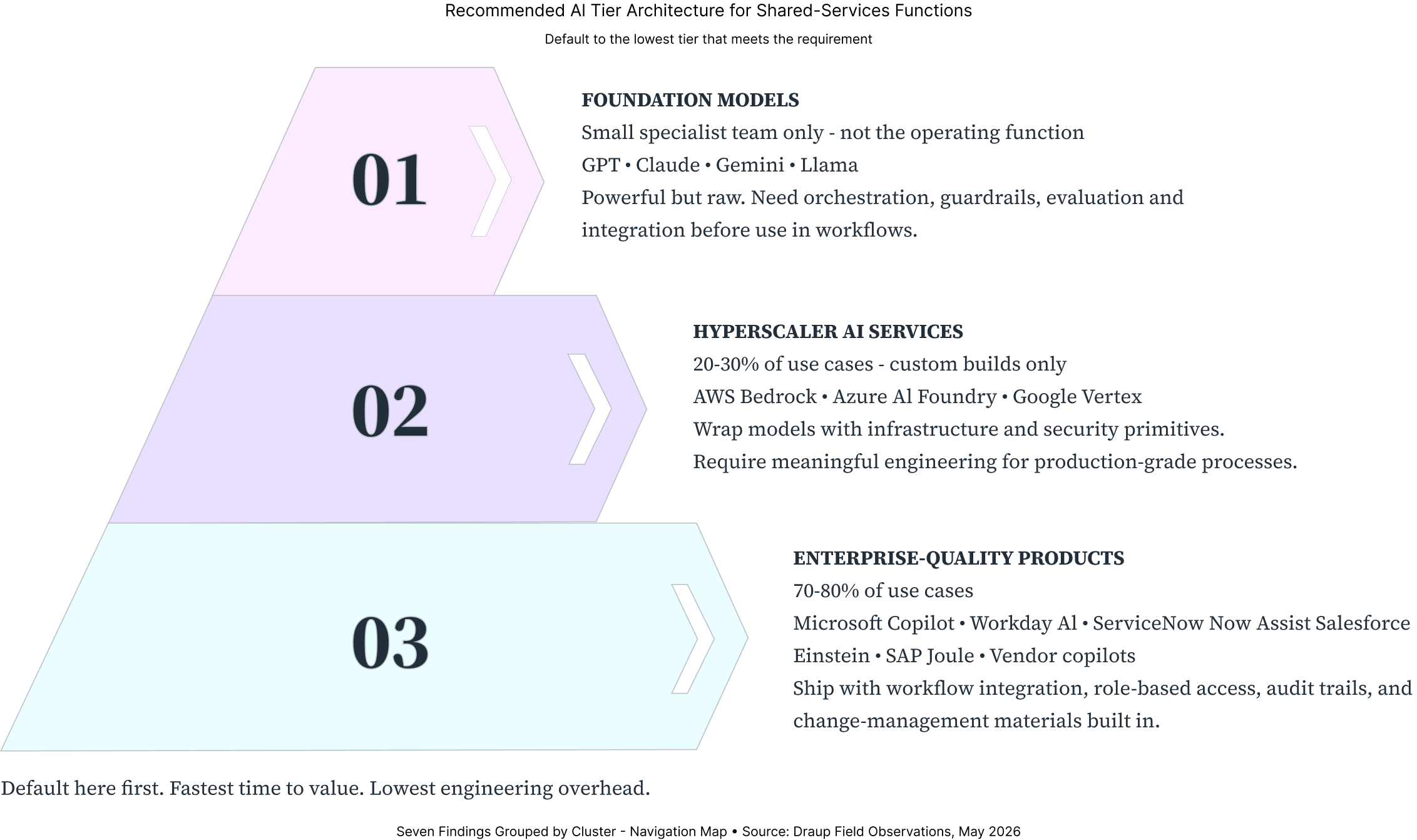
- Foundation models (GPT, Claude, Gemini, Llama) are powerful but raw. They need orchestration, guardrails, evaluation, and integration before they are useful in a shared-services workflow. This work belongs to a small specialist team, not the operating function.
- Hyperscaler AI services (AWS Bedrock, Azure AI Foundry, Google Vertex) wrap models with infrastructure and security primitives, but still require meaningful engineering to translate into production-grade business processes. Appropriate for the 20 to 30% of use cases that require custom builds.
- Enterprise-quality products (Microsoft Copilot, Workday AI, ServiceNow Now Assist, Salesforce Einstein, SAP Joule, vendor copilots) ship with workflow integration, role-based access, audit trails, and change-management materials built in. These should cover 70 to 80% of shared-services use cases.
What It Means:
For most shared-services functions, the fastest path to value is enterprise-quality products for the majority of use cases, with selective custom builds on hyperscaler services for the minority that genuinely require them. The temptation to go directly to foundation models - because they feel more powerful or more innovative - typically extends timelines by a year or more and produces capability that an enterprise product would have delivered in weeks.
Strategic Implications:
Make the New Skills Visible So People Can Become More Valuable
The Findings:
The biggest predictor of whether a shared-services team adopts AI is whether the people on it can see how it makes them more valuable to the company, not less. That requires explicit, named skill paths that a person can put on their CV and that the organization officially recognizes in performance reviews and pay bands.
The Named Skills (stated in PDF):
- Prompt design
- Workflow orchestration
- AI governance
- Output auditing
- Process intelligence
What It Means:
Without a visible value view, AI is experienced as a threat. With it, AI becomes a career accelerator. The companies that get adoption right are the ones that publish skill ladders, certify their people on them, and tie them to compensation. Adoption follows incentives. When the skill path is invisible, the only thing employees can see is what the AI is taking. When it is visible, they can see what they are gaining.
Strategic Implications:
How We Support Shared-Services AI Transformation
Draup's platform provides real-time workforce and skills intelligence that enables shared-services leaders to make the sequence, staffing, and skill decisions the seven findings demand. We analyze 25M+ data points daily from 75,000+ sources across Fortune 500 companies, including function-level skills demand signals, AI-tier adoption patterns, and compensation benchmarks for emerging AI roles.
For Shared Services and Operations Leaders:
Map current headcount capability against the skills the seven findings require - workflow orchestration, AI governance, output auditing, process intelligence - and identify where the gap is largest.
Draup's skills ontology covers 800M+ profiles and 450M+ job descriptions. Use it to benchmark your shared-services AI skill ladder against what Fortune 500 peers are already requiring and compensating.
Identify candidates with proven shared-services AI deployment experience across the right tier - enterprise-quality product operators, workflow orchestration specialists, AI governance leads - not generalist AI interest.
Track which shared-services roles are absorbing AI tasks fastest, which skill clusters are growing in adjacent markets, and where internal reskilling offers a faster path than external hiring.
Implications for Enterprise Decision-Makers
The seven findings point to a consistent pattern in how shared-services AI transformation succeeds or fails. For leaders making decisions now:

Sequence before scale
The where of AI deployment matters more than the how much. Upstream application at classification and intake beats downstream application at summarisation and exception handling in every function studied.

Audit before you add
Thirty to forty percent of proposed AI use cases are already partially solved. Spend the audit budget before the AI budget.

Fix the foundation before building on it
The 80% automation adoption threshold is not a soft guideline. It is the difference between AI that compounds on a solid base and AI that inherits the dysfunction of a broken one.

Govern by metrics, not by demos
Every AI initiative without a named metric and a sponsor who owns it will become a pilot that no one defends when budget pressure arrives.

Choose the right tier
Enterprise-quality products for 70 to 80% of use cases. Custom hyperscaler builds for 20 to 30%. Foundation-model work for a small specialist team only. Default to the lowest tier that meets the requirement.

Frame for expansion, not reduction
The organizational frame is the choice of pace. Expansion framing produces learning organizations. Reduction framing produces protected ones.

Make skill paths visible before rolling out products
Adoption follows incentives. If people cannot see how AI makes them more valuable, they will experience it as a threat and behave accordingly.
Methodology and Sources
How We Derived These Findings
Observation Basis
- The seven findings come from Draup field observations across Finance, HR, Customer Service, and Procurement / IT / Corporate Services shared-services functions.
- Observations span organizations at different stages of AI deployment - from early pilots to scaled production - across multiple geographies and company sizes.
- The findings are stated as design principles derived from observed patterns of success and failure, not from a controlled study or a representative sample.
Scope and Caveats
- All explicit figures stated in this guide (30 to 40% of use cases already partially solved; 80% automation adoption threshold; 70 to 80% enterprise product allocation; 20 to 30% hyperscaler custom build allocation) are Draup design principles derived from field observation, not independently validated statistical measures.
- The upstream vs downstream examples (Customer Service, Procurement, HR) are drawn directly from the source PDF and represent observed patterns, not controlled experiments.
- The named AI skill paths (prompt design, workflow orchestration, AI governance, output auditing, process intelligence) are stated verbatim from the source PDF.
Intended Audience
- These findings are intended for shared-services leaders, GBS heads, CFOs, CHROs, and enterprise AI transformation leaders who are making deployment and investment decisions now.
- They are not a maturity model and do not imply a required sequence of adoption stages.
Note: This page is structured as a decision guide for enterprise leaders evaluating AI transformation strategies for shared-services functions. It does not represent investment advice.

.svg)




.svg)
