
AI Workforce and
Generative AI TrendsIn Consumer Electronics
Introduction
AI and GenAI are moving from being feature add-ons to the core operating system of the consumer electronics industry. The biggest near-term disruption is concentrated in knowledge-intensive functions (especially in go-to-market and product-adjacent roles), while physical production roles face more selective exposure. At the same time, market context matters. The industry's growth is steady rather than explosive, which raises the bar for productivity and differentiation.
In our latest BrainDesk report, we focus on what this shift means for enterprise HR leaders supporting large CE workforces. Which functions face the fastest workflow redesign, where job families are being augmented vs displaced, and how emerging AI-native roles collide with already-tight talent markets? The data points to a workforce agenda that is less about AI adoption and more about sequencing role redesign, reskilling, and location strategy to keep product and operational roadmaps on track.
KEY DATA
- Around 30–35% of skills in Consumer Electronics could be impacted by Generative AI, largely in design, marketing, and administrative/support functions.
- Generative AI is expected to have the highest level of exposure (45–50%) in office and administrative support-related tasks across industries.
Comparative ExposureCE Sits in the Moderate-to-High GenAI Impact Zone
The bubble chart below positions Consumer Electronics in a moderate-to-high-impact-on-processes cluster relative to other industries.
Impact of Generative AI across Industries: Level of Workforce Exposure to Generative AI’s capabilities
Note: The above analysis is based on Draup’s research, insights from customer engagement, industry blogs, and whitepapers
*Ease of generative AI penetration indicates how readily a given industry can integrate and benefit from generativeAI solutions, based on factors like data availability, technology infrastructure, and workforce readiness.
Insights
Generative AI is predicted to have the highest level (45-50%) of exposure in the office and administrative support-related tasks among all industries
25% or (1/4th) of current workloads could be automated by Generative AI in the United States
Around 30–35% of skills in Consumer Electronics could be impacted by Generative AI, largely in design, marketing, and administrative/support functions.
Physically demanding professions, such as in the Construction and Maintenance industry, (6% and 4% respectively) have minimal exposure to AI
AI in Marketing and SalesFunction-Level Disruption and Workflow Ripple Effects
The functional map below operationalizes the disruption pattern. Beyond routine tasks, Generative AI significantly influences complex processes, with Marketing and Sales expected to be among the sectors most affected. GenAI is influencing both assistive accuracy and higher-order tasks like content creation, personalization, market research, and sales forecasting.
For workforce planning, this is a signal to treat go-to-market roles as early work redesign candidates, not only for automation but for new performance expectations.
Draup Analyzed the Impact of Generative AI on the Sub-Segments of Business Functions Across Industries
Note: The above business areas are not exhaustive and are based on Draup’s research, insights from customer engagement, industry blogs, and whitepapers.
Source: Draup’s internal analysis, Insights from Draup’s customer engagements and surveys Draup analyses 16+ Million data attributes every day to help global HR leaders solve their challenges.
Cross-Industry Use-Case ConcentrationCE Aligns to Product & Commercial GenAI Patterns
Generative AI is expected to grow at a CAGR of 44.2% over the next decade, and AI is expected to generate over 2.3 million jobs by 2027.
The table below shows where GenAI use cases are most consistently applied across industries. For senior HR leaders, the matrix helps to translate GenAI adoption into which job families scale first. Practically, this is less about hiring only AI specialists and more about building role-based capabilities across functions so GenAI can move into everyday workflows.
Prominent Generative AI Use Cases by Industry

Note: Insights have been extracted from Draup’s ML model, which analyzes 2M+ news articles, publications, industry reports, research reports, government websites, labor market statistics, and publications, etc.
Product-Cycle EvolutionAI Becomes the Pillar of Device Differentiation
The consumer electronics industry is undergoing a significant transformation, with AI set to power the majority of the new devices by 2030 and ultimately influence nearly every product category.
The generational maturity visual below outlines a roadmap from manual/rule-based automation to advanced AI integration, and then to autonomous/self-optimizing device experiences.
Evolution of Consumer Electronics Industry
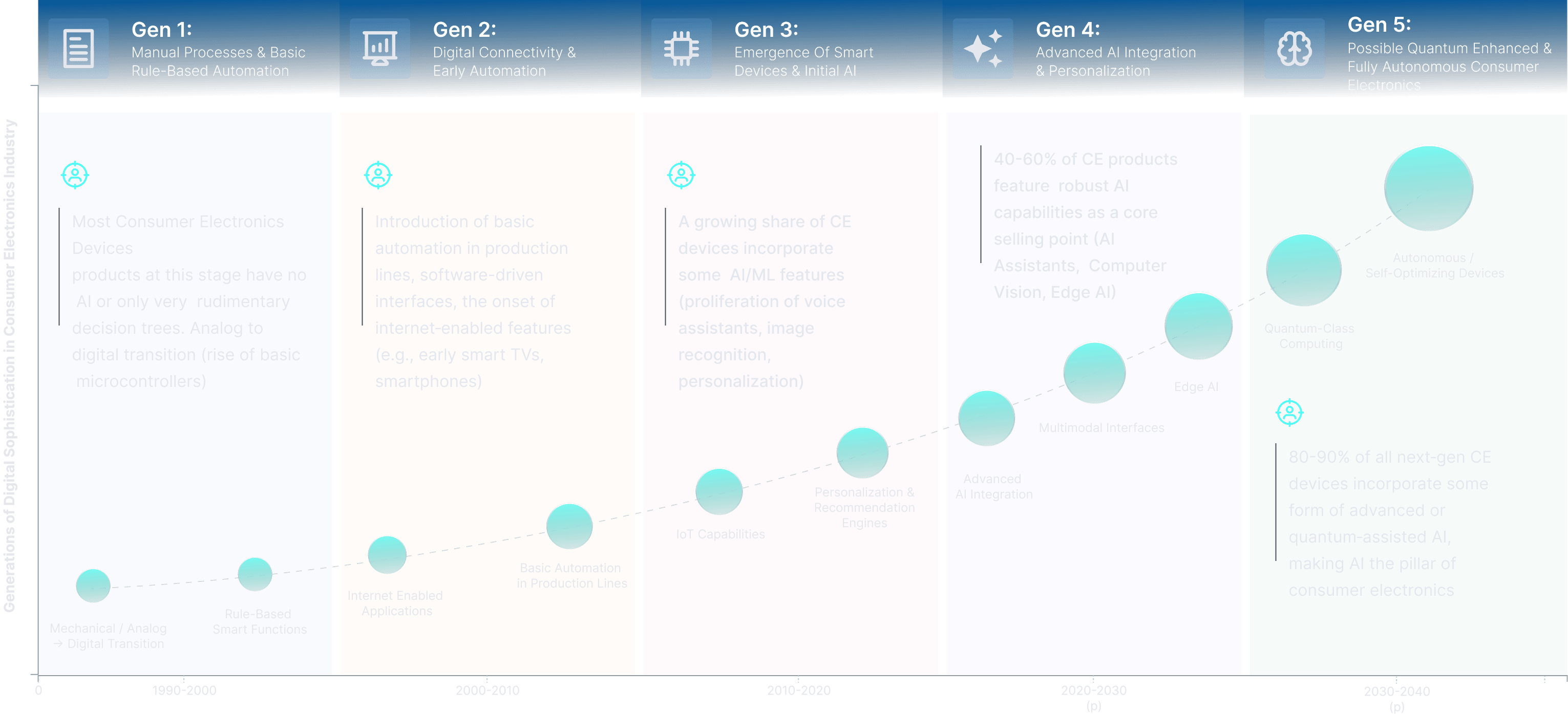
Note: The above information is derived from publicly available articles, portals/websites, research papers, and industry reports. Insights have been extracted from Draup’s ML model, which analyzes 2M+ news articles, publications, industryreports, research reports, government websites, labor market statistics, and publications, etc.
*(p) stands for predicted; The future generation: Gen 4& 5 (2020–2040) are forecasts based on secondary sources and may vary as technology evolves.
AI Skills ImpactHigh-Value Competencies Driving Workflow Transformation
Generative AI skills, such as NLP and Computer Vision, are driving significant changes in the consumer electronics industry's workload. The bubble chart below maps GenAI skill families by Workload Transformation level (how much the skill reshapes workflows) and Business Impact (how much measurable value it drives). Bubble size indicates the ease of Generative AI penetration in the Consumer Electronics industry, helping HR leaders differentiate between high-impact skills that are likely to diffuse quickly across job families versus those that may remain bottlenecked by specialist supply.
Impact of Generative AI Skills in Consumer Electronics Industry
Workload Transformation Level: A measure of how significantly a skill or technology reshapes existing workflows, automating tasks, enhancing efficiency, and redefining human-machine collaboration.
Business Impact: The degree to which a skill or technology drives measurable value—boosting productivity, reducing costs, accelerating innovation, and creating competitive advantage
Note: Above analysis is based on Draup’s research, insights from customer engagement, industry blogs, and whitepapers.
Job Architecture ShiftEmerging AI-Automation Roles Expand as Manual Roles Decline
The Consumer Electronics industry is seeing a rise in AI-driven and automation-focused roles, while traditional manual roles are becoming redundant, and critical roles remain essential for stability.
The scatter below between augmentation and disruption is useful for segmentation. We see three workforce clusters:
Three Workforce Clusters
Emerging roles
New and evolving positions driven by advancements in AI, automation, and next-gen technologies, shaping the industry's future.
Redundant roles
Traditional roles are declining due to automation, technological advancements, and process optimizations, making them less relevant over time.
Critical roles
Essential for Consumer Electronics operations, these roles require specialized expertise and remain stable despite industry disruptions.
For workforce planning, this provides a prioritization logic. Redesign and reskill fastest where both disruption and augmentation are high, while pairing redundancy risk with internal mobility capacity.
Critical, Emerging and Redundant Consumer Electronics Roles

Note: The roles showcased have been randomly selected. The same analysis can be done for 2,700+ Draup job roles from Draup’s proprietary models. *Augmentation Index: A measure of how AI and automation enhance human capabilities by improving productivity, decision-making, and efficiency without completely replacing human roles. Higher augmentation indicates greater synergy between AI and human expertise.
*Disruption Index: A metric that quantifies the extent to which AI and automation displace or transform traditional job roles, workflows, or industries. A higher disruption index signifies a greater shift in job functions, requiring reskilling or adaptation.
Talent HotspotsCE Talent Concentration is Asia-led, with Key Depth in China, the U.S., and India
Asia leads the global CE talent market, with Shenzhen, Shanghai, and Beijing as major hubs. U.S. cities and Indian metros also play a key role. The map below shows a clear concentration of consumer electronics talent worldwide.
For workforce planning, this distribution supports a dual approach: protect and deepen pipelines in the mega-hubs, where engineering and product ecosystems are densest, while building secondary hubs to reduce concentration risk and improve time-to-fill for scarce roles.
Global Talent Hotspots: ~11.1 Million Global Consumer Electronics Talent
Workforce Pressure PointsTalent Scale, Shortage Risk, and Tight Markets Collide with GenAI Adoption
The chart below translates the shortage into a location strategy. The supply-demand gap in Shenzhen and Seoul is relatively high compared to other analyzed MSAs. This is primarily due to the surge in demand for advanced AI, embedded systems, and hardware engineering talent in these innovation hubs, outpacing the current local talent supply.
Demand and Supply Across the Top MSAs
Note: Supply and the demand data is calculated using Draup proprietary ML model which tracks 850M+ profiles
Talent Demand is the aggregate sum of the total talent supply and the unique unfilled job postings.
Demand supply ratio is defined as the ratio of demand vs supply; a higher demand supply ratio refers to a higher demand of the job role or family in the region and is unfavorable for talent hiring processes.
Conclusion
Across the U.S., we see data, analytics, and AI talent demand scaling in a market where the hardest constraint is not headcount; it’s competition in mature hubs and the evolving skill expectations of production-grade delivery. The most resilient enterprise talent strategies will have to combine a two-tier location footprint, compensation discipline aligned to role criticality, deliberate reskilling pathways into modern ML/MLOps workflows, and governance capacity that scales alongside AI adoption.
In practice, this means shifting from hiring for projects to building durable capability. Designing job architectures for end-to-end lifecycle work, investing in internal mobility, and treating data governance as a first-order operating requirement rather than a compliance afterthought.
