
Fortune 500 Hiring TrendsWhat Enterprise Talent Looks Like After AI Adoption
Introduction
Hiring in Fortune 500 is shifting from expansion-first to efficiency-first. Enterprise AI adoption is moving from specialist teams into core business functions, and job designs are becoming more modular and execution-heavy. Simultaneously, the skill requirements for each role are rising, indicating deeper tech infusion and more stringent role expectations across both tech and non-tech spaces.
In our latest BrainDesk report, we examine how Fortune 500 enterprise hiring trends in 2025 differ from 2024 across skills, workloads, job types, locations, experience mix, and AI adoption. Through this Databook, we aim to quantify where AI is diffusing the fastest, how skills density is growing, and why hiring is shifting towards operators, governance, and contract-based execution.
KEY DATA
- AI skill mentions in job descriptions increased the most in Customer Support & Service (+24.8%), Sales & Marketing (+23.6%), Industrial Manufacturing (+23.0%), and Financial Services Operations (+21.3%) from 2024–25.
- CFO-driven cost-optimization signals increased significantly across tech workloads, particularly in DevOps & Reliability (+64.3%) and AI/ML & Data Science (+61.6%). Finance hiring declines were more pronounced in roles characterised as high AI-augmentable (290K → 180K) versus low AI-augmentable (600K → 550K).


Methodology & Analytical FrameworkHow Draup Derived Its Enterprise Hiring Insights
1
Enterprise-Scale Data Foundation
- Our analysis across this Databook draws on Draup’s proprietary database of over 1B global job descriptions, from Fortune 500 companies across industries.
- Job postings span multiple geographies, functions, roles, and seniority levels.
- The core analysis covers 2024–25, with early directional signals from 2025–26 indicating emerging patterns.
2
Job and Skill Normalization
All job postings were standardized and mapped to:
- Job functions (e.g., IT, Finance, HR, Supply Chain, Sales)
- Hierarchical levels (including Individual Contributors, Managers, Directors and VPs)
Skills were extracted using NLP models, which were then mapped to Draup’s proprietary skills ontology.
3
Skills Density Measurement
- Skills Density refers to the average number of distinct skills required per role.
- We analysed year-over-year changes to identify role consolidation and technology and AI integration into traditional roles.
4
AI Signal Identification
AI-related skills and keywords (e.g., AI/ML, automation, governance, orchestration, data platforms) were tagged to measure:
- AI penetration across functions.
- The core analysis covers 2024–25, with early directional signals from 2025–26 indicating emerging patterns.
5
Control vs. Growth Skill Clustering
Skills were divided into two strategic hiring intents:
- Hire-for-Growth: includes platform and product development, GTM execution and expansion, and program and delivery management.
- Hire-for-Control: focuses on security, privacy, and resilience; risk, audit, and compliance, as well as AI governance and model risk, cost optimization and margin protection.
Year-on-year growth rates were calculated to analyze shifts in enterprise hiring priorities.
6
Cost-Optimization Signal Analysis
- Job descriptions were scanned for CFO and efficiency-oriented language, including terms such as cost optimization, ROI, margin protection, efficiency, optimization, and rationalization.
- Signal growth was analyzed across AI, cloud, data, DevOps, and security workloads.
7
External Hiring Trend Assessment
- We compared external hiring volumes for roles with high AI augmentation potential and low AI augmentation potential.
- Findings are categorized as “early signals” where trend maturity is still evolving.
8
Geographic Hiring Analysis
- Hiring activity was aggregated at the country level to assess growth momentum and regional rebalancing.
- Countries were classified into four categories: highly positive, slightly positive, slightly negative, and highly negative.
9
Analytical Guardrails
- Insights highlight directional trends, not single-point, isolated observations.
- Percentage growth reflects relative change, not absolute hiring volume.
- Explicit caveats are provided for emerging patterns that require longer validation cycles.
- This analysis is designed to focus on enterprise hiring intent and operating-model shifts, not short-term hiring volatility.
Beyond
IT and R&DAI Skills Mentions Growth in JD
AI penetration is rising across Fortune 500 business functions between 2024 and 2025. We see AI normalization in IT and R&D, while other functions show clear AI diffusion.
As observed in the graph below, AI hiring is increasingly becoming ‘embedded’, as we like to call it, in business and enterprise functions. This comes as AI skills and tools supporting automation, decision support, and productivity gains across frontline and operational workloads. We are also increasingly seeing them become more prevalent in job descriptions for Customer Support, Sales & Marketing, Manufacturing, and Financial Operations.
Growth of AI skills mentions in JDs analyzed across business functions of Fortune 500 companies (2024-2025)
Skills Density IncreasesHigher Skills-Per-Role Across Job Functions
Rising skill requirements in Fortune 500 job listings suggest deeper technology integration and clearer role expectations.
We see skill density (defined for this report, and as shown in the graph below, as Skills per JD or Role) rising sharply from 2024–25 to 2025–26 across major tech and enterprise functions.
Average skills per JD across job functions in Fortune 500 companies
Execution-Led HiringIndividual Contributors Grow Faster
Than Leadership
Fortune 500 companies are focusing on hiring individual contributors, with a stronger demand concentrated at the execution layer compared to the managerial and leadership levels.
As supported by the scatter distribution below, leadership hiring remains more selective and targeted.
Job demand growth rate across hierarchical levels in Fortune 500 companies from 2024-25

Global Hiring Trends ContinueGrowth Expands Across Diverse Markets
Hiring remained broadly global in 2024-2025, with talent at the top of Fortune 500 companies’ minds.
The map below shows an overall hiring trend across the world, suggesting that growth in talent hiring is strongest in a mix of smaller or regionally strategic markets. Large talent markets, countries like the USA, Canada, India, the UK, Australia, and China, show a more modest growth.
Hiring trend of Fortune 500 companies between 2024-25 and 2025-26
From Builders to OperatorsAI Operating Models and AI Governance
Demand is centered on what we call ‘Operators of AI’, with AI governance and integration skills scaling more quickly.
We see higher growth rates in Fortune 500 companies for AI skills that involve operating, governing, and scaling AI in enterprises rather than building AI. In the scatterplot below, we can see that skills oriented towards building and developing AI (like model training, deep learning, neural networks, and generative modelling) show relatively lower growth, consistent with a move from experimentation to deployment, orchestration, and control at scale.
YoY growth rate of AI skills in Fortune 500 companies from 2024-25 to 2025-26

CFO-Driven SignalsCost Optimization Language Surges in Tech Postings
In 2025, tech hiring language has increasingly become cost-optimization-focused, indicating a shift toward efficiency-led demand.
The graph below reveals that the strongest growth in CFO-driven signals is seen in DevOps & Reliability (+64.3%) and AI/ML & Data Science (+61.6%), indicating a greater emphasis on ROI, cost-to-serve, productivity gains, and margin protection over pure build-led growth.
Cost optimization-driven signals in tech job postings of Fortune 500 companies (2024–2025)
*CFO-driven signals refer to mentions of terms such as ROI, Margin protection, Cost Optimization, etc. in Job Descriptions
Hire for GrowthSecurity, Risk, and AI Governance Lead
Hiring growth in 2025 is strongest in control-oriented skill clusters, i.e., security, privacy, AI governance, risk, and cost optimization.
In the graph below, we see that ‘Hire for Growth’ clusters are materially lower than ‘Hire for Control’ clusters. This pattern reinforces enterprise AI scaling paired with Fortune 500 companies increasing hiring for roles focused on control, governance, and cost discipline.
YoY growth rate analysis of hire for control & hire for grow skill clusters

Execution CapacityContract and Specialist Hiring Rises
Fortune 500 hiring is moving toward more contract and specialist roles (with contract roles rising sharply) for flexible execution. In the graph on the left, we can see that contractual job postings increase from 520K (2024–25) to 610K (2025–26), showing a meaningful step-up in contingent demand.
On the right, we’ve shown a diagram that illustrates affected contract roles and business functions in Engineering R&D and Finance & Accounting. This shift signals flexible, demand-led workforce deployment.
Contractual job demand growth rate in Fortune 500 companies from 2024-25
Affected contract roles
& business functions (2024–25)*
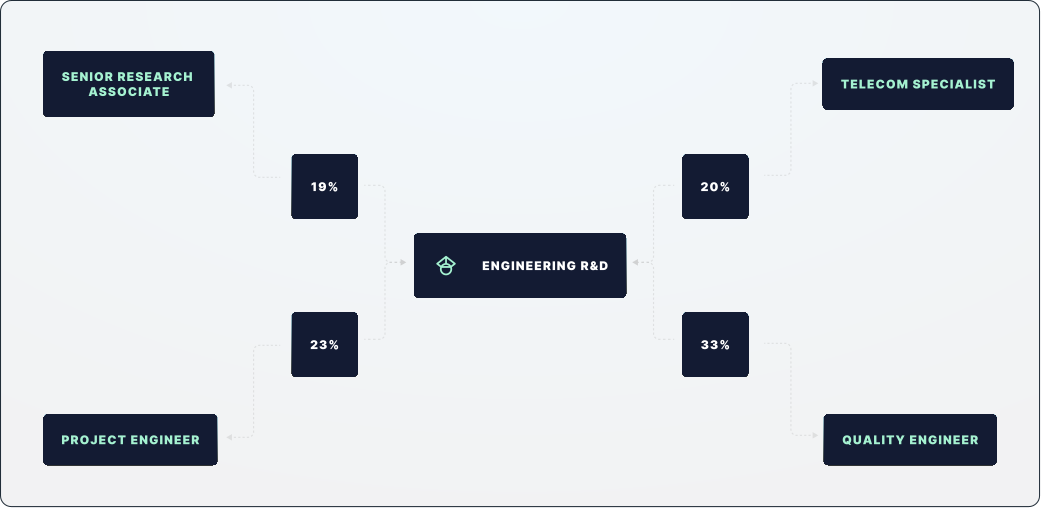
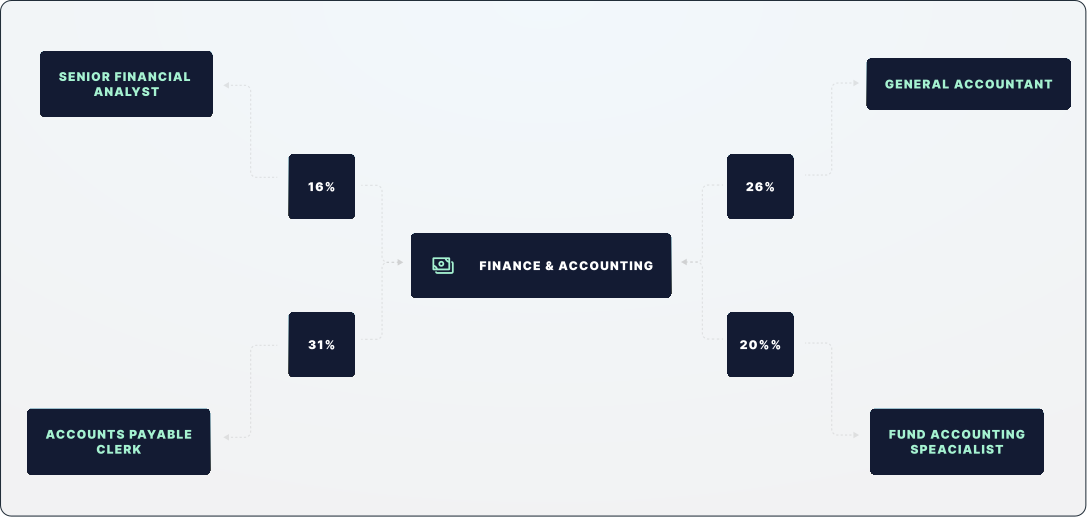
* These are illustrative examples of contractual job roles affected and are not an exhaustive list of business functions.
Early SignalsAI-Augmentable Finance Roles Decline Faster
Early Substitution Signal Early signals suggest external hiring is slowing in select roles, identified as highly automatable or augmentable by AI. Further data will be needed to confirm this trend, but we’re seeing hiring declines, particularly in high-AI-augmentable finance roles.
This can be seen in the graph below, postings for high AI augmentation finance roles fall from 290K in 2024–25 to 180K in 2025–26, while low AI augmentation finance roles decline more modestly from 600K to 550K.
Hiring declines are concentrated in high AI-augmentable finance
Conclusion
Across Fortune 500 hiring, we see AI transitioning from isolated centers of excellence into business and operational functions. Job designs are evolving to reflect the scope of adoption.
Skill requirements per role are increasing, pointing to role consolidation and greater cross-functional competency demands across both tech and enterprise operations. The most significant rise is linked to execution capacity (individual contributors), control-oriented work (security, risk, AI governance, cost optimization), and flexible staffing models (contract and specialist roles).
The implications for senior HR and talent leaders are clear: workforce planning must prioritize AI operating models (governance, orchestration, integration) and redesign roles around higher skill density. Expand adaptable talent strategies that balance core headcount with project-based capacity and pay close attention to the early signs of AI-driven substitution in highly augmentable job families.
